
Pulp Fiction, 1916 · page 113 of 212
The Argosy, Vol. 82, No. 3 — page 113: what you’re looking at
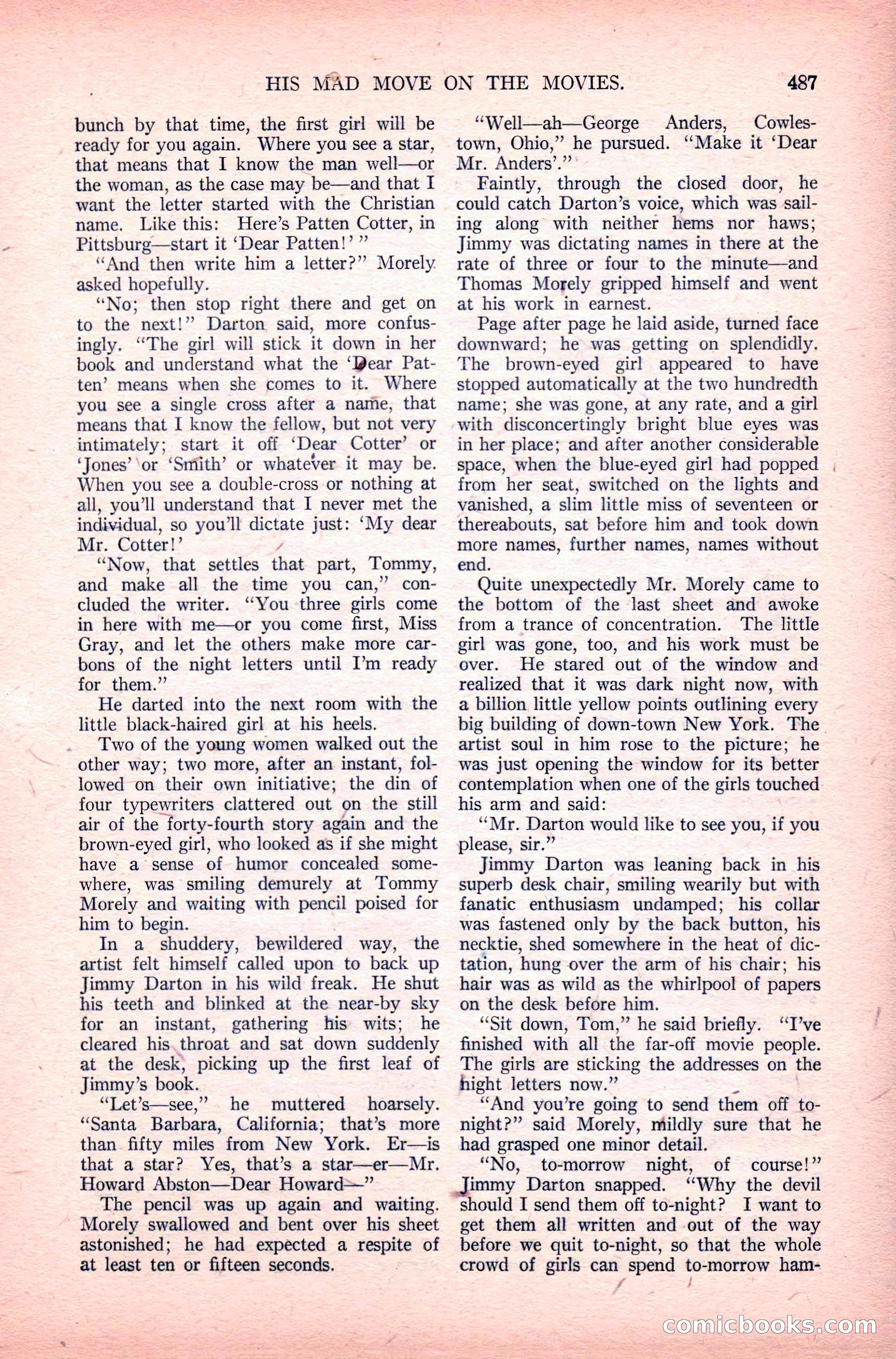
A restored page from Pulp Fiction, 1916. Page through the whole issue in the reader above.
📄 Transcribed text from this page (OCR, searchable)
Machine-transcribed from the original scan — historical spelling and the odd misread are preserved.
HIS MAD MOVE ON THE MOVIES. bunch by that time, the first girl will be ready for you again. Where you see a star, that means that I know the man well—or the woman, as the case may be—and that I want the letter started with the Christian name. Like this: Here’s Patten Cotter, in Pittsburg—start it ‘Dear Patten!’ ” “And then write him a letter?” Morely asked hopefully. “No; then stop right there and get on to the next!” Darton said, more confus- ingly. “The girl will stick it down in her book and understand what the ‘Wear Pat- ten’ means when she comes to it. Where you see a single cross after a name, that means that I know the fellow, but not very intimately; start it off ‘Dear Cotter’ or ‘Jones’ ‘or ‘Smith’ or whatever it may be. When you see a double-cross or nothing at all, you’ll understand that I never met the individual, so you'll dictate just: ‘My dear Mr. Cotter!’ “Now, that settles that part, Tommy, and make all the time you can,” con- cluded the writer. ‘‘You three girls come in here with me—or you come first, Miss Gray, and let the others make more car- bons of the night letters until I’m ready for them.” He darted into the next room with the little black-haired girl at his heels. Two of the young women walked out the other way; two more, after an instant, fol- lowed on their own initiative; the din of four typewriters clattered out on the still air of the forty-fourth story again and the brown-eyed girl, who looked as “if she might have a sense of humor concealed some- where, was smiling demurely at Tommy Morely and waiting with pencil poised for him to begin. In a shuddery, bewildered way, the artist felt himself called upon to back up Jimmy Darton in his wild freak. He shut his teeth and blinked at the near-by sky for an instant, gathering his wits; he cleared his. throat and sat down suddenly at the desk, picking up the first leaf of Jimmy’s book. “Let’s—see,” he muttered hoarsely. “Santa Barbara, California; that’s more than fifty miles from New York. Er—is that a star? Yes, that’s a star—er—Mr. Howard Abston—Dear Howard—” The pencil was up again and waiting. Morely swallowed and bent over his sheet astonished; he had expected a Eespite of at least ten or fifteen seconds. Jimmy Darton snapped. 487 ‘“Well—ah—George Anders, Cowles- town, Ohio,” he pursued. “Make it ‘Dear Mr. Anders’.” Faintly, through the closed door, he could catch Darton’s voice, which was sail- ing along with neither hems nor haws; Jimmy was dictating names in there at the rate of three or four to the minute—and Thomas Morely gripped himself and went at his work in earnest. Page after page he laid aside, turned face downward; he was getting on splendidly. The brown-eyed girl appeared to have stopped automatically at the two hundredth name; she was gone, at any rate, and a girl with disconcertingly bright blue eyes was in her place; and after another considerable space, when the blue-eyed girl had popped from her seat, switched on the lights and vanished, a slim little miss of seventeen or thereabouts, sat before him and took down more names, further names, names without end. Quite unexpectedly Mr. Morely came to the bottom of the last sheet and awoke from a trance of concentration. The little girl was gone, too, and his work must be over. He stared out of the window and realized that it was dark night now, with a billion little yellow points outlining every big building of down-town New York. The artist soul in him rose to the picture; he was just opening the window for its better contemplation when one of the girls touched his arm and said: “Mr. Darton would like to see you, if you please, sir.” Jimmy Darton was leaning back in his superb desk chair, smiling wearily but with fanatic enthusiasm undamped; his collar was fastened only by the back button, his necktie, shed somewhere in the heat of dic- tation, hung over the arm of his chair; his hair was as wild as the whirlpool of papers on the desk before him. “Sit down, Tom,” he said briefly. “I’ve finished with all the far-off movie people. The girls are sticking the addresses on the hight letters now.” “And you’re going to send them off to- night?” said Morely, mildly sure that he had grasped one minor detail. “No, to-morrow night, of course!” “Why the devil should I send them off to-night? I want to get them all written and out of the way before we quit to-night, so that the whole crowd of girls can spend to-morrow ham- / EOPMICLOO c S (E@)