
Pulp Fiction, 1916 · page 111 of 212
The Argosy, Vol. 82, No. 3 — page 111: what you’re looking at
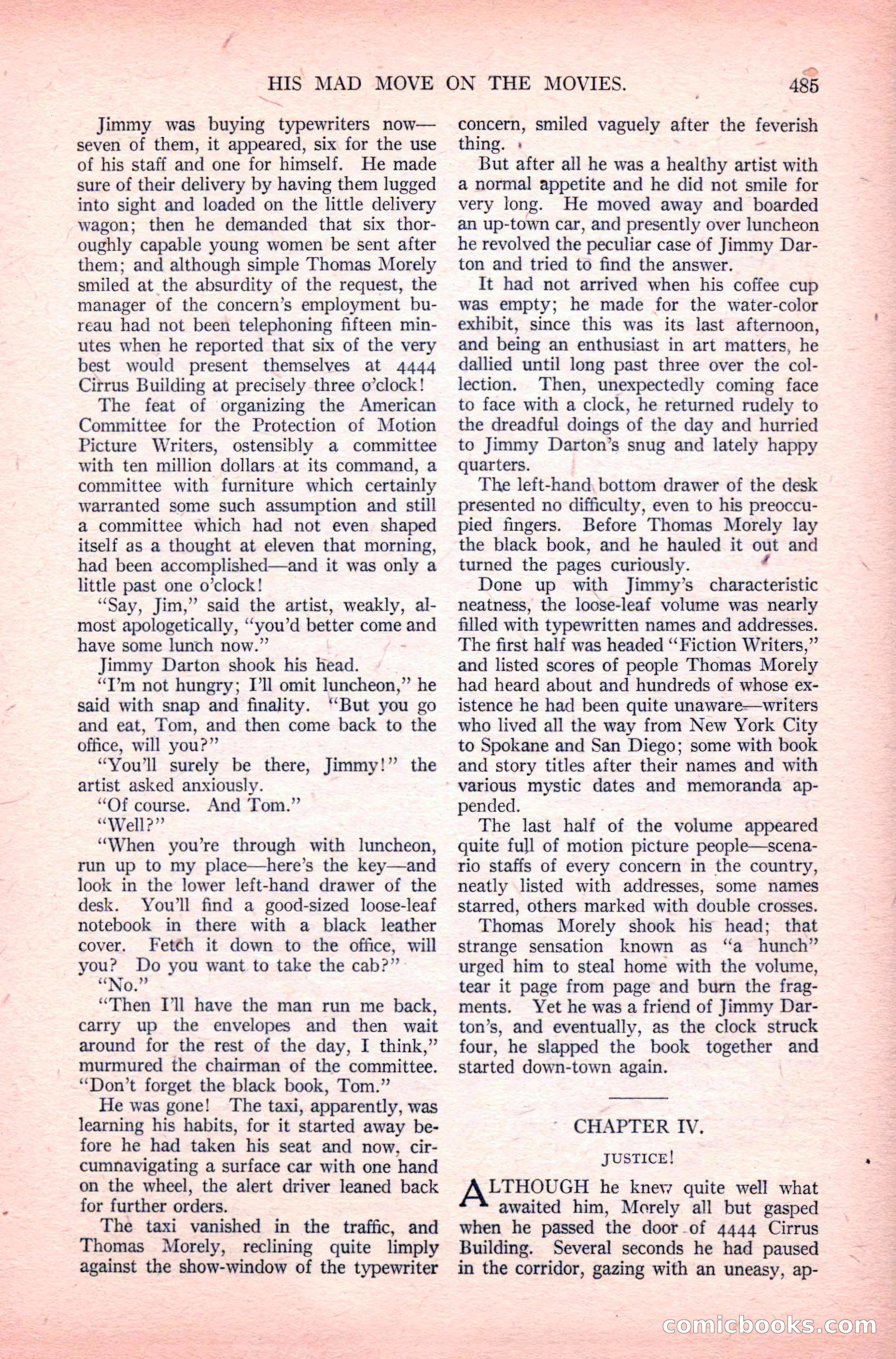
A restored page from Pulp Fiction, 1916. Page through the whole issue in the reader above.
📄 Transcribed text from this page (OCR, searchable)
Machine-transcribed from the original scan — historical spelling and the odd misread are preserved.
HIS MAD MOVE ON THE MOVIES. Jimmy was buying typewriters now— seven of them, it appeared, six for the use of his staff and one for himself. He made sure of their delivery by having them lugged into sight and loaded on the little delivery wagon; then he demanded that six thor- oughly capable young women be sent after them; and although simple Thomas Morely smiled at the absurdity of the request, the manager of the concern’s employment bu- reau had not been telephoning fifteen min- utes when he reported that six of the very best would present themselves at 4444 Cirrus Building at precisely three o’clock! The feat of organizing the American Committee for the Protection of Motion Picture Writers, ostensibly a committee with ten million dollars-at its command, a committee with furniture which certainly warranted some such assumption and still a committee which had not even shaped itself as a thought at eleven that morning, had been accomplished—and it was only a little past one o’clock! “Say, Jim,” said the artist, weakly, al- most apologetically, “you'd better come and have some lunch now.’ Jimmy Darton shook his head. “Tm not hungry; I’ll omit luncheon,” he said with snap and finality. “But you go and eat, Tom, and then come back to the office, will you?” “You'll surely be there, Jimmy!” the artist asked anxiously. “Of course. And Tom.” “Well?” “When you’re through with luncheon, run up to my place—here’s the key—and look in the lower left-hand drawer of the desk. You'll find a good-sized loose-leaf notebook in there with a black leather cover. Fetth it down to the office, will you? Do you want to take the cab?” “No. >) “Then [ll have the man run me back, carry up the envelopes and then wait around for the rest of the day, I think,” murmured the chairman of the committee. “Don’t forget the black book, Tom.” He was gone! The taxi, apparently, was learning his habits, for it started away be- fore he had taken his seat and now, cir- cumnavigating a surface car with one hand on the wheel, the alert driver leaned back for further orders. The taxi vanished in the traffic, and Thomas Morely, reclining quite limply against the show-window of the typewriter 485 concern, smiled vaguely after the feverish thing. : But after all he was a healthy artist with a normal appetite and he did not smile for very long. He moved away and boarded an up-town car, and presently over luncheon he revolved the peculiar case of Jimmy Dar- ton and tried to find the answer. It had not arrived when his coffee cup was empty; he made for the water-color exhibit, since this was its last afternoon, and being an enthusiast in art matters, he dallied until long past three over the col- lection. Then, unexpectedly coming face to face with a clock, he returned rudely to the dreadful doings of the day and hurried to Jimmy Darton’s snug and lately happy quarters. The left-hand, bottom drawer of the desk presented no difficulty, even to his preoccu- pied fingers. Before Thomas Morely lay the black book, and he hauled it out and turned the pages curiously. f Done up with Jimmy’s characteristic neatness, the loose-leaf volume was nearly filled with typewritten names and addresses. The first half was headed ‘‘Fiction Writers,” and listed scores of people Thomas Morely had heard about and hundreds of whose ex- istence he had been quite unaware—vwriters who lived all the way from New York City to Spokane and San Diego; some with book and story titles after their names and with various mystic dates and memoranda ap- pended. The last half of the volume appeared quite full of motion picture people—scena- rio staffs of every concern in the country, neatly listed with addresses, some names starred, others marked with double crosses. Thomas Morely shook his head; that strange sensation known as “a hunch” urged him to steal home with the volume, tear it page from page and burn the frag- ments. Yet he was a friend of Jimmy Dar- ton’s, and eventually, as the clock struck four, he slapped the book together and started down-town again. CHAPTER IV. JUSTICE! LTHOUGH he knew quite well what awaited him, Merely all but gasped when he passed the door-of 4444 Cirrus Building. Several seconds he had paused in the corridor, gazing with an uneasy, ap- Gomichoo (G <S (C@)