
Pulp Fiction, 1916 · page 110 of 212
The Argosy, Vol. 82, No. 3 — page 110: what you’re looking at
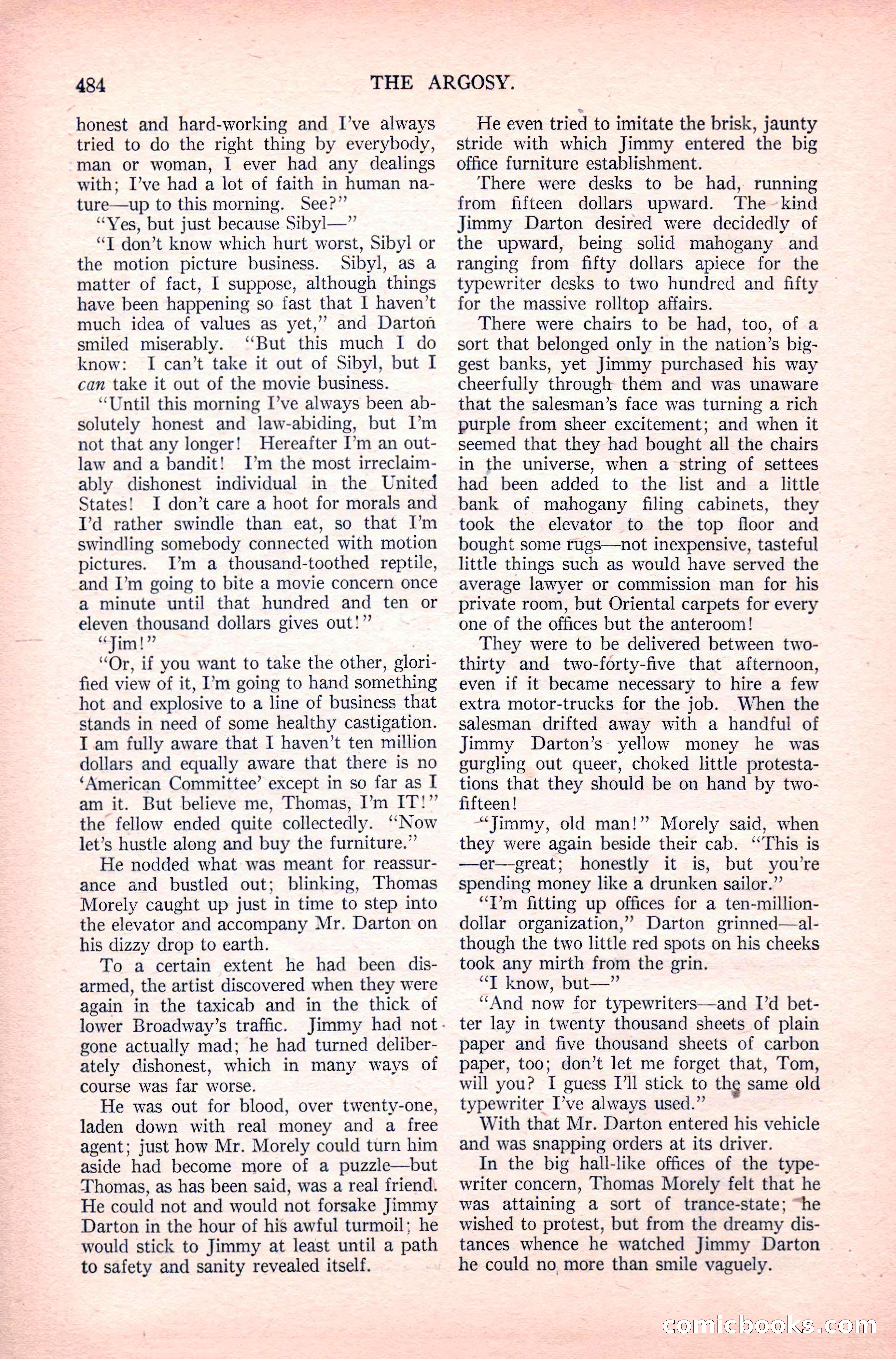
A restored page from Pulp Fiction, 1916. Page through the whole issue in the reader above.
📄 Transcribed text from this page (OCR, searchable)
Machine-transcribed from the original scan — historical spelling and the odd misread are preserved.
484 honest and hard-working and I’ve always tried to do the right thing by everybody, man or woman, I ever had any dealings with; I’ve had a lot of faith in human na- ture—up to this morning. See?” “Ves, but just because Sibyl—”’ “T don’t know which hurt worst, Sibyl or the motion picture business. Sibyl, as a matter of fact, I suppose, although things have been happening so fast that I haven’t much idea of values as yet,’’ and Darton smiled miserably. “But this much I do know: I can’t take it out of Sibyl, but I can take it out of the movie business. ‘Until this morning I’ve always been ab- solutely honest and law-abiding, but I’m not that any longer! Hereafter I’m an out- law and a bandit! I’m the most irreclaim- ably dishonest individual in the United States! I don’t care a hoot for morals and I’d rather swindle than eat, so that I’m swindling somebody connected with motion pictures. I’m a thousand-toothed reptile, and I’m going to bite a movie concern once a minute until that hundred and ten or eleven thousand dollars gives out!” “Or, if you want to take the other, glori- fied view of it, I’m going to hand something hot and explosive to a line of business that stands in need of some healthy castigation. I am fully aware that I haven’t ten million dollars and equally aware that there is no ‘American Committee’ except in so far as I am it. But believe me, Thomas, I’m IT!” the fellow ended quite collectedly. ‘‘Now let’s hustle along and buy the furniture.”’ He nodded what was meant for reassur- ance and bustled out; blinking, Thomas Morely caught up just in time to step into the elevator and accompany Mr. Darton on his dizzy drop to earth. To a certain extent he had been dis- armed, the artist discovered when they were again in the taxicab and in the thick of lower Broadway’s traffic. gone actually mad; he had turned deliber- ately dishonest, which in many ways of course was far worse. He was out for blood, over twenty-one, laden down with real money and a free agent; just how Mr. Morely could turn him aside had become more of a puzzle—but Thomas, as has been said, was a real friend. He could not and would not forsake Jimmy Darton in the hour of his awful turmoil; he would stick to Jimmy at least until a path to safety and sanity revealed itself. Jimmy had not- THE ARGOSY. He even tried to imitate the brisk, jaunty stride with which Jimmy entered the big office furniture establishment. There were desks to be had, running from fifteen dollars upward. The ~kind Jimmy Darton desired were decidedly of the upward, being solid mahogany and ranging from fifty dollars apiece for the typewriter desks to two hundred and fifty for the massive rolltop affairs. There were chairs to be had, too, of a sort that belonged only in the nation’s big- gest banks, yet Jimmy purchased his way cheerfully through them and was unaware that the salesman’s face was turning a rich purple from sheer excitement; and when it seemed that they had bought all the chairs in the universe, when a string of settees had been added to the list and a little bank of mahogany filing cabinets, they took the elevator to the top floor and bought some rugs—not inexpensive, tasteful little things such as would have served the average lawyer or commission man for his private room, but Oriental carpets for every one of the offices but the anteroom! They were to be delivered between two- thirty and two-forty-five that afternoon, even if it became necessary to hire a few extra motor-trucks for the job. When the salesman drifted away with a handful of Jimmy Darton’s- yellow money he was gurgling out queer, choked little protesta- tions that they should be on hand by two- fifteen ! “Jimmy, old man!” Morely said, when they were again beside their cab. ‘‘This is —er—-great; honestly it is, but you're spending money like a drunken sailor.” “Tm fitting up offices for a ten-million- dollar organization,” Darton grinned—al- though the two little red spots on his cheeks took any mirth from the grin. “T know, but—” “And now for typewriters—and I’d bet- ter lay in twenty thousand sheets of plain paper and five thousand sheets of carbon paper, too; don’t let me forget that, Tom, will you? I guess I'll stick to the same old typewriter I’ve always used.” With that Mr. Darton entered his vehicle and was snapping orders at its driver. In the big hall-like offices of the type- writer concern, Thomas Morely felt that he was attaining a sort of trance-state; “he wished to protest, but from the dreamy dis- tances whence he watched Jimmy Darton he could no more than smile vaguely. COPNICGLOOOLX< (Cc (C@)