
Pulp Fiction, 1916 · page 15 of 216
The Argosy, Vol. 82 No. 2 — page 15: what you’re looking at
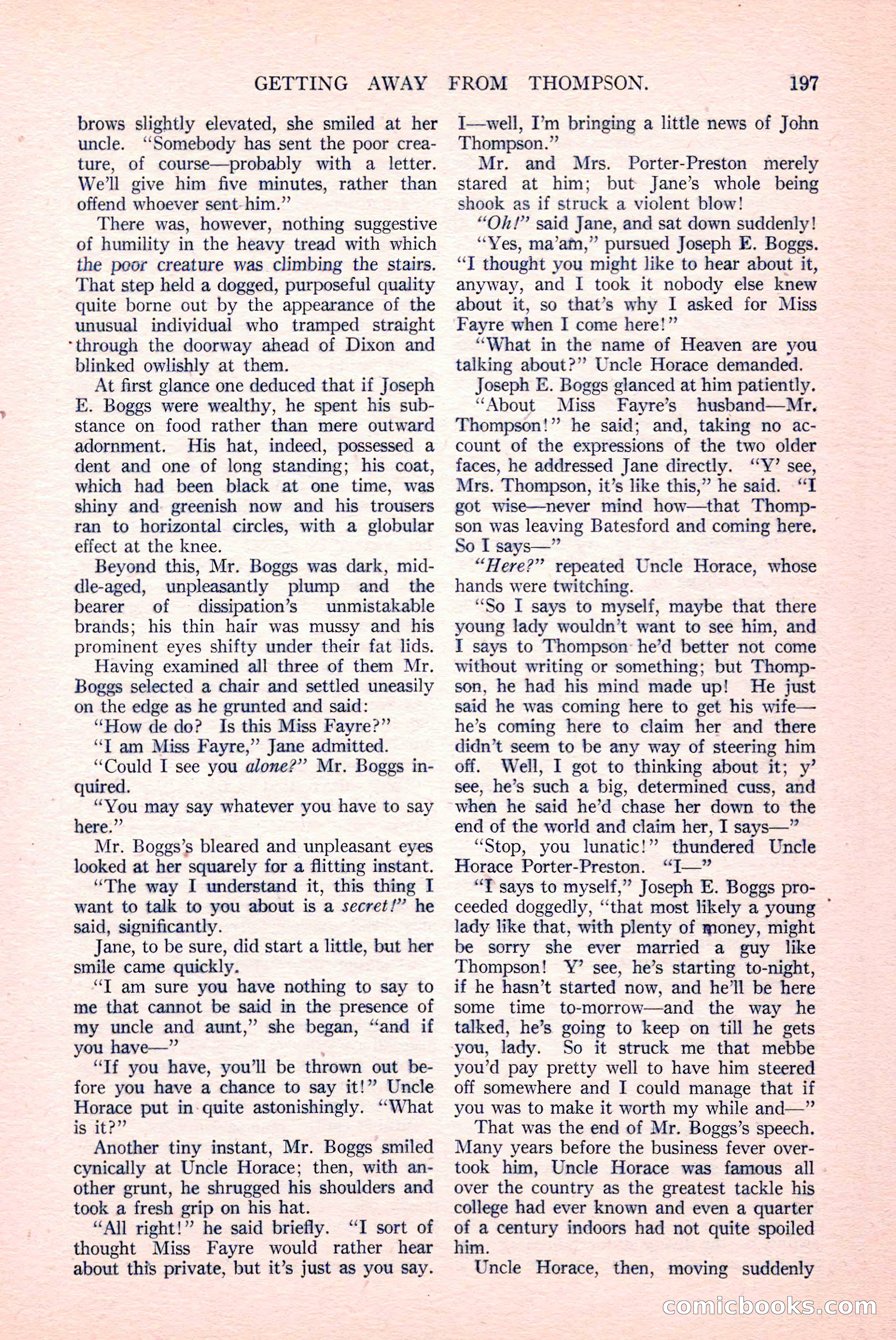
A restored page from Pulp Fiction, 1916. Page through the whole issue in the reader above.
📄 Transcribed text from this page (OCR, searchable)
Machine-transcribed from the original scan — historical spelling and the odd misread are preserved.
GETTING AWAY FROM THOMPSON. brows slightly elevated, she smiled at her uncle. ‘Somebody has sent the poor crea- ture, of course—probably with a letter. We'll give him five minutes, rather than offend whoever sent-him.”’ There was, however, nothing suggestive of humility in the heavy tread with which the peor creature was climbing the stairs. That step held a dogged, purposeful quality quite borne out by the appearance of the unusual individual who tramped straight ‘through the doorway ahead of Dixon and blinked owlishly at them. At first glance one deduced that if Joseph E. Boggs were wealthy, he spent his sub- stance on food rather than mere outward adornment. His hat, indeed, possessed a dent and one of long standing; his coat, which had been black at one time, was shiny and greenish now and his trousers ran to horizontal circles, with a globular effect at the knee. Beyond this, Mr. Boggs was dark, mid- dle-aged, unpleasantly plump and_ the bearer of dissipation’s unmistakable brands; his thin hair was mussy and his prominent eyes shifty under their fat lids. Having examined all three of them Mr. Boggs selected a chair and settled uneasily on the edge as he grunted and said: “How de do? Is this Miss Fayre?”’ “T am Miss Fayre,” Jane admitted. “Could I see you alone?” Mr. Boggs in- quired. “You may say whatever you have to say here.” Mr. Boggs’s bleared and unpleasant eyes looked at her squarely for a flitting instant. “The way I understand it, this thing I want to talk to you about is a secret!” he said, significantly. Jane, to be sure, did start a little, but her smile came quickly. “T am sure you have nothing to say to me that cannot be said in the presence of my uncle and aunt,” she began, “and if you haye—” | “Tf you have, you’ll be thrown out be- fore you have a chance to say it!” Uncle Horace put in-quite astonishingly. “What sate Another tiny instant, Mr. Boggs smiled cynically at Uncle Horace; then, with an- other grunt, he shrugged his shoulders and took a fresh grip on his hat. “All right!” he said briefly. “I sort of thought Miss Fayre would rather hear about this private, but it’s just as you say. you, lady. 197 I—well, I’m bringing a little news of John Thompson.” Mr. and Mrs. Porter-Preston merely stared at him; but Jane’s whole being shook as if struck a violent blow! “Oh!” said Jane, and sat down suddenly! “Yes, ma’am,” pursued Joseph E. Boggs. “I thought you might like to hear about it, anyway, and I took it nobody else knew about it, so that’s why I asked for Miss Fayre when I come here!” “What in the name of Heaven are you talking about?” Uncle Horace demanded. Joseph E. Boggs glanced at him patiently. “About Miss Fayre’s husband—Mr. Thompson!” he said; and, taking no ac- count of the expressions of the two older faces, he addressed Jane directly. ‘“Y’ see, Mrs. Thompson, it’s like this,” he said. “TI got wise—never mind how—that Thomp- son was leaving Batesford and coming here. So I says—” “Here?” repeated Uncle Horace, whose hands were twitching. ‘So I says to myself, maybe that there young lady wouldn’t want to see him, and I says to Thompson: he’d better not come without writing or something; but Thomp- son, he had his mind made up! He just said he was coming here to get his wife— he’s coming here to claim her and there didn’t seem to be any way of steering him off. Well, I got to thinking about it; y’ see, he’s such a big, determined cuss, and when he said he’d chase her down to the end of the world and claim her, I says—” “Stop, you lunatic!” thundered Uncle Horace Porter-Preston. “I—” “T says to myself,” Joseph E. Boggs pro- ceeded doggedly, “that most likely a young lady like that, with plenty of money, might be sorry she ever married a guy like Thompson! Y’ see, he’s starting to-night, if he hasn’t started now, and he’ll be here some time to-morrow—and the way he talked, he’s going to keep on till he gets So it struck me that mebbe you’d pay pretty well to have him steered off somewhere and I could manage that if you was to make it worth my while and—” That was the end of Mr. Boggs’s speech. Many years before the business fever over- took him, Uncle Horace was famous all over the country as the greatest tackle his college had ever known and even a quarter of a century indoors had not quite spoiled him. Uncle Horace, then, moving suddenly CORMICLOOOKS (C@)