
Pulp Fiction, 1916 · page 14 of 216
The Argosy, Vol. 82 No. 2 — page 14: what you’re looking at
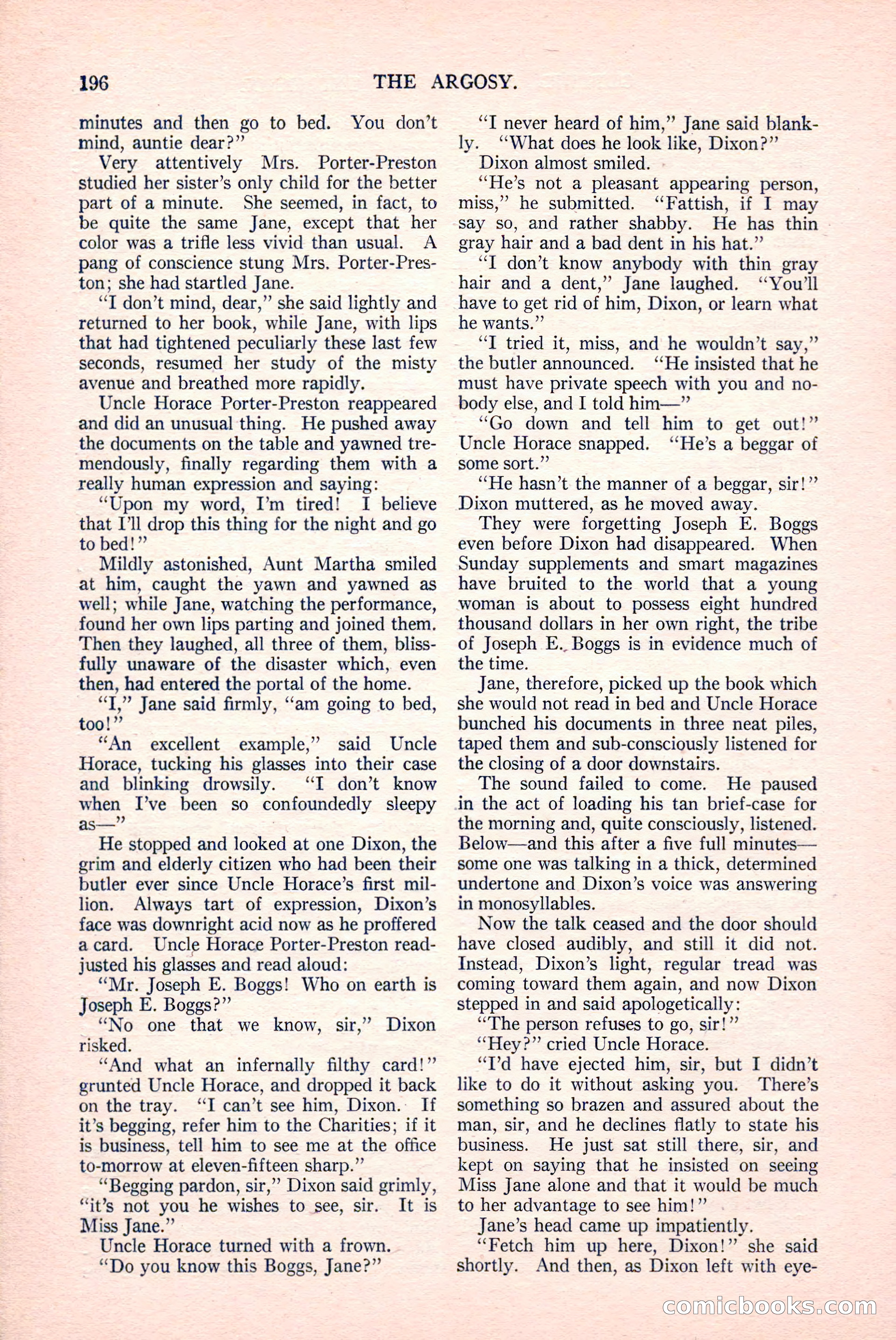
A restored page from Pulp Fiction, 1916. Page through the whole issue in the reader above.
📄 Transcribed text from this page (OCR, searchable)
Machine-transcribed from the original scan — historical spelling and the odd misread are preserved.
196 minutes and then go to bed. You don’t mind, auntie dear?” Very attentively Mrs. Porter-Preston studied her sister’s only child for the better part of a minute. She seemed, in fact, to be quite the same Jane, except that her color was a trifle less vivid than usual. A pang of conscience stung Mrs. Porter-Pres- ton; she had startled Jane. “T don’t mind, dear,” she said lightly and returned to her book, while Jane, with lips that had tightened peculiarly these last few seconds, resumed her study of the misty avenue and breathed more rapidly. Uncle Horace Porter-Preston reappeared and did an unusual thing. He pushed away the documents on the table and yawned tre- mendously, finally regarding them with a really human expression and saying: “Upon my word, I’m tired! I believe that I'll drop this thing for the night and go to bed!” Mildly astonished, Aunt Martha smiled at him, caught the yawn and yawned as well; while Jane, watching the performance, found her own lips parting and joined them. Then they laughed, all three of them, bliss- fully unaware of the disaster which, even then, had entered the portal of the home. “T,.” Jane said firmly, “‘am going to bed, too!” “An excellent example,” said Uncle Horace, tucking his glasses into their case and blinking drowsily. ‘I don’t know when I’ve been so confoundedly sleepy 2c” ‘ He stopped and looked at one Dixon, the grim and elderly citizen who had been their butler ever since Uncle Horace’s first mil- lion. Always tart of expression, Dixon’s face was downright acid now as he proffered acard. Uncle Horace Porter-Preston read- justed his glasses and read aloud: “Mr. Joseph E. Boggs! Who on earth is Joseph E. Boggs?” “No one that we know, sir, risked. “And what an infernally filthy card!” erunted Uncle Horace, and dropped it back on the tray. “I can’t see him, Dixon. If it’s begging, refer him to the Charities; if it is business, tell him to see me at the office to-morrow at eleven-fifteen sharp.” “Begging pardon, sir,” Dixon said grimly, “it’s not you he wishes to see, sir. It is Miss Jane.” Uncle Horace turned with a frown. “Do you know this Boggs, Jane?” ” Dixon THE ARGOSY. “T never heard of him,” Jane said blank- ‘What does he look like, Dixon?”’ Dixon almost smiled. ‘““He’s not a pleasant appearing person, miss,” he submitted. “Fattish, if I may say so, and rather shabby. He has thin gray hair and a bad dent in his hat.” “T don’t know anybody with thin gray hair and a dent,” Jane laughed. ‘You'll have to get rid of him, Dixon, or learn what he wants.” ‘I tried it, miss, and he wouldn’t say,” the butler announced. ‘“‘He insisted that he must have private speech with you and no- body else, and I told him—” “Go down and tell him to get out!” Uncle Horace snapped. ‘‘He’s a beggar of some sort.” ‘‘He hasn’t the manner of a beggar, sir!” Dixon muttered, as he moved away. They were forgetting Joseph E. Boggs even before Dixon had disappeared. When Sunday supplements and smart magazines have bruited to the world that a young woman is about to possess eight hundred thousand dollars in her own right, the tribe of Joseph E.. Boggs is in evidence much of the time. Jane, therefore, picked up the book which she would not read in bed and Uncle Horace bunched his documents in three neat piles, taped them and sub-consciously listened for the closing of a door downstairs. The sound failed to come. He paused in the act of loading his tan brief-case for the morning and, quite consciously, listened. Below—and this after a five full minutes— some one was talking in a thick, determined undertone and Dixon’s voice was answering in monosyllables. Now the talk ceased and the door should have closed audibly, and still it did not. Instead, Dixon’s light, regular tread was coming toward them again, and now Dixon stepped in and said apologetically: ‘The person refuses to go, sir!” “Hey?” cried Uncle Horace. “Td have ejected him, sir, but I didn’t like to do it without asking you. There’s something so brazen and assured about the man, sir, and he declines flatly to state his business. He just sat still there, sir, and kept on saying that he insisted on seeing Miss Jane alone and that it would be much to her advantage to see him!”’ Jane’s head came up impatiently. “Fetch him up here, Dixon!” she said shortly. And then, as Dixon left with eye- ly. COMMICLO® S (C@