
Pulp Fiction, 1916 · page 129 of 216
The Argosy, Vol. 82 No. 2 — page 129: what you’re looking at
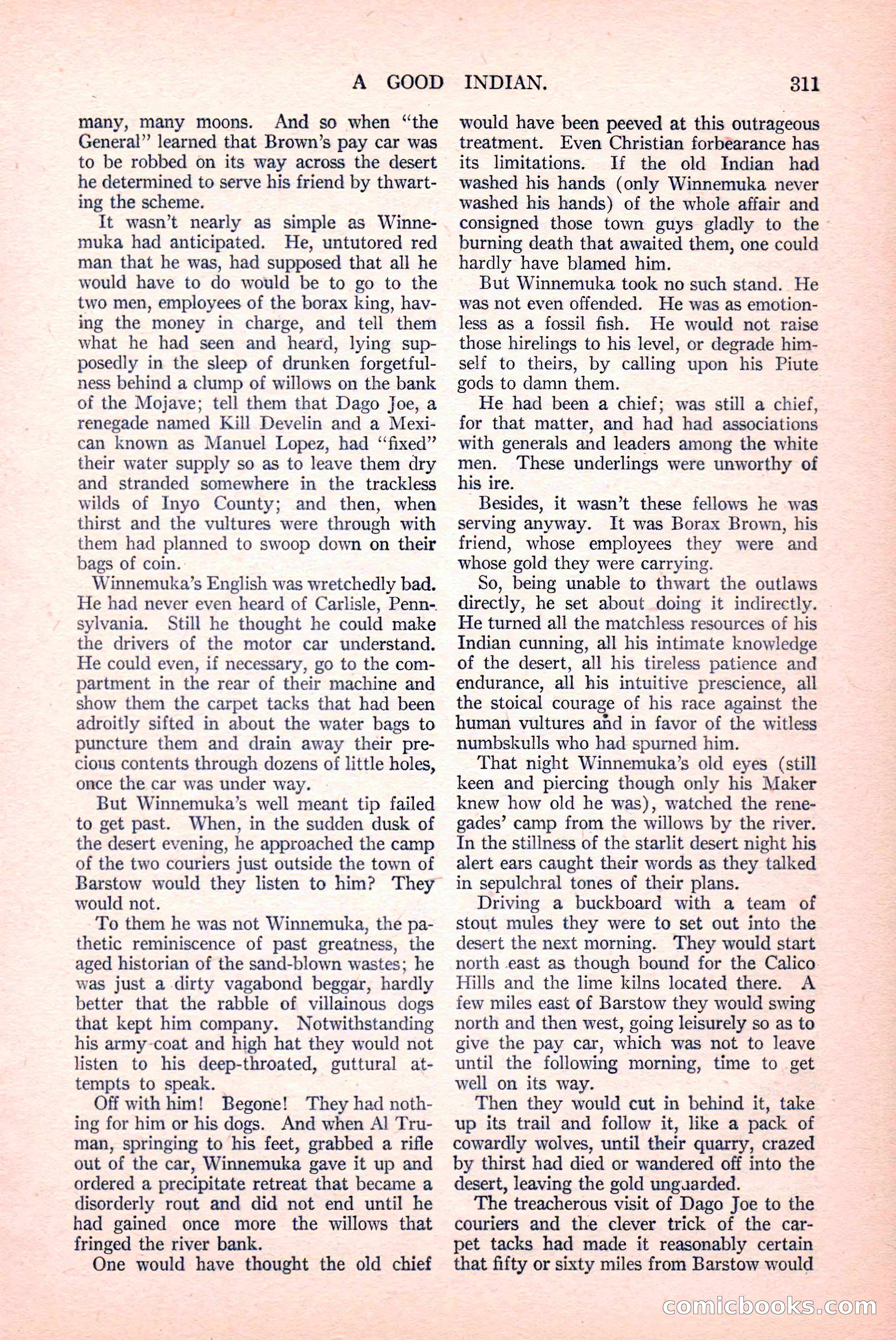
A restored page from Pulp Fiction, 1916. Page through the whole issue in the reader above.
📄 Transcribed text from this page (OCR, searchable)
Machine-transcribed from the original scan — historical spelling and the odd misread are preserved.
A GOOD INDIAN. many, many moons. And so when “the General” learned that Brown’s pay car was to be robbed on its way across the desert he determined to serve his friend by thwart- ing the scheme. It wasn’t nearly as simple as Winne- muka had anticipated. He, untutored red man that he was, had supposed that all he would have to do would be to go to the two men, employees of the borax king, hav- ing the money in charge, and tell them what he had seen and heard, lying sup- posedly in the sleep of drunken forgetful- ness behind a clump of willows on the bank of the Mojave; tell them that Dago foe, a renegade named Kill Develin and a Mexi- can known as Manuel Lopez, had ‘‘fixed” their water supply so as to leave them dry and stranded somewhere in the trackless wilds of Inyo County; and then, when thirst and the vultures were through with them had planned to swoop down on their bags of coin. Winnemuka’s English was wretchedly bad. He had never even heard of Carlisle, Penn-. sylvania. Still he thought he could make the drivers of the motor car understand. He could even, if necessary, go to the com- partment in the rear of their machine and show them the carpet tacks that had been adroitly sifted in about the water bags to puncture them and drain away their pre- cious contents through dozens of little holes, once the car was under way. But Winnemuka’s well meant tip failed to get past. When, in the sudden dusk of the desert evening, he approached the camp of the two couriers just outside the town of Barstow would they listen to him? They would not. To them he was not Winnemuka, the pa- thetic reminiscence of past greatness, the aged historian of the sand-blown wastes; he was just a dirty vagabond beggar, hardly better that the rabble of villainous dogs that kept him company. Notwithstanding his army-coat and high hat they would not listen to his deep-throated, guttural at- tempts to speak. Off with him! Begone! ‘They had noth- ing for him or his dogs. And when Al Tru- man, springing to his feet, grabbed a rifle out of the car, Winnemuka gave it up and ordered a precipitate retreat that became a disorderly rout and did not end until he had gained once more the willows that fringed the river bank. One would have thought the old chief all would have been peeved at this outrageous treatment. Even Christian forbearance has its limitations. If the old Indian had washed his hands (only Winnemuka never washed his hands) of the whole affair and consigned those town guys gladly to the — burning death that awaited them, one could hardly have blamed him. But Winnemuka took no such stand. He was not even offended. He was as emotion- less as a fossil fish. He would not raise those hirelings to his level, or degrade him- self to theirs, by calling upon his Piute gods to damn them. He had been a chief; was still a chief, for that matter, and had had associations with generals and leaders among the white men. These underlings were unworthy of his ire. : Besides, it wasn’t these fellows he was serving anyway. It was Borax Brown, his friend, whose employees they were and whose gold they were carrying. So, being unable to thwart the outlaws directly, he set about doing it indirectly. | He turned all the matchless resources of his Indian cunning, all his intimate knowledge of the desert, all his tireless patience and endurance, all his intuitive prescience, all the stoical courage of his race against the human vultures and in favor of the witless numbskulls who had spurned him. That night Winnemuka’s old eyes (still keen and piercing though only his Maker knew how old he was), watched the rene- gades’ camp from the willows by the river. In the stillness of the starlit desert night his alert ears caught their words as they talked in sepulchral tones of their plans. Driving a buckboard with a team of stout mules they were to set out into the desert the next morning. They would start north east as though bound for the Calico. Hills and the lime kilns located there. A few miles east of Barstow they would swing north and then west, going leisurely so as to give the pay car, which was not to leave until the following morning, time to get well on its way. Then they would cut in behind it, take up its trail and follow it, like a pack of cowardly wolves, until their quarry, crazed by thirst had died or wandered off into the desert, leaving the gold unguarded. The treacherous visit of Dago Joe to the couriers and the clever trick of the car- pet tacks had made it reasonably certain that fifty or sixty miles from Barstow would CORMICLOOOKS (C@)