
Pulp Fiction, 1916 · page 99 of 216
The Argosy, Vol. 81, No. 4 — page 99: what you’re looking at
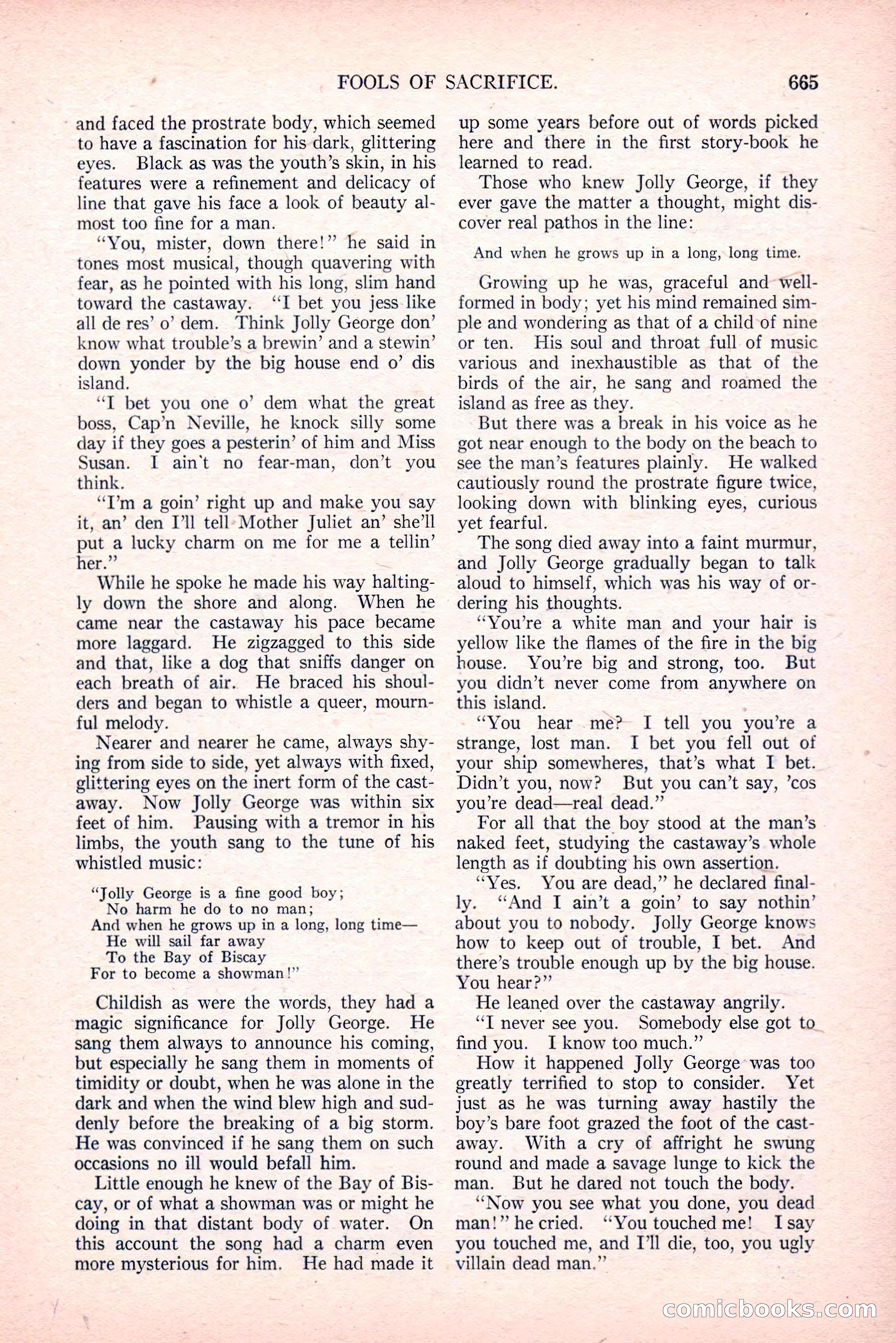
A restored page from Pulp Fiction, 1916. Page through the whole issue in the reader above.
📄 Transcribed text from this page (OCR, searchable)
Machine-transcribed from the original scan — historical spelling and the odd misread are preserved.
FOOLS OF SACRIFICE. and faced the prostrate body, which seemed to have a fascination for his dark, glittering eyes. Black as was the youth’s skin, in his features were a refinement and delicacy of line that gave his face a look of beauty al- most too fine for a man. “You, mister, down there!” he said in tones most musical, though quavering with fear, as he pointed with his long, slim hand toward the castaway. ‘‘I bet you Jess like all de res’ 0’ dem. Think Jolly George don’ know what trouble’s a brewin’ and a stewin’ down yonder by the big house end o’ dis island. ‘“T bet you one o’ dem what the great boss, Cap’n Neville, he knock silly some day if they goes a pesterin’ of him and Miss Susan. I aint no fear-man, don’t you think. “T’m a goin’ right up and make you say it, an’ den I'll tell Mother Juliet an’ she’ll put a lucky charm on me for me a tellin’ her.” While he spoke he made his way halting- ly down the shore and along. When he came near the castaway his pace became more laggard. He zigzagged to this side and that, like a dog that sniffs danger on each breath of air. He braced his shoul- ders and began to whistle a queer, mourn- ful melody. Nearer and nearer he came, always shy- ing from side to side, yet always with fixed, glittering eyes on the inert form of the cast- away. Now Jolly George was within six feet of him. Pausing with a tremor in his limbs, the youth sang to the tune of his whistled music: “Tolly George is a fine good boy; No harm he do to no man; And when he grows up in a long, long time— He will sail far away To the Bay of Biscay For to become a showman!”’ Childish as were the words, they had a magic significance for Jolly George. He sang them always to announce his coming, but especially he sang them in moments of timidity or doubt, when he was alone in the dark and when the wind blew high and sud- denly before the breaking of a big storm. He was convinced if he sang them on such occasions no ill would befall him. Little enough he knew of the Bay of Bis- cay, or of what a showman was or might he doing in that distant body of water. On this account the song had a charm even more mysterious for him. He had made it 665 up some years before out of words picked here and there in the first story-book he learned to read. Those who knew Jolly George, if they ever gave the matter a thought, might dis- cover real pathos in the line: And when he grows up in a long, long time. Growing up he was, graceful and well- formed in body; yet his mind remained sim- ple and wondering as that of a child of nine or ten. His soul and throat full of music various and inexhaustible as that of the birds of the air, he sang and roamed the island as free as they. But there was a break in his voice as he got near enough to the body on the beach to see the man’s features plainly. He walked cautiously round the prostrate figure twice, looking down with blinking eyes, curious yet fearful. The song died away into a faint murmur, and Jolly George gradually began to talk aloud to himself, which was his way of or- dering his thoughts. “Youwre a white man and your hair is yellow like the flames of the fire in the big house. You’re big and strong, too. But you didn’t never come from anywhere on this island. “You hear me? I tell you you’re a strange, lost man. I bet you fell out of your ship somewheres, that’s what I bet. Didn’t you, now? But you can’t say, ’cos you’re dead—real dead.” For all that the boy stood at the man’s naked feet, studying the castaway’s whole length as if doubting his own assertion. “Yes. You are dead,” he declared final- ly. “And I ain’t a goin’ to say nothin’ about you to nobody. Jolly George knows how to keep out of trouble, I bet. And there’s trouble enough up by the big house. You hear?” He leaned over the castaway angrily. “T never see you. Somebody else got to find you. I know too much.” How it happened Jolly George’ was too ereatly terrified to stop to consider. Yet just as he was turning away hastily the boy’s bare foot grazed the foot of the cast- away. With a cry of affright he swung round and made a savage lunge to kick the man. But he dared not touch the body. ‘“Now you see what you done, you dead man!” hecried. ‘‘You touched me! I say you touched me, and I'll die, too, you ugly villain dead man.” COMMICLOOKS EO