
Pulp Fiction, 1916 · page 98 of 216
The Argosy, Vol. 81, No. 4 — page 98: what you’re looking at
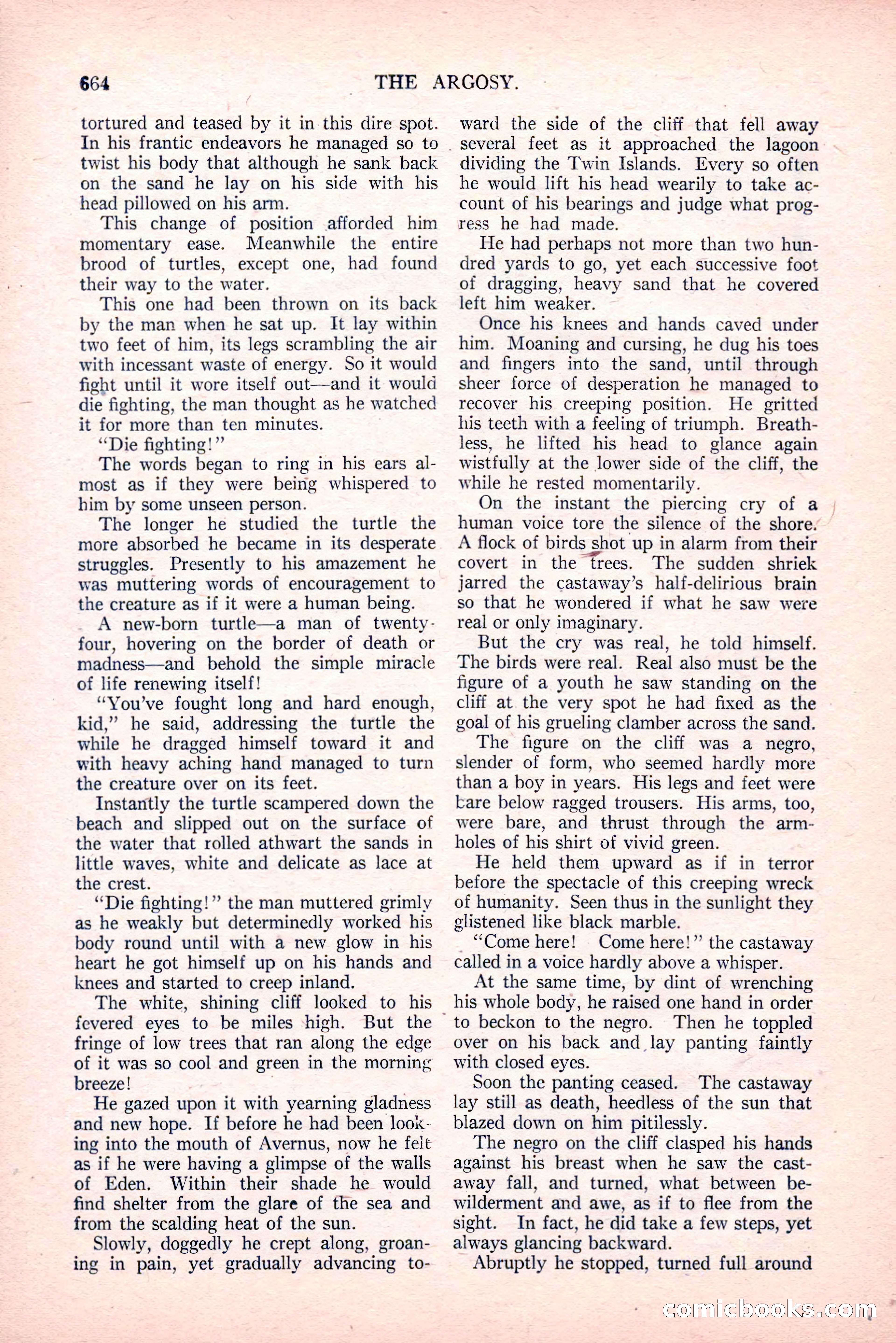
A restored page from Pulp Fiction, 1916. Page through the whole issue in the reader above.
📄 Transcribed text from this page (OCR, searchable)
Machine-transcribed from the original scan — historical spelling and the odd misread are preserved.
664 THE tortured and teased by it in this dire spot. In his frantic endeavors he managed so to | twist his body that although he sank back on the sand he lay on his side with his head pillowed on his arm. This change of position afforded him momentary ease. Meanwhile the entire brood of turtles, except one, had found their way to the water. This one had been thrown on its back by the man when he sat up. It lay within two feet of him, its legs scrambling the air with incessant waste of energy. So it would fight until it wore itself out—and it would die fighting, the man thought as he watched it for more than ten minutes. “Die fighting!” The words began to ring in his ears al- most as if they were being whispered to him by some unseen person. The longer he studied the turtle the more absorbed he became in its desperate struggles. Presently to his amazement he was muttering words of encouragement to the creature as if it were a human being. A new-born turtle—a man of twenty- four, hovering on the border of death or madness—and behold the simple miracle of life renewing itself! “Vou’ve fought long and hard enough, kid,” he said, addressing the turtle the while he dragged himself toward it and with heavy aching hand managed to turn the creature over on its feet. Instantly the turtle scampered down the beach and slipped out on the surface of the water that rolled athwart the sands in little waves, white and delicate as lace at the crest. “Die fighting!” the man muttered grimly as he weakly but determinedly worked his body round until with a new glow in his heart he got himself up on his hands and knees and started to creep inland. The white, shining cliff looked to his fevered eyes to be miles high. But the fringe of low trees that ran along the edge of it was so cool and green in the morning breeze! : He gazed upon it with yearning gladness and new hope. If before he had been loox- ing into the mouth of Avernus, now he felt as if he were having a glimpse of the walls of Eden. Within their shade he would find shelter from the glare of the sea and from the scalding heat of the sun. Slowly, doggedly he crept along, groan- ing in pain, yet gradually advancing to- - to beckon to the negro. ARGOSY. ward the side of the cliff that fell away several feet as it approached the lagoon dividing the Twin Islands. Every so often he would lift his head wearily to take ac- count of his bearings and judge what prog- ress he had made. He had perhaps not more than two hun- dred yards to go, yet each successive foot of dragging, heavy sand that he covered left him weaker. Once his knees and hands caved under him. Moaning and cursing, he dug his toes and fingers into the sand, until through sheer force of desperation he managed to recover his creeping position. He gritted his teeth with a feeling of triumph. Breath- less, he lifted his head to glance again wistfully at the lower side of the cliff, the while he rested momentarily. On the instant the piercing cry of a human voice tore the silence of the shore. A flock of birds shot up in alarm from their covert in the trees. The sudden shriek jarred the castaway’s half-delirious brain so that he wondered if what he saw were real or only imaginary. But the cry was real, he told himself. The birds were real. Real also must be the figure of a youth he saw standing on the cliff at the very spot he had fixed as the goal of his grueling clamber across the sand. The figure on the cliff was a negro, slender of form, who seemed hardly more than a boy in years. His legs and feet were care below ragged trousers. His arms, too, were bare, and thrust through the arm- holes of his shirt of vivid green. He held them upward as if in terror before the spectacle of this creeping wreck of humanity. Seen thus in the sunlight they glistened like black marble. _ “Come here! Come here!” the castaway called in a voice hardly above a whisper. At the same time, by dint of wrenching his whole body, he raised one hand in order Then he toppled over on his back and_ lay panting faintly with closed eyes. Soon the panting ceased. The castaway lay still as death, heedless of the sun that blazed down on him pitilessly. The negro on the cliff clasped his hands against his breast when he saw the cast- away fall, and turned, what between be- wilderment and awe, as if to flee from the sight. In fact, he did take a few steps, yet always glancing backward. Abruptly he stopped, turned full around CORMICGLOOOKS (C@)