
Pulp Fiction, 1916 · page 67 of 216
The Argosy, Vol. 81, No. 4 — page 67: what you’re looking at
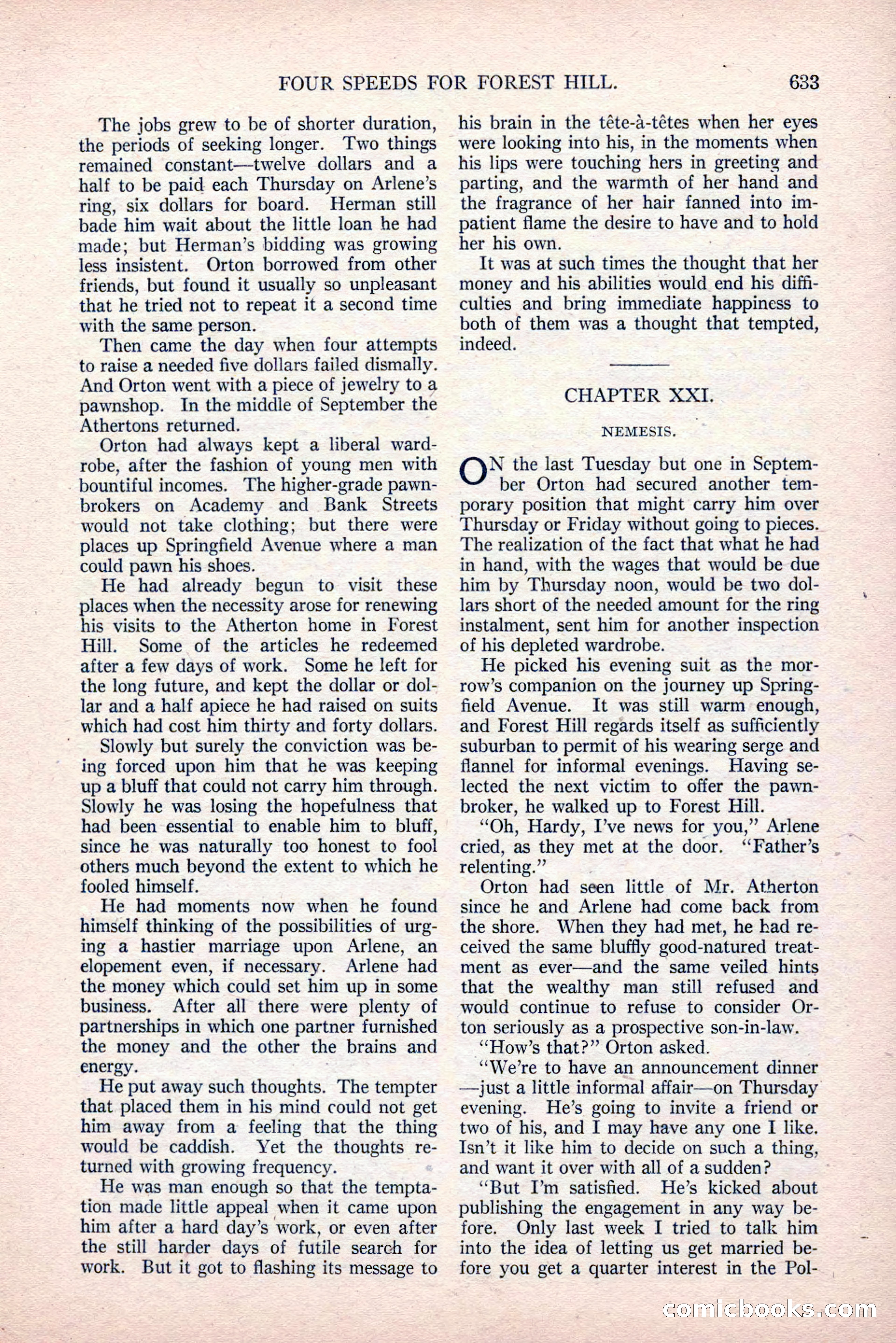
A restored page from Pulp Fiction, 1916. Page through the whole issue in the reader above.
📄 Transcribed text from this page (OCR, searchable)
Machine-transcribed from the original scan — historical spelling and the odd misread are preserved.
FOUR SPEEDS FOR FOREST HILL. The jobs grew to be of shorter duration, the periods of seeking longer. Two things remained constant—twelve dollars and a half to be paid each Thursday on Arlene’s ring, six dollars for board. Herman still bade him wait about the little loan he had made; but Herman’s bidding was growing less insistent. Orton borrowed from other friends, but found it usually so unpleasant that he tried not to repeat it a second time with the same person. Then came the day when four attempts to raise a needed five dollars failed dismally. And Orton went with a piece of jewelry to a pawnshop. In the middie of September the Athertons returned. Orton had always kept a liberal ward- robe, after the fashion of young men with bountiful incomes. The higher-grade pawn- brokers on Academy and Bank Streets would not take clothing; but there were places up Springfield Avenue where a man could pawn his shoes. He had already begun to visit these places when the necessity arose for renewing his visits to the Atherton home in Forest Hill. Some of the articles he redeemed after a few days of work. Some he left for the long future, and kept the dollar or dol- lar and a half apiece he had raised on suits which had cost him thirty and forty dollars. Slowly but surely the conviction was be- ing forced upon him that he was keeping up a bluff that could not carry him through. Slowly he was losing the hopefulness that had been essential to enable him to bluff, since he was naturally too honest to fool others much beyond the extent to which he fooled himself. He had moments now when he found himself thinking of the possibilities of urg- ing a hastier marriage upon Arlene, an elopement even, if necessary. Arlene had the money which could set him up in some business. After all there were plenty of partnerships in which one partner furnished the money and the other the brains and energy. He put away such thoughts. The tempter that placed them in his mind could not get him away from a feeling that the thing would be caddish. Yet the thoughts re- turned with growing frequency. He was man enough so that the tempta- tion made little appeal when it came upon him after a hard day’s work, or even after the still harder days of futile search for work. But it got to flashing its message to 633 his brain in the téte-a-tétes when her eyes were looking into his, in the moments when his lips were touching hers in greeting and parting, and the warmth of her hand and the fragrance of her hair fanned into im- patient flame the desire to have and to hold her his own. . It was at such times the thought that her money and his abilities would end his diffi- culties and bring immediate happiness to both of them was a thought that tempted, indeed. CHAPTER XXI. NEMESIS. | N the last Tuesday but one in Septem- ber Orton had secured another tem- porary position that might carry him over Thursday or Friday without going to pieces. The realization of the fact that what he had in hand, with the wages that would be due him by Thursday noon, would be two dol- lars short of the needed amount for the ring instalment, sent him for another inspection of his depleted wardrobe. He picked his evening suit as the mor- row’s companion on the journey up Spring- field Avenue. It was still warm enough, and Forest Hill regards itself as sufficiently suburban to permit of his wearing serge and flannel for informal evenings. Having se- lected the next victim to offer the pawn- broker, he walked up to Forest Hill. “Oh, Hardy, I’ve news for you,” Arlene cried, as they met at the door. ‘‘Father’s relenting.”’ Orton had seen little of Mr. Atherton since he and Arlene had come back from the shore. When they had met, he had re- ceived the same bluffly good-natured treat- ment as ever—and the same veiled hints that the wealthy man still refused and would continue to refuse to consider Or- ton seriously as a prospective son-in-law. “How’s that?” Orton asked. “We're to have an announcement dinner —just a little informal affair—on Thursday evening. He’s going to invite a friend or two of his, and I may have any one I like. Isn’t it like him to decide on such a thing, and want it over with all of a sudden? “But I’m satisfied. He’s kicked about publishing the engagement in any way be- fore. Only last week I tried to talk him into the idea of letting us get married be- fore you get a quarter interest in the Pol- | (© JOO AMG SS (S@)