
Pulp Fiction, 1916 · page 66 of 216
The Argosy, Vol. 81, No. 4 — page 66: what you’re looking at
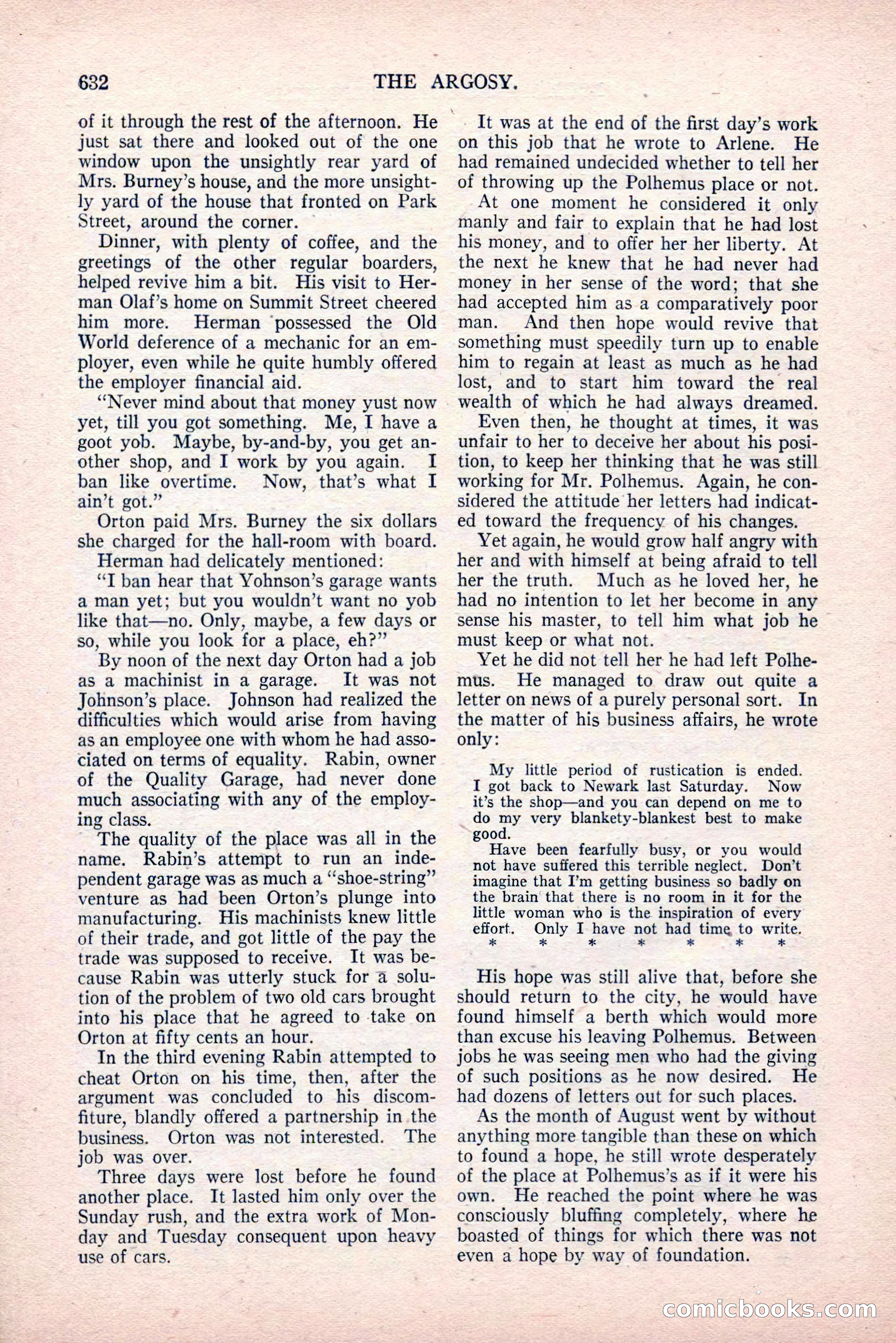
A restored page from Pulp Fiction, 1916. Page through the whole issue in the reader above.
📄 Transcribed text from this page (OCR, searchable)
Machine-transcribed from the original scan — historical spelling and the odd misread are preserved.
632 of it through the rest of the afternoon. He ~ just sat there and looked out of the one window upon the unsightly rear yard of Mrs. Burney’s house, and the more unsight- ly yard of the house that fronted on Park Street, around the corner. © Dinner, with plenty of coffee, and the greetings of the other regular boarders, helped revive him a bit. His visit to Her- man Olaf’s home on Summit Street cheered him more. Herman ‘possessed the Old World deference of a mechanic for an em- ployer, even while he quite humbly offered the employer financial aid. ‘Never mind about that money yust now yet, till you got something. Me, I have a goot yob. Maybe, by-and-by, you get an- other shop, and I work by you again. I ban like overtime. Now, that’s what I ain’t got.” Orton paid Mrs. Burney the six dollars she charged for the hall-room with board. Herman had delicately mentioned: “T ban hear that Yohnson’s garage wants a man yet; but you wouldn’t want no yob like that—no. Only, maybe, a few days or so, while you look for a place, eh?” By noon of the next day Orton had a job as a machinist in a garage. It was not Johnson’s place. Johnson had realized the difficulties which would arise from having as an employee one with whom he had asso- ciated on terms of equality. Rabin, owner of the Quality Garage, had never done much associating with any of the employ- ing class. The quality of the place was all in the name. Rabin’s attempt to run an inde- pendent garage was as much a “shoe-string” venture as had been Orton’s plunge into manufacturing. His machinists knew little of their trade, and got little of the pay the trade was supposed to receive. It was be- cause Rabin was utterly stuck for a solu- tion of the problem of two old cars brought into his place that he agreed to take on Orton at fifty cents an hour. In the third evening Rabin attempted to cheat Orton on his time, then, after the argument was concluded to his discom- fiture, blandly offered a partnership in the business. Orton was not interested. The job was over. Three days were lost before he found another place. It lasted him only over the Sunday rush, and the extra work of Mon- day and Tuesday consequent upon heavy use of cars. THE ARGOSY. It was at the end of the first day’s work on this job that he wrote to Arlene. He had remained undecided whether to tell her of throwing up the Polhemus place or not. At one moment he considered it only manly and fair to explain that he had lost his money, and to offer her her liberty. At the next he knew that he had never had money in her sense of the word; that she had accepted him as a comparatively poor man. And then hope would revive that something must speedily turn up to enable him to regain at least as much as he had lost, and to start him toward the real wealth of which he had always dreamed. Even then, he thought at times, it was unfair to her to deceive her about his posi- tion, to keep her thinking that he was still working for Mr. Polhemus. Again, he con- sidered the attitude her letters had indicat- ed toward the frequency of his changes. Yet again, he would grow half angry with her and with himself at being afraid to tell her the truth. Much as he loved her, he had no intention to let her become in any sense his master, to tell him what job he must keep or what not. Yet he did not tell her he had left Polhe- mus. He managed to draw out quite a letter on news of a purely personal sort. In the matter of his business affairs, he wrote only: My little period of rustication is ended. I got back to Newark last Saturday. Now it’s the shop—and you can depend on me to do ae very blankety-blankest best to make ood. : Have been fearfully busy, or you would not have suffered this terrible neglect. Don’t imagine that I’m getting business so badly on the brain that there is no room in it for the little woman who is the inspiration of every effort. Only I have not had time to write. * * * * * Ps * His hope was still alive that, before she should return to the city, he would have found himself a berth which would more than excuse his leaving Polhemus. Between jobs he was seeing men who had the giving of such positions as he now desired. He had dozens of letters out for such places. As the month of August went by without anything more tangible than these on which to found a hope, he still wrote desperately of the place at Polhemus’s as if it were his own. He reached the point where he was consciously bluffing completely, where he boasted of things for which there was not even a hope by way of foundation. (EO) NOOLKS ANG (E@)