
Pulp Fiction, 1916 · page 21 of 216
The Argosy, Vol. 81, No. 4 — page 21: what you’re looking at
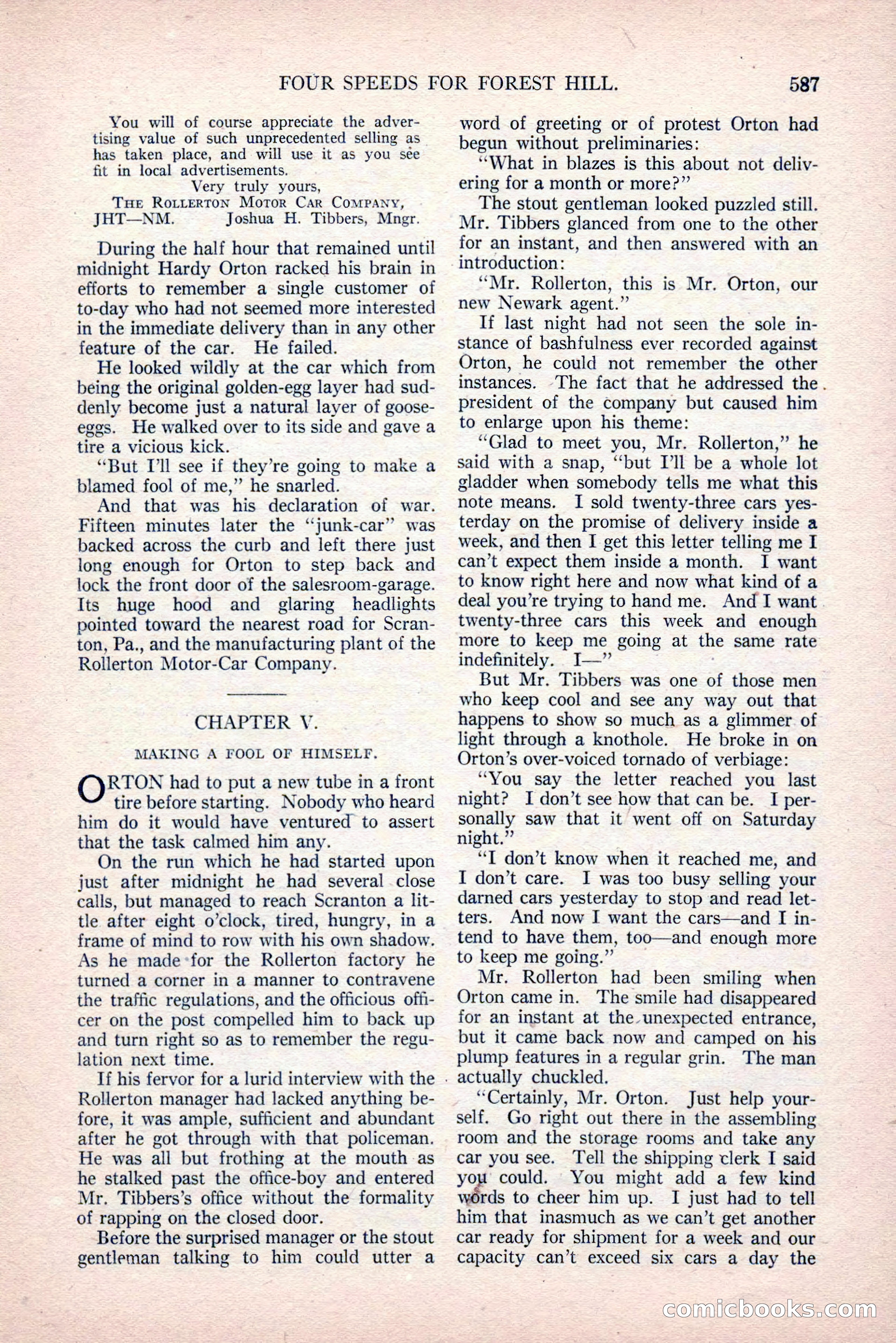
A restored page from Pulp Fiction, 1916. Page through the whole issue in the reader above.
📄 Transcribed text from this page (OCR, searchable)
Machine-transcribed from the original scan — historical spelling and the odd misread are preserved.
FOUR SPEEDS FOR FOREST HILL. You will of course appreciate the adver- tising value of such unprecedented selling as has taken place, and will use it as you see fit in local advertisements. Very truly yours, THe RoLLERTON Motor Car Company, JHT—NM. Joshua H. Tibbers, Mngr. During the half hour that remained until midnight Hardy Orton racked his brain in efforts to remember a single customer of to-day who had not seemed more interested in the immediate delivery than in any other feature of the car. He failed. He looked wildly at the car which from being the original golden-egg layer had sud- denly become just a natural layer of goose- eges. He walked over to its side and gave a tire a vicious kick. “But Dll see if they’re going to make a blamed fool of me,” he snarled. And that was his declaration of war. Fifteen minutes later the ‘‘junk-car” was backed across the curb and left there just long enough for Orton to step back and lock the front door of the salesroom-garage. Its huge hood and glaring headlights pointed toward the nearest road for Scran- ton, Pa., and the manufacturing plant of the Rollerton Motor-Car Company. CHAPTER V. MAKING A FOOL OF HIMSELF. O TON had to put a new tube in a front tire before starting. Nobody who heard him do it would have ventured to assert that the task calmed him any. On the run which he had started upon just after midnight he had several close calls, but managed to reach Scranton a lit- tle after eight o’clock, tired, hungry, in a frame of mind to row with his own shadow. As he made*for the Rollerton factory he turned a corner in a manner to contravene the traffic regulations, and the officious offi- cer on the post compelled him to back up and turn right so as to remember the regu- lation next time. If his fervor for a lurid interview with the . Rollerton manager had lacked anything be- fore, it was ample, sufficient and abundant after he got through with that policeman. He was all but frothing at the mouth as he stalked past the office-boy and entered Mr. Tibbers’s office without the formality of rapping on the closed door. Before the surprised manager or the stout gentleman talking to him could utter a 587 word of greeting or of protest Orton had begun without preliminaries: ‘‘What in blazes is this about not deliv- ering for a month or more?” The stout gentleman looked puzzled still. Mr. Tibbers glanced from one to the other for an instant, and then answered with an introduction: “Mr. Rollerton, this is Mr. Orton, our new Newark agent.” If last night had not seen the sole in- stance of bashfulness ever recorded against Orton, he could not remember the other instances. ~The fact that he addressed the. president of the company but caused him to enlarge upon his theme: “Glad to meet you, Mr. Rollerton,” he said with a snap, “but Vl be a whole lot gladder when somebody tells me what this note means. I sold twenty-three cars yes- terday on the promise of delivery inside a week, and then I get this letter telling me I can’t expect them inside a month. I want to know right here and now what kind of a deal you’re trying to hand me. And I want twenty-three cars this week and enough more to keep me going at the same rate indefinitely. I—” But Mr. Tibbers was one of those men who keep cool and see any way out that happens to show so much as a glimmer of light through a knothole. He broke in on Orton’s over-voiced tornado of verbiage: ‘You say the letter reached you last night? I don’t see how that can be. I per- sonally saw that it went off on Saturday night.” ‘“T don’t know when it reached me, and I don’t care. I was too busy selling your darned cars yesterday to stop and read let- ters. And now I want the cars—and I in- tend to have them, too—and enough more to keep me going.” Mr. Rollerton had been smiling when Orton came in. The smile had disappeared for an instant at the unexpected entrance, but it came back now and camped on his plump features in a regular grin. The man actually chuckled. “Certainly, Mr. Orton. Just help your- self. Go right out there in the assembling room and the storage rooms and take any car you see. Tell the shipping clerk I said you could. You might add a few kind words to cheer him up. I just had to tell him that inasmuch as we can’t get another car ready for shipment for a week and our capacity can’t exceed six cars a day the COPMICLOOOKS (C@