
Pulp Fiction, 1916 · page 20 of 216
The Argosy, Vol. 81, No. 4 — page 20: what you’re looking at
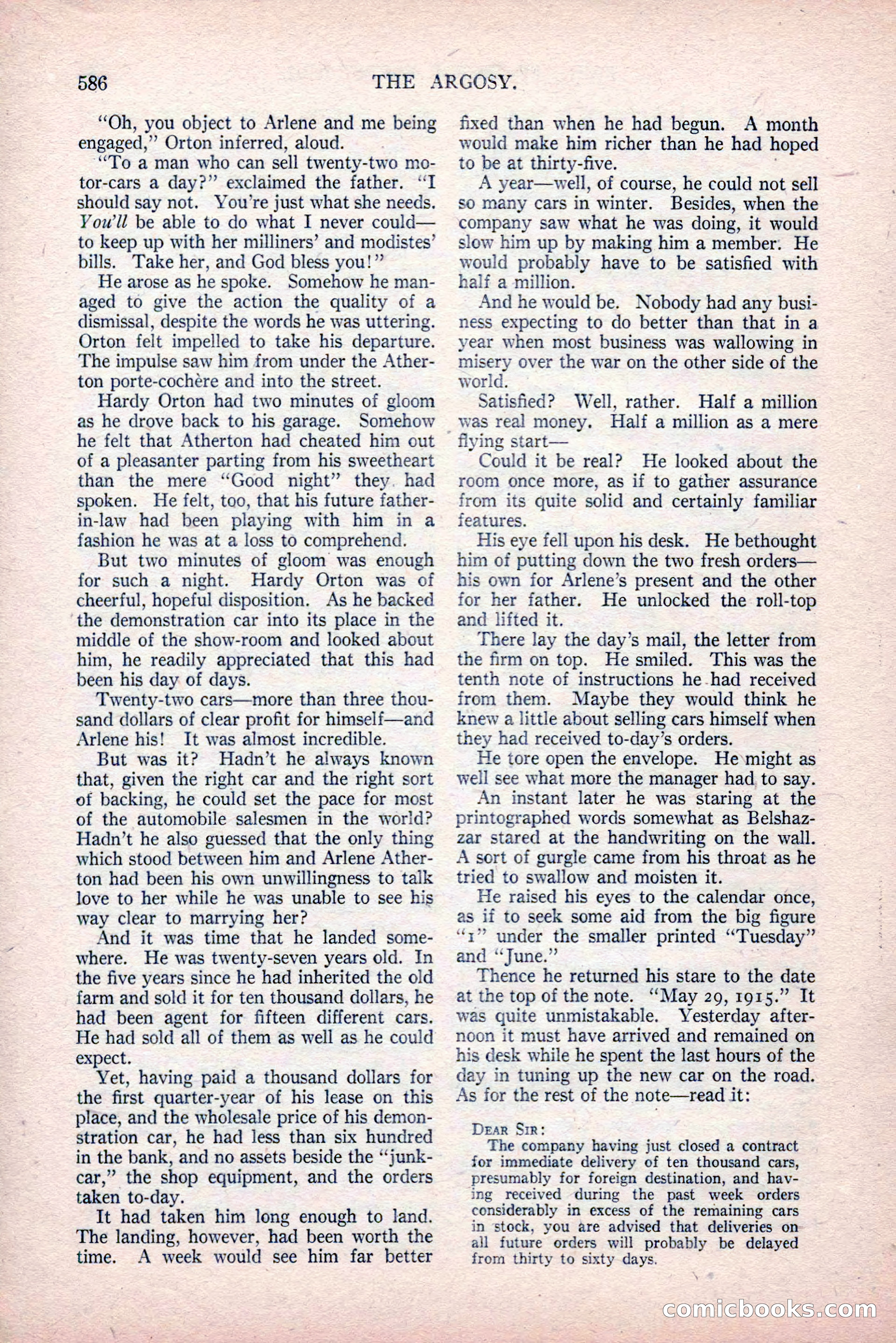
A restored page from Pulp Fiction, 1916. Page through the whole issue in the reader above.
📄 Transcribed text from this page (OCR, searchable)
Machine-transcribed from the original scan — historical spelling and the odd misread are preserved.
586 “Oh, you object to Arlene and me being engaged,” Orton inferred, aloud. “To a man who can sell twenty-two mo- tor-cars a day?” exclaimed the father. “TI should say not. You’re just what she needs. Youll be able to do what I never could— to keep up with her milliners’ and modistes’ bills. Take her, and God bless you!” He arose as he spoke. Somehow he man- aged to give the action the quality of a dismissal, despite the words he was uttering. Orton felt impelled to take his departure. The impulse saw him from under the Ather- ton porte-cochére and into the street. Hardy Orton had two minutes of gloom as he drove back to his garage. Somehow he felt that Atherton had cheated him out of a pleasanter parting from his sweetheart than the mere “Good night” they. had spoken. He felt, too, that his future father- in-law had been playing with him in a fashion he was at a loss to comprehend. But two minutes of gloom was enough for such a night. Hardy Orton was of cheerful, hopeful disposition. As he backed the demonstration car into its place in the middle of the show-room and looked about him, he readily appreciated that this had been his day of days. Twenty-two cars—more than three thou- sand dollars of clear profit for himself—and Arlene his! It was almost incredible. But was it? Hadn’t he always known that, given the right car and the right sort of backing, he could set the pace for most of the automobile salesmen in the world? Hadn’t he also guessed that the only thing which stood between him and Arlene Ather- ton had been his own unwillingness to talk love to her while he was unable to see his way clear to marrying her? And it was time that he landed some- where. He was twenty-seven years old. In the five years since he had inherited the old farm and sold it for ten thousand dollars, he had been agent for fifteen different cars. He had sold all of them as well as he could expect. Yet, having paid a thousand dollars for the first quarter-year of his lease on this place, and the wholesale price of his demon- stration car, he had less than six hundred in the bank, and no assets beside the “‘junk- car,” the shop equipment, and the orders taken to-day. It had taken him long enough to land. The landing, however, had been worth the time. A week would see him far better THE ARGOSY. fixed than when he had begun. A month would make him richer than he had hoped to be at thirty-five. A year—vwell, of course, he could not sell SO many cars in winter. Besides, when the company saw what he was doing, it would slow him up by making him a member. He would probably have to be satisfied with half a million. And he would be. Nobody had any busi- ness expecting to do better than that in a year when most business was wallowing in misery over the war on the other side of the world. Satisfied? Well, rather. was real money. fiying start— Could it be real? He looked about the room once more, as if to gather assurance from its quite solid and certainly familiar features. His eye fell upon his desk. He bethought him of putting down the two fresh orders— his own for Arlene’s present and the other for her father. He unlocked the roll-top and lifted it. There lay the day’s mail, the letter from the firm on top. He smiled. This was the tenth note of instructions he-had received from them. Maybe they would think he knew a little about selling cars himself when they had received to-day’s orders. He tore open the envelope. He might as well see what more the manager had to say. An instant later he was staring at the printographed words somewhat as Belshaz- zar stared at the handwriting on the wall. A sort of gurgle came from his throat as he tried to swallow and moisten it. He raised his eyes to the calendar once, as ii to seek some aid from the big figure “x” under the smaller printed ‘‘Tuesday” and “June.” Thence he returned his stare to the date at the top of the note. “May 29, 1915.” It was quite unmistakable. Yesterday after- noon it must have arrived and remained on his desk while he spent the last hours of the day in tuning up the new car on the road. As for the rest of the note—read it: Half a million Half a million as a mere Dear Sir: The company having just closed a contract for immediate delivery of ten thousand cars, presumably for foreign destination, and hav- ing received during the past week orders considerably in excess of the remaining cars in stock, you are advised that deliveries on all future orders will probably be delayed from thirty to sixty days. COMMIEOOOKS (F@)