
Pulp Fiction, 1916 · page 156 of 216
The Argosy, Vol. 81, No. 4 — page 156: what you’re looking at
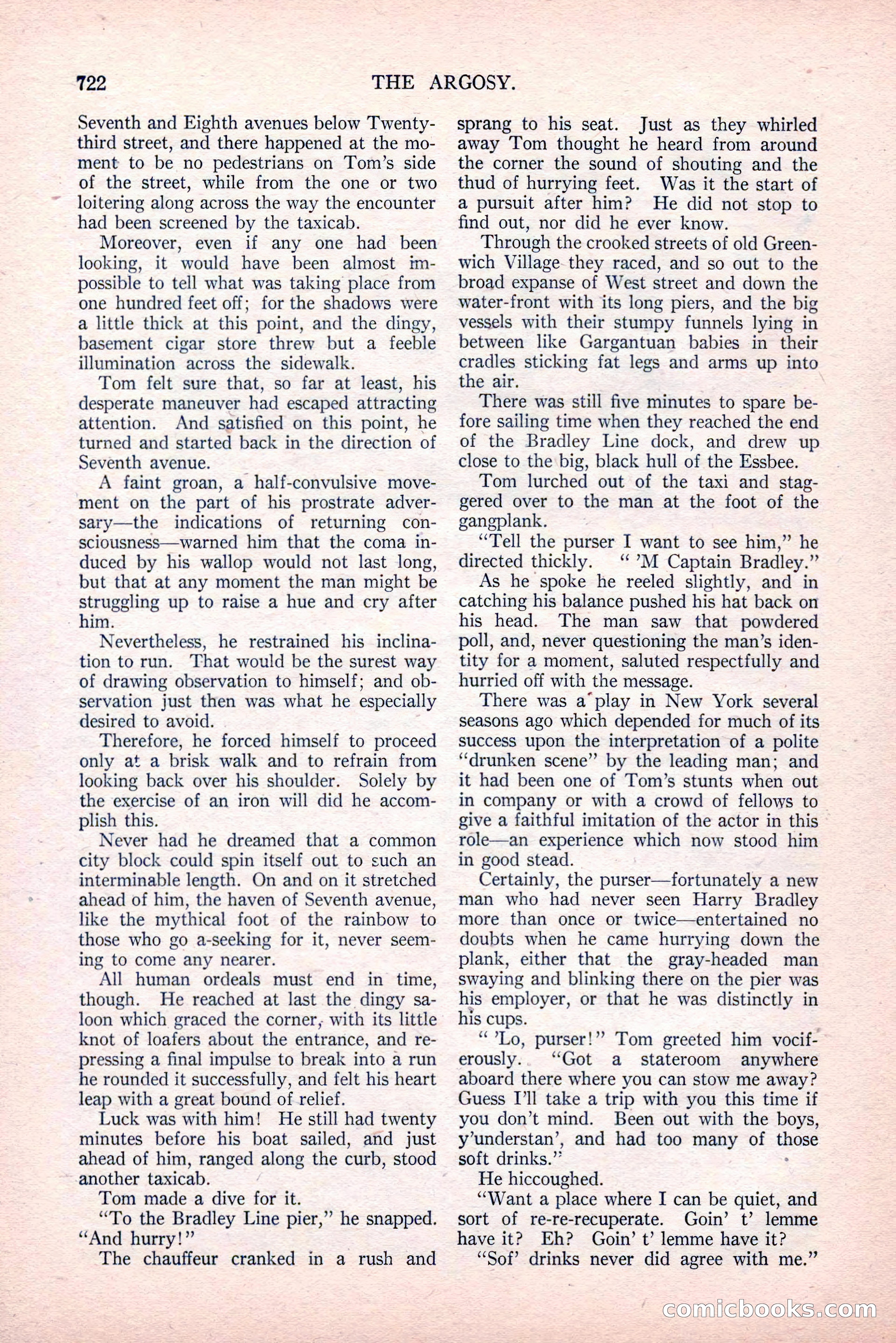
A restored page from Pulp Fiction, 1916. Page through the whole issue in the reader above.
📄 Transcribed text from this page (OCR, searchable)
Machine-transcribed from the original scan — historical spelling and the odd misread are preserved.
722 Seventh and Eighth avenues below Twenty- third street, and there happened at the mo- ment to be no pedestrians on Tom’s side of the street, while from the one or two loitering along across the way the encounter had been screened by the taxicab. Moreover, even if any one had been looking, it would have been almost im- possible to tell what was taking place from one hundred feet off; for the shadows were a little thick at this point, and the dingy, basement cigar store threw but a feeble illumination across the sidewalk. Tom felt sure that, so far at least, his desperate maneuver had escaped attracting attention. And satisfied on this point, he turned and started back in the direction of Seventh avenue. A faint groan, a half-convulsive move- ment on the part of his prostrate adver- sary—the indications of returning con- sciousness—warned him that the coma in- duced by his wallop would not last long, but that at any moment the man might be struggling up to raise a hue and cry after him. Nevertheless, he restrained his inclina- tion to run. That would be the surest way of drawing observation to himself; and ob- servation just then was what he especially desired to avoid. Therefore, he forced himself to proceed only at a brisk walk and to refrain from looking back over his shoulder. Solely by the exercise of an iron will did he accom- plish this. Never had he dreamed that a common city block could spin itself out to such an interminable length. On and on it stretched ahead of him, the haven of Seventh avenue, like the mythical foot of the rainbow to those who go a-seeking for it, never seem- ing to come any nearer. All human ordeals must end in time, though. He reached at last the dingy sa- loon which graced the corner, with its little knot of loafers about the entrance, and re- pressing a final impulse to break into a run he rounded it successfully, and felt his heart leap with a great bound of relief. Luck was with him! He still had twenty minutes before his boat sailed, and just ahead of him, ranged along the curb, stood another taxicab. Tom made a dive for it. “To the Bradley Line pier,” “And hurry!” The chauffeur cranked in a rush and he snapped. THE ARGOSY. sprang to his seat. Just as they whirled away Tom thought he heard from around the corner the sound of shouting and the thud of hurrying feet. Was it the start of a pursuit after him? He did not stop to find out, nor did he ever know. Through the crooked streets of old Green- wich Village they raced, and so out to the broad expanse of West street and down the water-front with its long piers, and the big vessels with their stumpy funnels lying in between like Gargantuan babies in their cradles sticking fat legs and arms up into the air. There was still five minutes to spare be- fore sailing time when they reached the end of the Bradley Line dock, and drew up close to the big, black hull of the Essbee. Tom lurched out of the taxi and stag- gered over to the man at the foot of the gangplank. “Tell the purser I want to see him,” he directed thickly. ‘“ ’M Captain Bradley. a As he spoke he reeled slightly, and in catching his balance pushed his hat back on his head. The man saw that powdered poll, and, never questioning the man’s iden- tity for a moment, saluted respectfully and hurried off with the message. There was a play in New York several seasons ago which depended for much of its success upon the interpretation of a polite ‘drunken scene” by the leading man; and it had been one of Tom’s stunts when out in company or with a crowd of fellows to give a faithful imitation of the actor in this role—an experience which now stood him in good stead. Certainly, the purser—fortunately a new man who had never seen Harry Bradley more than once or twice—entertained no doubts when he came hurrying down the plank, either that the gray-headed man swaying and blinking there on the pier was his employer, or that he was distinctly in his cups. ‘““’Lo, purser!”” Tom greeted him vocif- erously. “Got a stateroom anywhere aboard there where you can stow me away? Guess I'll take a trip with you this time if you don’t mind. Been out with the boys, y’understan’, and had too many of nee soft drinks.” He hiccoughed. ‘“‘Want a place where I can be quiet, and sort of re-re-recuperate. Goin’ t’ lemme have it? Eh? Goin’ t’ lemme have it? ‘Sof’? drinks never did agree with me.” ECORMICLOO® (C S (E@)