
Pulp Fiction, 1916 · page 155 of 216
The Argosy, Vol. 81, No. 4 — page 155: what you’re looking at
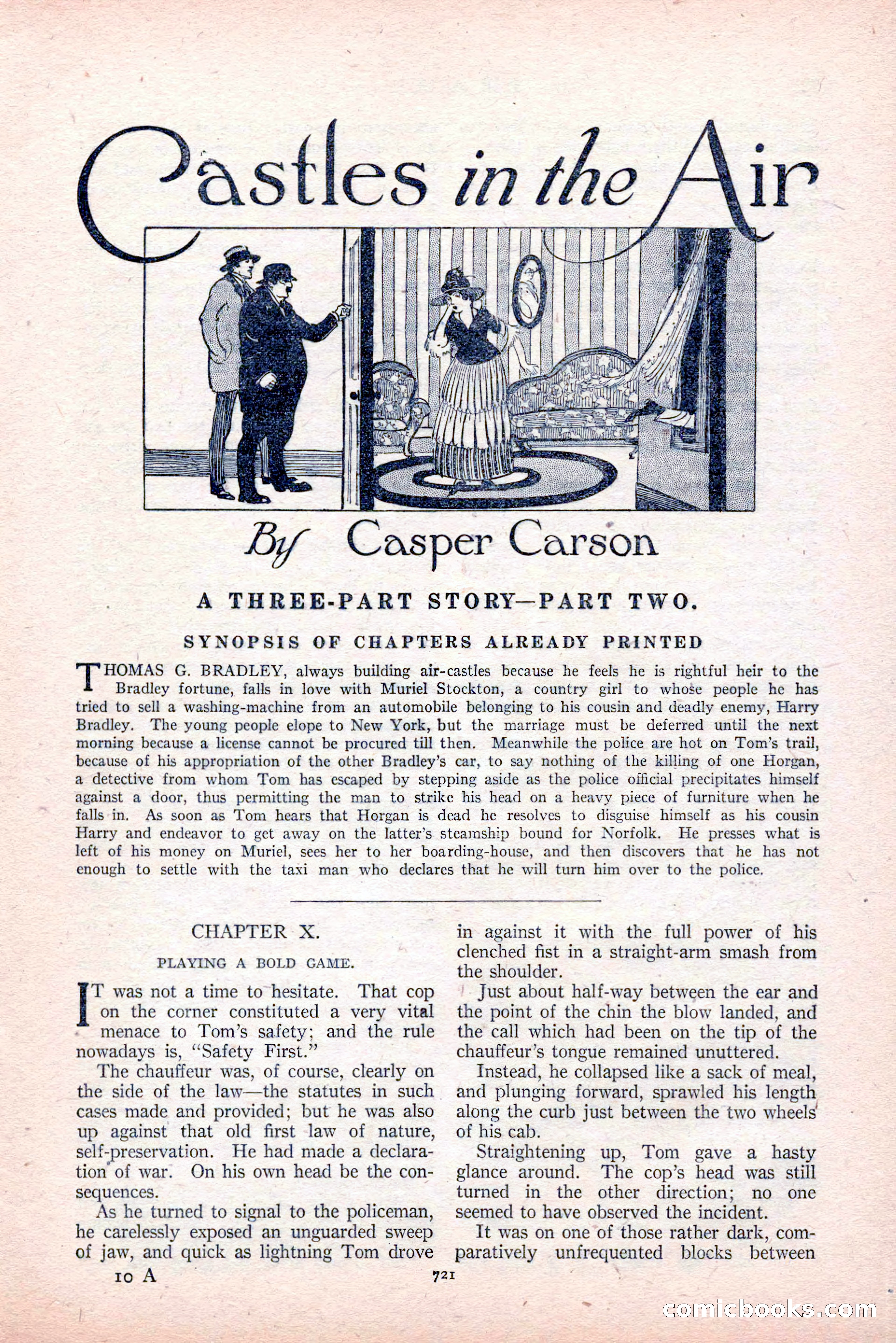
A restored page from Pulp Fiction, 1916. Page through the whole issue in the reader above.
📄 Transcribed text from this page (OCR, searchable)
Machine-transcribed from the original scan — historical spelling and the odd misread are preserved.
astles mn the / \ir By Casper Carson A THREE-PART STORY—PART TWO. SYNOPSIS OF CHAPTERS ALREADY PRINTED HOMAS G. BRADLEY, always building air-castles because he feels he is rightful heir to the Bradley fortune, falls in love with Muriel Stockton, a country girl to whose people he has tried to sell a washing-machine from an automobile belonging to his cousin and deadly enemy, Harry Bradley. The young people elope to New York, but the marriage must be deferred until the next morning because a license cannot be procured till then. Meanwhile the police are hot on Tom’s trail, because of his appropriation of the other Bradley’s car, to say nothing of the killing of one Horgan, a detective from whom Tom has escaped by stepping aside as the police official precipitates himself against a door, thus permitting the man to strike his head on a heavy piece of furniture when he falls in. As soon as Tom hears that Horgan is dead he resolves to disguise himself as his cousin Harry and endeavor to get away on the latter’s steamship bound for Norfolk. He presses what is left of his money on Muriel, sees her to her boarding-house, and then discovers that he has not enough to settle with the taxi man who declares that he will turn him over to the police, CHAPTER X. PLAYING A BOLD GAME. T was not a time to hesitate. That cop on the corner constituted a very vital menace to Tom’s safety; and the rule nowadays is, “Safety First.” The chauffeur was, of course, clearly on the side of the law—the statutes in such cases made and provided; but he was also up against that old first law of nature, sel f- -preservation. He had made a declara- tion of war. On his own head be the con- sequences. As he turned to signal to the policeman, he carelessly exposed an unguarded sweep of jaw, and quick as lightning Tom drove 10 A in against it with the full power of his clenched fist in a straight-arm smash from the shoulder. Just about half-way between the ear and the point of the chin the blow landed, and the call which had been on the tip of the chauffeur’s tongue remained unuttered. Instead, he collapsed like a sack of meal, and plunging forward, sprawled his length along the curb just between the two wheels of his cab. Straightening up, Tom gave a hasty glance around. The cop’s head was still turned in the other direction; no one seemed to have observed the incident. It was on one of those rather dark, com- paratively unfrequented blocks between 721 COPMICLOOOKS (C@)