
Pulp Fiction, 1916 · page 115 of 216
The Argosy, Vol. 81, No. 4 — page 115: what you’re looking at
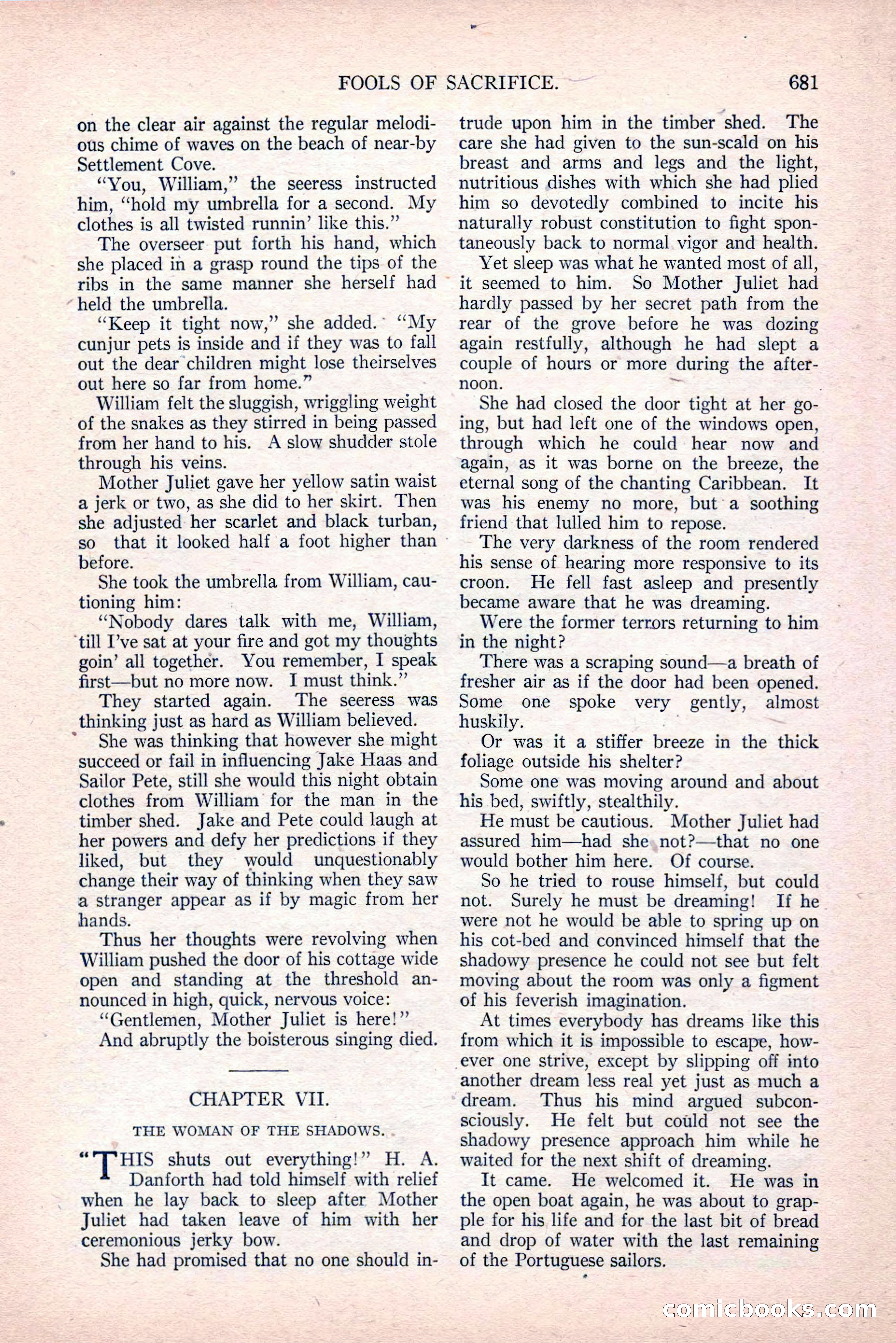
A restored page from Pulp Fiction, 1916. Page through the whole issue in the reader above.
📄 Transcribed text from this page (OCR, searchable)
Machine-transcribed from the original scan — historical spelling and the odd misread are preserved.
FOOLS OF SACRIFICE. on the clear air against the regular melodi- ous chime of waves on the beach of near-by Settlement Cove. “Vou, William,” the seeress instructed him, “hold my umbrella for a second. My clothes is all twisted runnin’ like this.”’ The overseer put forth his hand, which she placed in a grasp round the tips of the ribs in the same manner she herself had ‘held the umbrella. “Keep it tight now,” she added.” “My cunjur pets is inside and if they was to fall out the dear children might lose theirselves out here so far from home.” William felt the sluggish, wriggling weight of the snakes as they stirred in being passed from her hand to his. A slow shudder stole through his veins. Mother Juliet gave her yellow satin waist a jerk or two, as she did to her skirt. Then she adjusted her scarlet and black turban, so that it looked half a foot higher than © before. She took the umbrella from William, cau- tioning him: “Nobody dares talk with me, William, ‘till I’ve sat at your fire and got my thoughts goin’ all together. You remember, I speak first—but no more now. I must think.” They started again. The seeress was thinking just as hard as William believed. * She was thinking that however she might succeed or fail in influencing Jake Haas and Sailor Pete, still she would this night obtain clothes from William for the man in the timber shed. Jake and Pete could laugh at her powers and defy her predictions if they liked, but they would unquestionably change their way of thinking when they saw a stranger appear as if by magic from her hands. Thus her thoughts were revolving when William pushed the door of his cottage wide open and standing at the threshold an- nounced in high, quick, nervous voice: “Gentlemen, Mother Juliet is here!”’ And abruptly the boisterous singing died. CHAPTER VII. THE WOMAN OF THE SHADOWS. “THIS shuts out everything!” H. A. Danforth had told himself with relief when he lay back to sleep after Mother Juliet had taken leave of him with her ceremonious jerky bow. She had promised that no one should in- 681 trude upon him in the timber shed. The care she had given to the sun-scald on his breast and arms and legs and the light, nutritious dishes with which she had plied him so devotedly combined to incite his naturally robust constitution to fight spon- taneously back to normal vigor and health. Yet sleep was what he wanted most of all, ~ it seemed to him. So Mother Juliet had hardly passed by her secret path from the rear of the grove before he was dozing again restfully, although he had slept a couple of hours or more during the after- noon. = She had closed the door tight at her go- ing, but had left one of the windows open, through which he could hear now and again, as it was borne on the breeze, the eternal song of the chanting Caribbean. It was his enemy no more, but’a soothing friend that lulled him to repose. The very darkness of the room rendered his sense of hearing more responsive to its croon. He fell fast asleep and presently became aware that he was dreaming. Were the former terrors returning to him in the night? There was a scraping sound—a breath of fresher air as if the door had been opened. Some one spoke very gently, almost huskily. es Or was it a stiffer breeze in the thick foliage outside his shelter? Some one was moving around and about his bed, swiftly, stealthily. He must be cautious. Mother Juliet had assured him—had she. not?—that no one would bother him here. Of course. So he tried to rouse himself, but could not. Surely he must be dreaming! If he were not he would be able to spring up on his cot-bed and convinced himself that the shadowy presence he could not see but felt moving about the room was only a figment of his feverish imagination. At times everybody has dreams like this from which it is impossible to escape, how- ever one strive, except by slipping off into another dream less real yet just as much a dream. Thus his mind argued subcon- sciously. He felt but could not see the shadowy presence approach him while he waited for the next shift of dreaming. It came. He welcomed it. He was in the open boat again, he was about to grap- ple for his life and for the last bit of bread and drop of water with the last remaining of the Portuguese sailors. NOOLKS AMUG (C@ (C@)