
Pulp Fiction, 1916 · page 114 of 216
The Argosy, Vol. 81, No. 4 — page 114: what you’re looking at
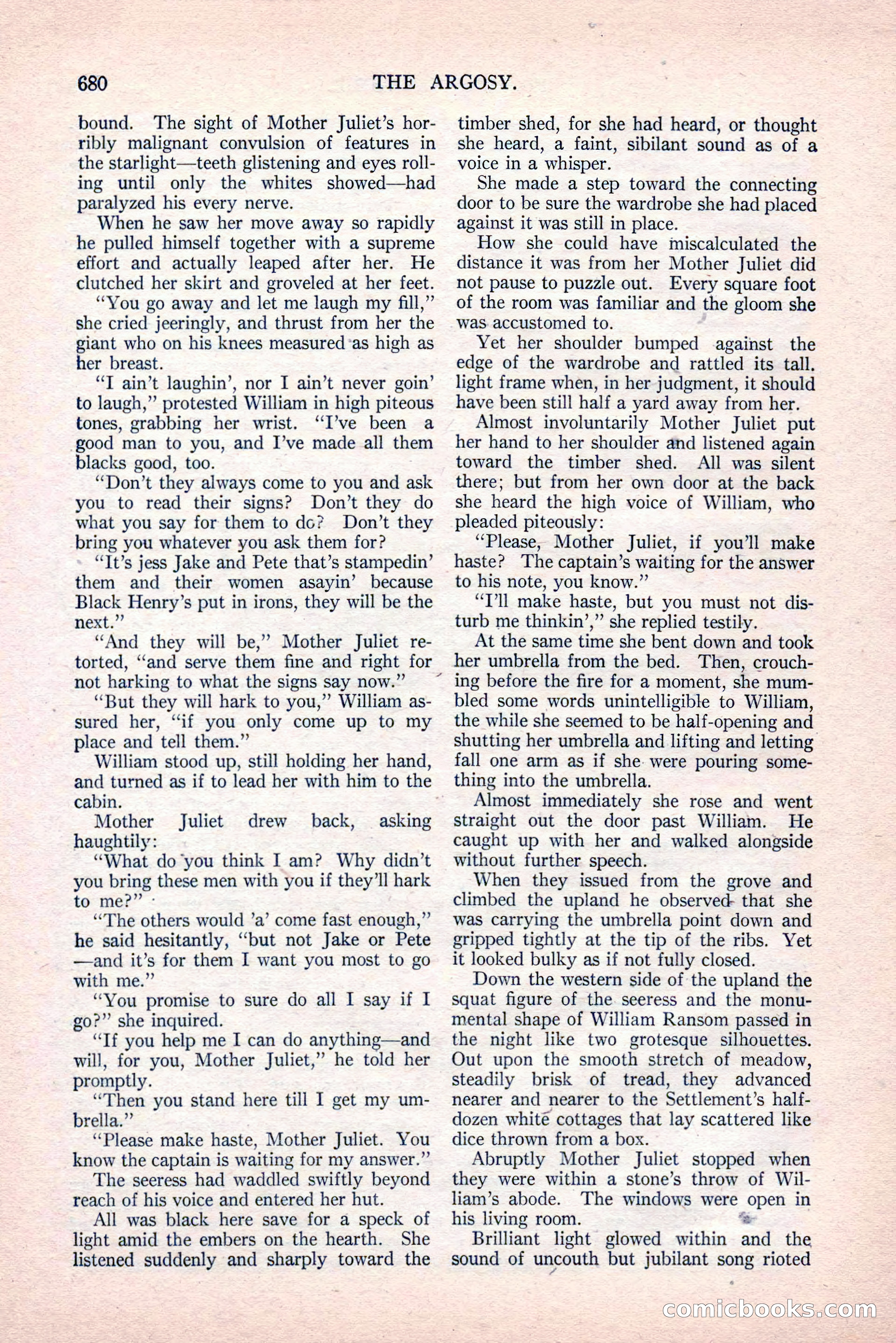
A restored page from Pulp Fiction, 1916. Page through the whole issue in the reader above.
📄 Transcribed text from this page (OCR, searchable)
Machine-transcribed from the original scan — historical spelling and the odd misread are preserved.
680 bound. The sight of Mother Juliet’s hor- ribly malignant convulsion of features in the starlight—teeth glistening and eyes roll- ing until only the whites showed—had paralyzed his every nerve. When he saw her move away so rapidly he pulled himself together with a supreme effort and actually leaped after her. He clutched her skirt and groveled at her feet. “Vou go away and let me laugh my fill,” she cried jeeringly, and thrust from her the giant who on his knees measured ‘as high as her breast. “T ain’t laughin’, nor I ain’t never goin’ to laugh,” protested William in high piteous tones, grabbing her wrist. “I’ve been a good man to you, and I’ve made all them blacks good, too. “Don’t they always come to you and ask you to read their signs? Don’t they do what you say for them to do? Don’t they bring you whatever you ask them for? “Tt’s jess Jake and Pete that’s stampedin’ them and their women asayin’ because Black Henry’s put in irons, they will be the next.” “And they will be,’ Mother Juliet re- torted, ‘“‘and serve them fine and right for not harking to what the signs say now.” “But they will hark to you,” William as- sured her, “if you only come up to my place and tell them.” William stood up, still holding her hand, and turned as if to lead her with him to the cabin. Mother haughtily: “What do you think I am? Why didn’t you bring these men with you if they’ll hark to me?” - ‘The others would ’a’ come fast enough,” he said hesitantly, “but not Jake or Pete —and it’s for them I want you most to go with me.” “You promise to sure do all I say if I go?” she inquired. “Tf you help me I can do anything—and will, for you, Mother Juliet,” he told her promptly. “Then you stand here till I get my um- brella.”’ ‘Please make haste, Mother Juliet. You know the captain is waiting for my answer.” The seeress had waddled swiftly beyond reach of his voice and entered her hut. All was black here save for a speck of light amid the embers on the hearth. She listened suddenly and sharply toward the Juliet drew’ back, asking THE ARGOSY. timber shed, for she had heard, or thought she heard, a faint, sibilant sound as of a voice in a whisper. She made a step toward the connecting door to be sure the wardrobe she had placed against it was still in place. How she could have miscalculated the distance it was from her Mother Juliet did not pause to puzzle out. Every square foot of the room was familiar and the gloom she was accustomed to. Yet her shoulder bumped against the edge of the wardrobe and rattled its tall. light frame when, in her judgment, it should have been still half a yard away from her. Almost involuntarily Mother Juliet put her hand to her shoulder and listened again toward the timber shed. All was silent there; but from her own door at the back she heard the high voice of William, who pleaded piteously: ‘Please, Mother Juliet, if you’ll make haste? The captain’s waiting for the answer to his note, you know.” “T’ll make haste, but you must not dis- turb me thinkin’,” she replied testily. At the same time she bent down and took her umbrella from the bed. Then, crouch- ~ ing before the fire for a moment, she mum- bled some words unintelligible to William, the while she seemed to be half-opening and shutting her umbrella and lifting and letting fall one arm as if she were pouring some- thing into the umbrella. Almost immediately she rose and went straight out the door past William. He caught up with her and walked alongside without further speech. When they issued from the grove and climbed the upland he observed- that she was carrying the umbrella point down and gripped tightly at the tip of the ribs. Yet it looked bulky as if not fully closed. Down the western side of the upland the squat figure of the seeress and the monu- mental shape of William Ransom passed in the night like two grotesque silhouettes. Out upon the smooth stretch of meadow, steadily brisk of tread, they advanced nearer and nearer to the Settlement’s half- dozen white cottages that lay scattered like dice thrown from a box. Abruptly Mother Juliet stopped when they were within a stone’s throw of Wil- liam’s abode. The windows were open in his living room. 2 Brilliant light glowed within and the sound of uncouth but jubilant song rioted COMMICOOOKS (©)