
Pulp Fiction, 1915 · page 78 of 246
The Argosy, September 1915 — page 78: what you’re looking at
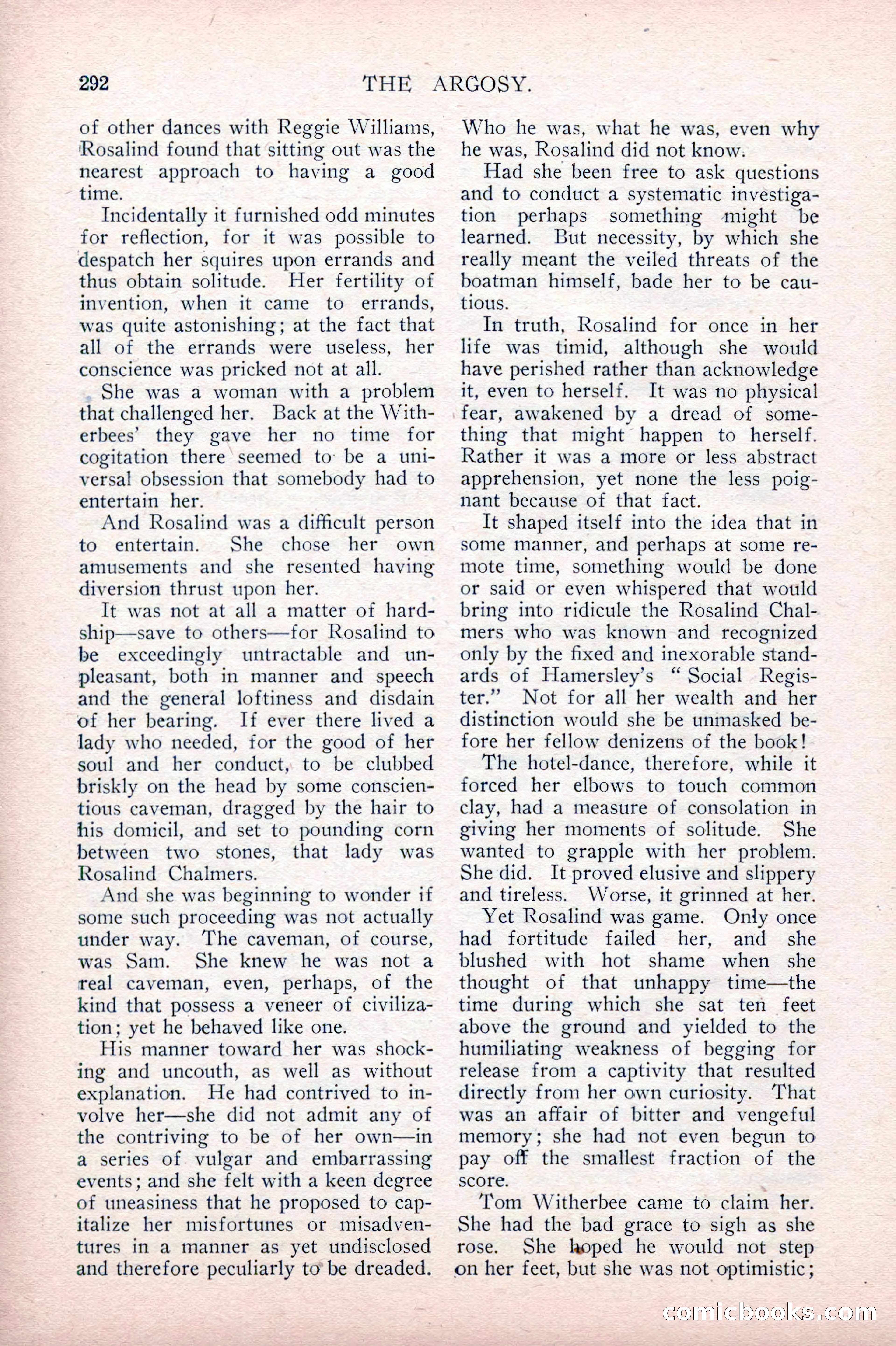
A restored page from Pulp Fiction, 1915. Page through the whole issue in the reader above.
📄 Transcribed text from this page (OCR, searchable)
Machine-transcribed from the original scan — historical spelling and the odd misread are preserved.
292 of other dances with Reggie Williams, ‘Rosalind found that sitting out was the nearest approach to having a good time. Incidentally it furnished odd minutes for reflection, for it was possible to despatch her squires upon errands and thus obtain solitude. Her fertility of invention, when it came to errands, was quite astonishing; at the fact that all of the errands were useless, her conscience was pricked not at all. She was a woman with a problem that challenged her. Back at the With- erbees’ they gave her no time for cogitation there seemed to: be a uni- versal obsession that somebody had to entertain her. And Rosalind was a difficult person to entertain. She chose her own amusements and she resented having diversion thrust upon her. It was not at all a matter of hard- ship—save to others—for Rosalind to be exceedingly untractable and un- pleasant, both in manner and speech and the general loftiness and disdain of her bearing. If ever there lived a lady who needed, for the good of her soul and her conduct, to be clubbed briskly on the head by some conscien- tious caveman, dragged by the hair to his domicil, and set to pounding corn between two stones, that lady was Rosalind Chalmers. And she was beginning to wonder if some such proceeding was not actually under way. The caveman, of course, was Sam. She knew he was not a real caveman, even, perhaps, of the kind that possess a veneer of civiliza- tion; yet he behaved like one. His manner toward her was shock- ing and uncouth, as well as without explanation. He had contrived to in- volve her—she did not admit any of the contriving to be of her own—in a series of vulgar and embarrassing events; and she felt with a keen degree of uneasiness that he proposed to cap- italize her misfortunes or misadven- tures in a manner as yet undisclosed and therefore peculiarly to’ be dreaded. THE ARGOSY. Who he was, what he was, even why he was, Rosalind did not know. Had she been free to ask questions and to conduct a systematic investiga- tion perhaps something might be learned. But necessity, by which she really meant the veiled threats of the boatman himself, bade her to be cau- tious. In truth, Rosalind for once in her life was timid, although she would have perished rather than acknowledge it, even to herself. It was no physical fear, awakened by a dread of some- thing that might happen to herself. Rather it was a more or less abstract apprehension, yet none the less poig- nant because of that fact. It shaped itself into the idea that in some manner, and perhaps at some re- mote time, something would be done or said or even whispered that would bring into ridicule the Rosalind Chal- mers who was known and recognized only by the fixed and inexorable stand- ards of Hamersley’s “ Social Regis- ter.”’ Not for all her wealth and her distinction would she be unmasked be- fore her fellow denizens of the book! The hotel-dance, therefore, while it forced her elbows to touch common clay, had a measure of consolation in giving her moments of solitude. She wanted to grapple with her problem. She did. It proved elusive and slippery and tireless. Worse, it grinned at her. Yet Rosalind was game. Only once had fortitude failed her, and she blushed with hot shame when she thought of that unhappy time—the time during which she sat ten feet above the ground and yielded to the humiliating weakness of begging for release from a captivity that resulted directly from her own curiosity. That was an affair of bitter and vengeful memory; she had not even begun to pay off the smallest fraction of the score. | Tom Witherbee came to claim her. She had the bad grace to sigh as she rose. She hoped he would not step on her feet, but she was not optimistic; EOPNICLOOOLKS (C@)