
Pulp Fiction, 1915 · page 77 of 246
The Argosy, September 1915 — page 77: what you’re looking at
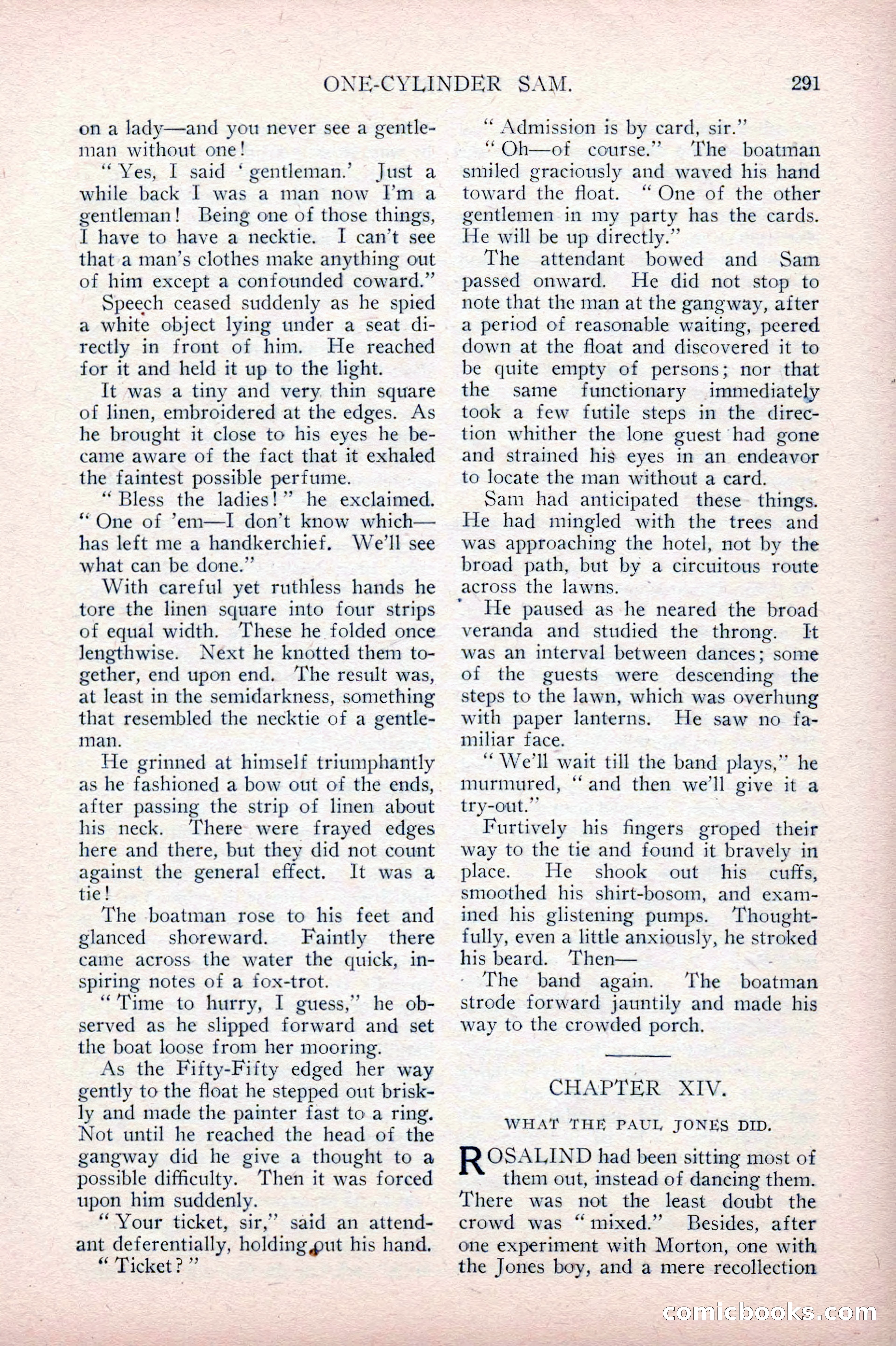
A restored page from Pulp Fiction, 1915. Page through the whole issue in the reader above.
📄 Transcribed text from this page (OCR, searchable)
Machine-transcribed from the original scan — historical spelling and the odd misread are preserved.
ONE-CYLINDER SAM. on a lady—and you never see a gentle- man without one! “Yes, I said ‘gentleman.’ Just a while back I was a man now I’m a gentleman! Being one of those things, I have to have a necktie. I can’t see that a man’s clothes make anything out of him except a confounded coward.” Speech ceased suddenly as he spied a white object lying under a seat di- rectly in front of him. He reached for it and held it up to the light. It was a tiny and very. thin square of linen, embroidered at the edges. As he brought it close to his eyes he be- came aware of the fact that it exhaled the faintest possible perfume. “Bless the ladies!” he exclaimed. * One of ’em—lI don’t know which— has left me a handkerchief. We'll see what can be done.” With careful yet ruthless hands he tore the linen square into four strips of equal width. These he folded once lengthwise. Next he knotted them to- gether, end upon end. ‘The result was, at least in the semidarkness, something that resembled the necktie of a gentle- man. He grinned at himself triumphantly as he fashioned a bow out of the ends, after passing the strip of linen about his neck. There were frayed edges here and there, but they did not count against the general effect. It was a tie! The boatman rose to his feet and glanced shoreward. Faintly there came across the water the quick, in- spiring notes of a fox-trot. “Time to hurry, I guess,’ he ob- served as he slipped forward and set the boat loose from her mooring. As the Fifty-Fifty edged her way gently to the float he stepped out brisk- ly and made the painter fast to a ring. Not until he reached the head of the gangway did he give a thought to a possible difficulty. Then it was forced upon him suddenly. * Your ticket, sir,’ said an attend- ant deferentially, holding put his hand. Ticket?” 291 ‘Admission is by card, sir.” “ Oh—of course.” ‘The boatman smiled graciously and waved his hand toward the float. “ One of the other gentlemen in my party has the cards. He will be up directly.” The attendant bowed and Sam passed onward. He did not stop to note that the man at the gangway, aiter a period of reasonable waiting, peered down at the float and discovered it to be quite empty of persons; nor that the same functionary immediately took a few futile steps in the direc- tion whither the lone guest had gone and strained his eyes in an endeavor to locate the man without a card. Sam had anticipated these things. He had mingled with the trees and was approaching the hotel, not by the broad path, but by a circuitous route across the lawns. He paused as he neared the broad veranda and studied the throng. It was an interval between dances; some of the guests were descending the steps to the lawn, which was overhung with paper lanterns. He saw no fa- miliar face. ‘We'll wait till the band plays,”’ he murmured, “and then we'll give it a try-out.”’ : Furtively his fingers groped their way to the tie and found it bravely in place. He shook out his cuffs, smoothed his shirt-bosom, and exam- ined his glistening pumps. ‘Thought- fully, even a little anxiously, he stroked his beard. Then— The band again. ‘The boatman strode forward jauntily and made his way to the crowded porch. CHAPTER XIV. WHAT THE PAUL JONES DID. ROSALIN D had been sitting most of them out, instead of dancing them. There was not the least doubt the crowd was “ mixed.’ Besides, after one experiment with Morton, one with the Jones boy, and a mere recollection COPMICLOOOKS (E@)