
Pulp Fiction, 1915 · page 215 of 246
The Argosy, September 1915 — page 215: what you’re looking at
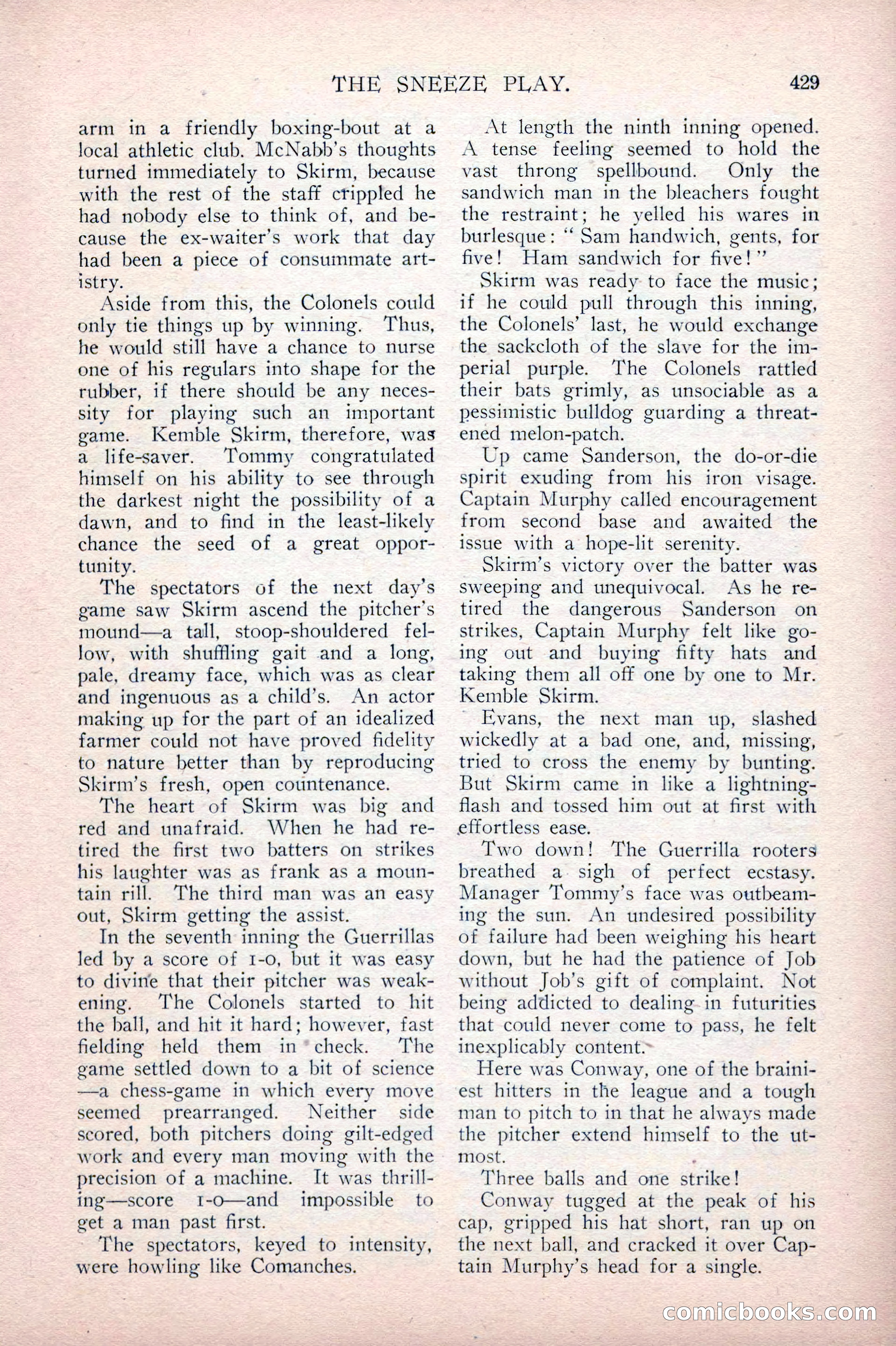
A restored page from Pulp Fiction, 1915. Page through the whole issue in the reader above.
📄 Transcribed text from this page (OCR, searchable)
Machine-transcribed from the original scan — historical spelling and the odd misread are preserved.
THE SNEEZE PLAY. arm in a friendly boxing-bout at a local athletic club. McNabb’s thoughts turned immediately to Skirm, because with the rest of the staff crippled he had nobody else to think of, and be- cause the ex-waiter’s work that day had been a piece of consummate art- istry. Aside from this, the Colonels could only tie things up by winning. Thus, he would still have a chance to nurse one of his regulars into shape for the rubber, if there should be any neces- sity for playing such an important game. Kemble Skirm, therefore, was a life-saver. Tommy congratulated himself on his ability to see through the darkest night the possibility of a dawn, and to find in the least-likely chance the seed of a great oppor- tunity. The spectators of the next day’s game saw Skirm ascend the pitcher's mound—a tall, stoop-shouldered fel- low, with shuffling gait and a long, pale, dreamy face, which was as clear and ingenuous as a child’s. An actor making up for the part of an idealized farmer could not have proved fidelity to nature better than by reproducing Skirm’s fresh, open countenance. The heart of Skirm was big and red and unafraid. When he had re- tired the first two batters on strikes his laughter was as frank as a moun- tain rill. The third man was an easy out, Skirm getting the assist. In the seventh inning the Guerrillas led by a score of 1-0, but it was easy to divine that their pitcher was weak- ening. The Colonels started to hit the ball, and hit it hard; however, fast fielding held them in*check. The game settled down to a bit of science a chess-game in which every move seemed prearranged. Neither — side scored, both pitchers doing gilt-edged work and every man moving with the precision of a machine. It was thrill- ing—score 1-O—and impossible to get a man past first. The spectators, keyed to intensity, were howling like Comanches. 429 At length the ninth inning opened. A tense feeling seemed to hold the vast throng spellbound. Only the sandwich man in the bleachers fought the restraint; he yelled his wares in burlesque: “Sam handwich, gents, for five! Ham sandwich for five!” Skirm was ready to face the music; if he could pull through this inning, the Colonels’ last, he would exchange the sackcloth of the slave for the im- perial purple. The Colonels rattled their bats grimly, as unsociable as a pessimistic bulldog guarding a threat- ened melon-patch. Up came Sanderson, the do-or-die spirit exuding from his iron visage. Captain Murphy called encouragement from second base and awaited the issue with a hope-lit serenity. Skirm’s victory over the batter was sweeping and unequivocal. As he re- tired the dangerous Sanderson on strikes, Captain Murphy felt like go- ing out and buying fifty hats and taking them all off one by one to Mr. Kemble Skirm. ' Evans, the next man up, slashed wickedly at a bad one, and, missing, tried to cross the enemy by bunting. But Skirm came in like a lightning- flash and tossed him out at first with effortless ease. Two down! The Guerrilla rooters breathed a. sigh of perfect ecstasy. Manager Tommy’s face was outbeam- ing the sun. An undesired possibility of tailure had been weighing his heart down, but he had the patience of Job without Job’s gift of complaint. Not being addicted to dealing. in futurities that could never come to pass, he felt inexplicably content> Here was Conway, one of the braini- est hitters in the league and a tough man to pitch to in that he always made the pitcher extend himself to the ut- most. : Three balls and one strike! Conway tugged at the peak of his cap, gripped his hat short, ran up on the next ball, and cracked it over Cap- tain Murphy’s head for a single. EOPMICLOOOKS (E@)