
Pulp Fiction, 1915 · page 214 of 246
The Argosy, September 1915 — page 214: what you’re looking at
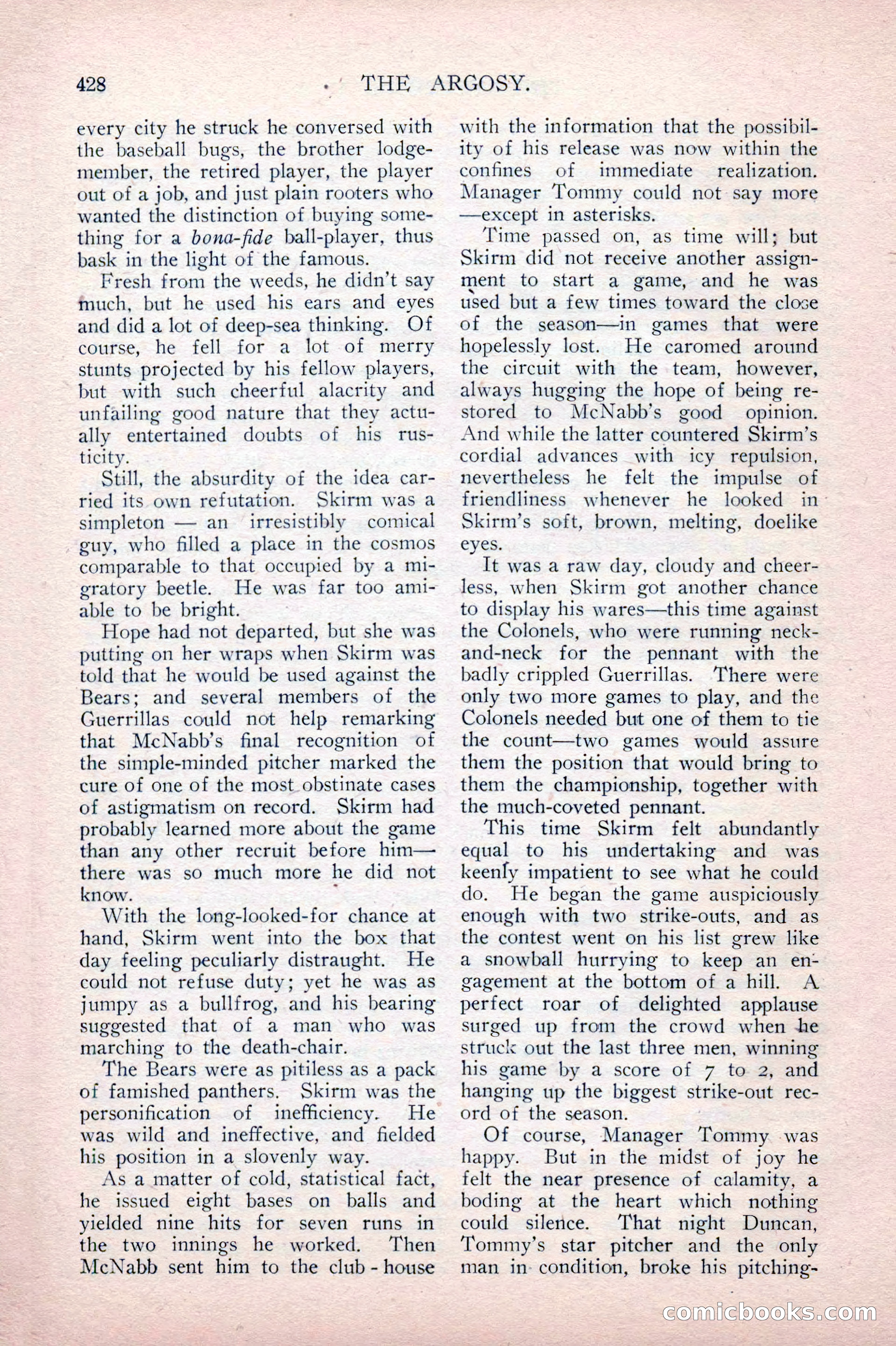
A restored page from Pulp Fiction, 1915. Page through the whole issue in the reader above.
📄 Transcribed text from this page (OCR, searchable)
Machine-transcribed from the original scan — historical spelling and the odd misread are preserved.
428 THE every city he struck he conversed with the baseball bugs, the brother lodge- member, the retired player, the player out of a job, and just plain rooters who wanted the distinction of buying some- thing for a bona-fide ball-player, thus bask in the light of the famous. Fresh from the weeds, he didn’t say much, but he used his ears and eyes and did a lot of deep-sea thinking. Of course, he fell for a lot of merry stunts projected by his fellow players, but with such cheerful alacrity and unfailing good nature that they actu- ally entertained doubts of his rus- ticity. Still, the absurdity of the idea car- ried its own refutation. Skirm was a simpleton — an irresistibly comical guy, who filled a place in the cosmos comparable to that occupied by a mi- gratory beetle. He was far too ami- able to be bright. Hope had not departed, but she was putting on her wraps when Skirm was told that he would be used against the Bears; and several members of the Guerrillas could not help remarking that McNabb’s final recognition of the simple-minded pitcher marked the cure of one of the most obstinate cases of astigmatism on record. Skirm had probably learned more about the game than any other recruit before him— there was so much more he did not know. 2 With the long-looked-for chance at hand, Skirm went into the box that day feeling peculiarly distraught. He could not refuse duty; yet he was as jumpy as a bullfrog, and his bearing suggested that of a man who was marching to the death-chair. The Bears were as pitiless as a pack of famished panthers, Skirm was the personification of inefficiency. He was wild and ineffective, and fielded his position in a slovenly way. As a matter of cold, statistical fact, he issued eight bases on balls and yielded nine hits for seven runs in the two innings he worked. Then McNabb sent him to the club - house ARGOSY. with the information that the possibil- ity of his release was now within the confines of immediate realization. Manager Tommy could not say more —except in asterisks. Time passed on, as time will; but Skirm did not receive another assign- ment to start a game, and he was used but a few times toward the close of the season—in games that were hopelessly lost. He caromed around the circuit with the team, however, always hugging the hope of being re- stored to McNabb’s good opinion. And while the latter countered Skirm’s cordial advances with icy repulsion, nevertheless he felt the impulse of friendliness whenever he looked Skirm’s soft, brown, melting, doelike eyes. It was a raw day, cloudy and cheer- less, when Skirm got another chance to display his wares—this time against the Colonels, who were running neck- and-neck for the pennant with the badly crippled Guerrillas. There were only two more games to play, and the Colonels needed but one of them to tie the count—two games would assure them the position that would bring to them the championship, together with the much-coveted pennant. This time Skirm felt abundantly equal to his undertaking and was keenly impatient to see what he could do. He began the game auspiciously enough with two strike-outs, and as the contest went on his list grew like a snowball hurrying to keep an en- gagement at the bottom of a hill. A perfect roar of delighted applause surged up from the crowd when she struck out the last three men, winning his game by a score of 7 to 2, and hanging up the biggest strike-out rec- ord of the season. Of course, Manager Tommy was happy. But in the midst of joy he felt the near presence of calamity, a boding at the heart which nothing could silence. That night Duncan, Tommy’s star pitcher and the only man in- condition, broke his pitching- EOPMICLOOO KS in (C@)