
Pulp Fiction, 1915 · page 205 of 246
The Argosy, September 1915 — page 205: what you’re looking at
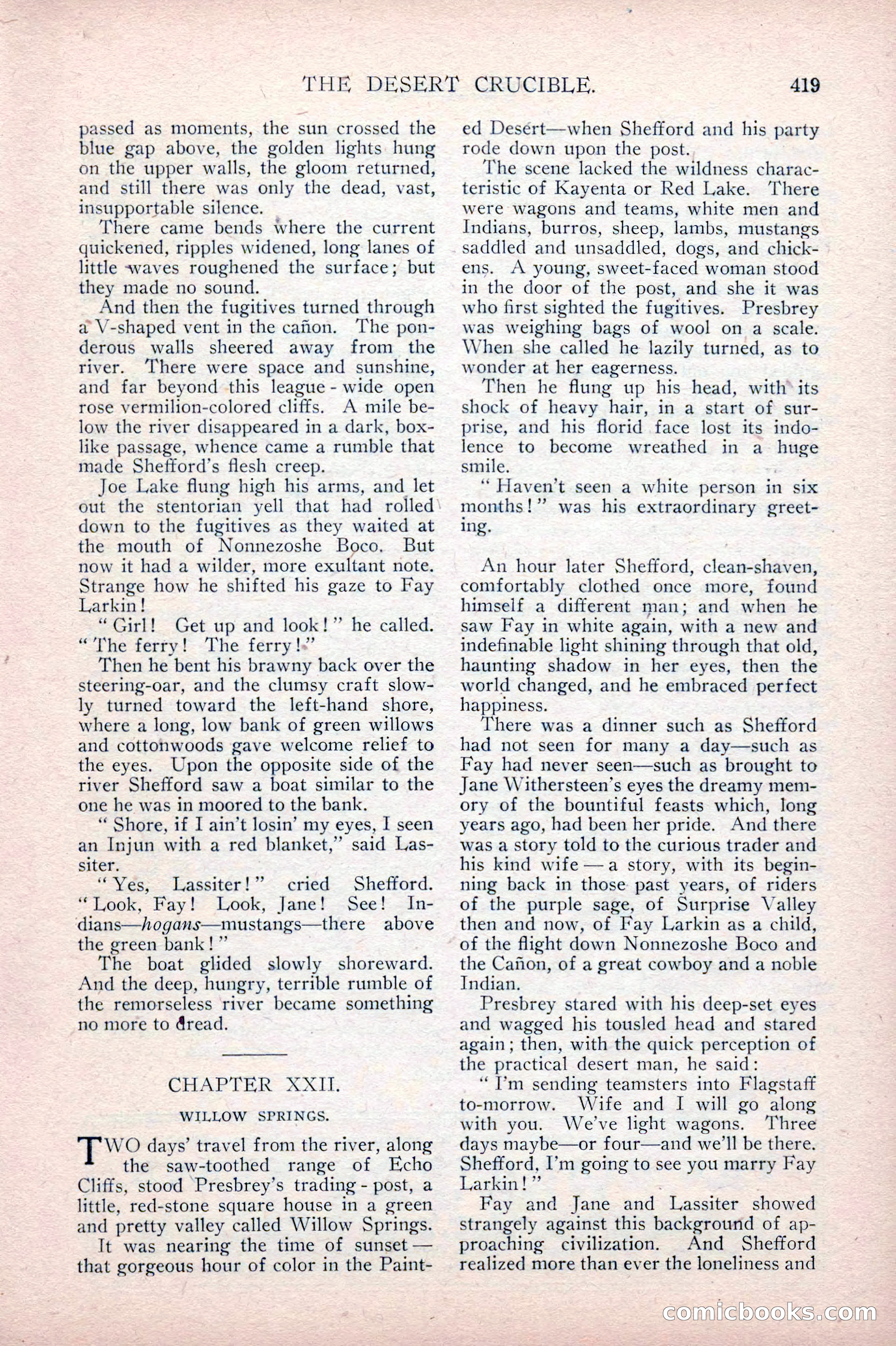
A restored page from Pulp Fiction, 1915. Page through the whole issue in the reader above.
📄 Transcribed text from this page (OCR, searchable)
Machine-transcribed from the original scan — historical spelling and the odd misread are preserved.
THE DESERT CRUCIBLE. passed as moments, the sun crossed the blue gap above, the golden lights hung on the upper walls, the gloom returned, and still there was only the dead, vast, insupportable silence. There came bends where the current quickened, ripples widened, long lanes of little waves roughened the surface; but they made no sound. And then the fugitives turned through a V-shaped vent in the cafion. The pon- derous walls sheered away from the river. ‘There were space and sunshine, and far beyond this league - wide open rose vermilion-colored cliffs. A mile be- low the river disappeared in a dark, box- like passage, whence came a rumble that made Shefford’s flesh creep. Joe Lake flung high his arms, and let out the stentorian yell that had rolled‘ down to the fugitives as they waited at the mouth of Nonnezoshe Boco, But now it had a wilder, more exultant note. Strange how he shifted his gaze to Fay Larkin! “ Girl! Get up and look!” he called. “The ferry! The ferry!’ Then he bent his brawny back over the steering-oar, and the clumsy craft slow- ly turned toward the left-hand shore, where a long, low bank of green willows and cottonwoods gave welcome relief to the eyes. Upon the opposite side of the river Shefford saw a boat similar to the one he was in moored to the bank. ‘‘ Shore, if I ain’t losin’ my eyes, I seen an Injun with a red blanket,” said Las- siter. ‘Yes, Lassiter!” cried Shefford. ‘Look, Fay! Look, Jane! -See! -In- dians—hogans—mustangs—there above the green bank!” The boat glided slowly shoreward. And the deep, hungry, terrible rumble of the remorseless river became something no more to dread. CHAPTER XXII. WILLOW SPRINGS. ‘Two days’ travel from the river, along the saw-toothed range of Echo Cliffs, stood Presbrey’s trading - post, a little, red-stone square house in a green and pretty valley called Willow Springs. It was nearing the time of sunset — that gorgeous hour of color in the Paint- 419 ed Desért—when Shefford and his party rode down upon the post. The scene lacked the wildness charac- teristic of Kayenta or Red Lake. ‘There were wagons and teams, white men and Indians, burros, sheep, lambs, mustangs saddled and unsaddled, dogs, and chick- ens. A young, sweet-faced woman stood in the door of the post, and she it was who first sighted the fugitives. Presbrey was weighing bags of wool on a scale. When she called he lazily turned, as to wonder at her eagerness. Then he flung up his head, with’ its shock of heavy hair, in a start of sur- prise, and his florid face lost its indo- lence to become wreathed in a huge smile. ‘Haven't seen a white person in six months!’’ was his extraordinary greet- ing. An hour later Shefford, clean-shaven, comfortably clothed once more, found himself a different man; and when he saw Fay in white again, with a new and indefinable light shining through that old, haunting shadow in her eyes, then the world changed, and he embraced perfect happiness. There was a dinner such as Sheftord had not seen for many a day—such as Fay had never seen—such as brought to Jane Withersteen’s eyes the dreamy mem- ory of the bountiful feasts which, long years ago, had been her pride. And there was a story told to the curious trader and his kind wife —a story, with its begin- ning back in those past years, of riders of the purple sage, of Surprise Valley then and now, of Fay Larkin as a child, of the flight down Nonnezoshe Boco and the Cafion, of a great cowboy and a noble Indian. Presbrey stared with his deep-set eyes and wagged his tousled head and stared again; then, with the quick perception of the practical desert man, he said: ‘I’m sending teamsters into Flagstaff to-morrow. Wife and I will go along with you. We've light wagons. Three days maybe—or four—and we'll be there. Shefford, I’m going to see you marry Fay Larkin!” Fay and Jane and Lassiter showed strangely against this background of ap- proaching civilization. And Shefford realized more than ever the loneliness and conniclooolks (C©)