
Pulp Fiction, 1915 · page 204 of 246
The Argosy, September 1915 — page 204: what you’re looking at
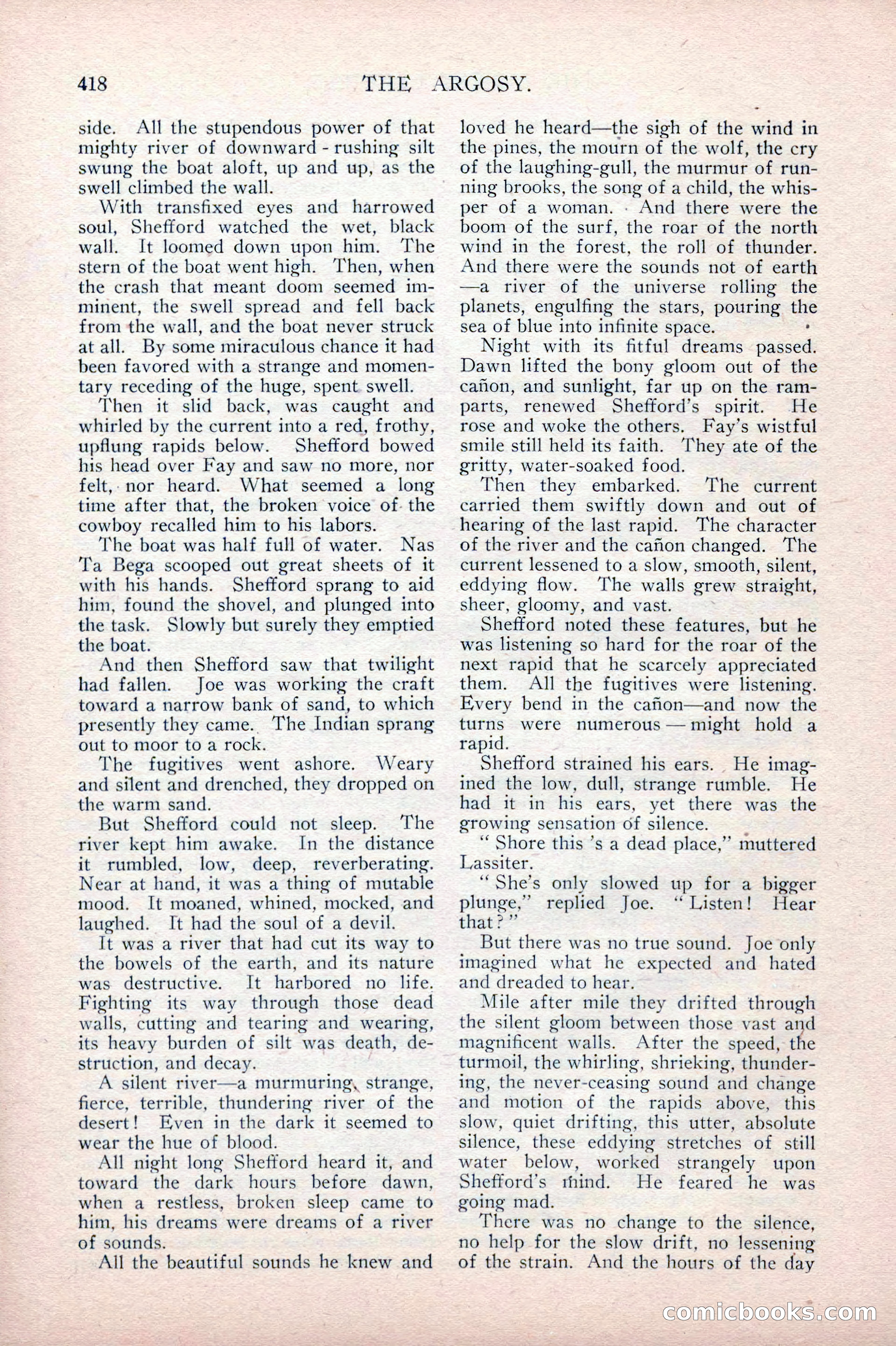
A restored page from Pulp Fiction, 1915. Page through the whole issue in the reader above.
📄 Transcribed text from this page (OCR, searchable)
Machine-transcribed from the original scan — historical spelling and the odd misread are preserved.
418 side. All the stupendous power of that mighty river of downward - rushing silt swung the boat aloft, up and up, as the swell climbed the wall. With transfixed eyes and harrowed soul, Shefford watched the wet, black wall. It loomed down upon him. The stern of the boat went high. Then, when the crash that meant doom seemed im- minent, the swell spread and fell back from the wall, and the boat never struck at all. By some miraculous chance it had been favored with a strange and momen- tary receding of the huge, spent swell. Then it slid back, was caught and whirled by the current into a red, frothy, upflung rapids below. Shefford bowed his head over Fay and saw no more, nor felt, nor heard. What seemed a long time after that, the broken voice of- the cowboy recalled him to his labors. The boat was half full of water. Nas Ta Bega scooped out great sheets of it with his hands. Shefford sprang to aid him, found the shovel, and plunged into the task. Slowly but surely they emptied the boat. And then Shefford saw that twilight had fallen. Joe was working the craft toward a narrow bank of sand, to which presently they came. The Indian sprang out to moor to a rock. The fugitives went ashore. Weary and silent and drenched, they dropped on the warm sand. But Shefford could not sleep. The river kept him awake. In the distance it rumbled, low, deep, reverberating. Near at hand, it was a thing of mutable mood. It moaned, whined, mocked, and laughed. It had the soul of a devil. It was a river that had cut its way to the bowels of the earth, and its nature was destructive. It harbored no life. Fighting its way through those dead walls, cutting and tearing and wearing, its heavy burden of silt was death, de- struction, and decay. A silent river—a murmuring, strange, fierce, terrible, thundering river of the desert! Even in the dark it seemed to wear the hue of blood. All night long Shefford heard it, and toward the dark hours before dawn, when a restless, broken sleep came to him, his dreams were dreams of a river of sounds. All the beautiful sounds he knew and THE ARGOSY. loved he heard—the sigh of the wind in the pines, the mourn of the wolf, the cry of the laughing-gull, the murmur of run- ning brooks, the song of a child, the whis- per of a woman. . And there were the boom of the surf, the roar of the north wind in the forest, the roll of thunder. And there were the sounds not of earth —a river of the universe rolling the planets, engulfing the stars, pouring = sea of blue into infinite space. Night with its fitful dreams sagsed: Dawn lifted the bony gloom out of the cafion, and sunlight, far up on the ram- parts, renewed Shefford’s spirit. He rose and woke the others. Fay’s wistful smile still held its faith. They ate of the gritty, water-soaked food. Then they embarked. ‘The current carried them swiftly down and out of hearing of the last rapid. The character of the river and the cafion changed. The current lessened to a slow, smooth, silent, eddying flow. The walls grew straight, sheer, gloomy, and vast. Shefford noted these features, but he was listening so hard for the roar of the next rapid that he scarcely appreciated them. All the fugitives were listening. Every bend in the cafion—and now the turns were numerous — might hold a rapid. Shefford strained his ears. He imag- ined the low, dull, strange rumble. He had it in his ears, yet there was the growing sensation of silence. ‘ Shore this ’s a dead place,’ Lassiter. ‘““She’s only slowed up for a bigger plunge,” replied Joe. ‘“ Listen! Hear that?” But there was no true sound. Joe only imagined what he expected and hated and ‘dreaded to hear. Mile after mile they drifted through the silent gloom between those vast and magnificent walls. After the speed, the turmoil, the whirling, shrieking, thunder- ing, the never-ceasing sound and change and motion of the rapids above, this slow, quiet drifting, this utter, absolute silence, these eddying stretches of still water below, worked strangely upon Shefford’s thind. He feared he was going mad. There was no change to the silence, no help for the slow drift, no lessening of the strain. And the hours of the day ’ muttered Eomichbooks (©)