
Pulp Fiction, 1914 · page 17 of 258
The Argosy, August 1914 — page 17: what you’re looking at
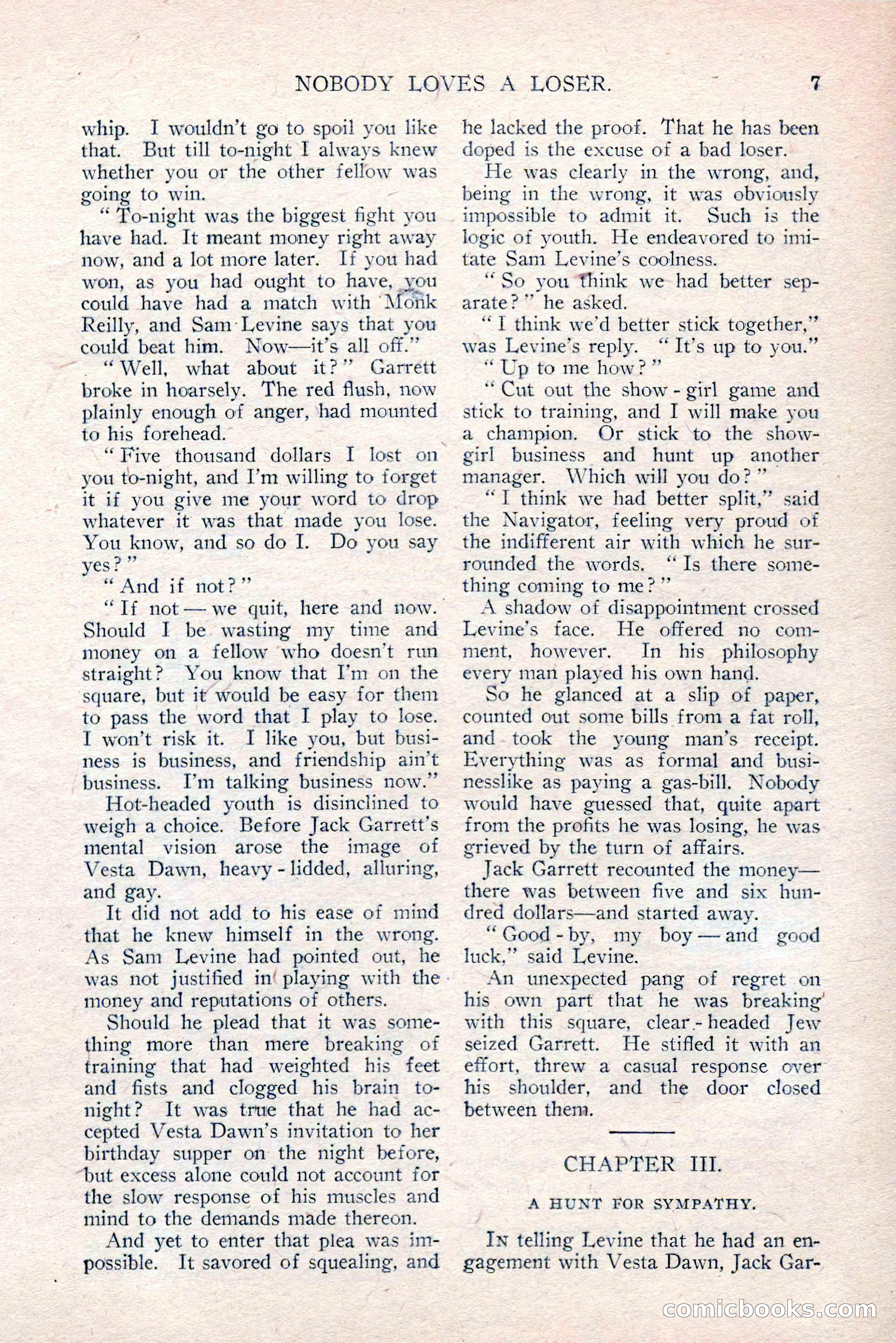
A restored page from Pulp Fiction, 1914. Page through the whole issue in the reader above.
📄 Transcribed text from this page (OCR, searchable)
Machine-transcribed from the original scan — historical spelling and the odd misread are preserved.
NOBODY LOVES A LOSER. 7 whip. I wouldn’t go to spoil you like that. But till to-night | always knew whether you or the other fellow was going to win. “To-night was the biggest fight you have had. It meant money right away now, and a lot more later. If you had won, as you had ought to have, you could have had a match with ‘Monk Reilly, and Sam’ Levine says that you could beat him. Now—it’s all off.” “Well, what about it?” Garrett broke in hoarsely. The red flush, now plainly enough of anger, had mounted to his forehead. “Five thousand dollars I lost on you to-night, and I’m willing to forget it if you give me your word to drop whatever it was that made you lose. You know, and so do I. Do you say yes?” “And if not?” “Tf not—we quit, here and now. Should I be wasting my time and money on a fellow who doesn’t run straight? You know that I’m on the square, but it would be easy for them to pass the word that I play to lose. I won’t risk it. I like you, but busi- ness is business, and friendship ain't business. I’m talking business now.” Hot-headed youth is disinclined to weigh a choice. Before Jack Garrett's mental vision arose the image of Vesta Dawn, heavy - lidded, alluring, and gay. It did not add to his ease of mind that he knew himself in the wrong. As Sam Levine had pointed out, he was not justified in‘ playing with the. money and reputations of others. Should he plead that it was some- thing more than mere breaking of training that had weighted his feet and fists and clogged his brain to- night? It was true that he had ac- cepted Vesta Dawn’s invitation to her birthday supper on the night before, ‘but excess alone could not account for the slow response of his muscles and mind to the demands made thereon. And yet to enter that plea was im- possible. It savored of squealing, and he lacked the proof. That he has been doped is the excuse of a bad loser. He was clearly in the wrong, and, being in the wrong, it was obviously impossible to admit it. Such is the logic of youth. He endeavored to imi- tate Sam Levine’s coolness. ‘So you think we had better sep- arate?” he asked. ‘| think we'd better stick together,” was Levine's reply. “It’s up to you.” “Up to me how?” “Cut out the show - girl game and stick to training, and I will make you a champion. Or stick to the show- girl business and hunt up another manager. Which will you do? ” “TI think we had better split,” said the Navigator, feeling very proud of the indifferent air with which he sur- rounded the words. “Is there some- thing coming to me?” A shadow of disappointment crossed Levine's face. He offered no com- ment, however. In his philosophy every man played his own hand. So he glanced at a slip of paper, counted out some bills from a fat roll, and. took the young man’s receipt. Everything was as formal and busi- nesslike as paying a gas-bill. Nobody would have guessed that, quite apart from the profits he was losing, he was grieved by the turn of affairs. there was between five and six hun- dred dollars—and started away. “Good-by, my boy—and good luck,’ said Levine. An unexpected pang of regret on his own part that he was breaking’ with this square, clear - headed Jew seized Garrett. He stifled it with an effort, threw a casual response over his shoulder, and the door closed between them. CHAPTER IIt. A HUNT FOR SYMPATHY. In telling Levine that he had an en- gagement with Vesta Dawn, Jack Gar- Go TOO mie S (C@