
Pulp Fiction, 1914 · page 16 of 258
The Argosy, August 1914 — page 16: what you’re looking at
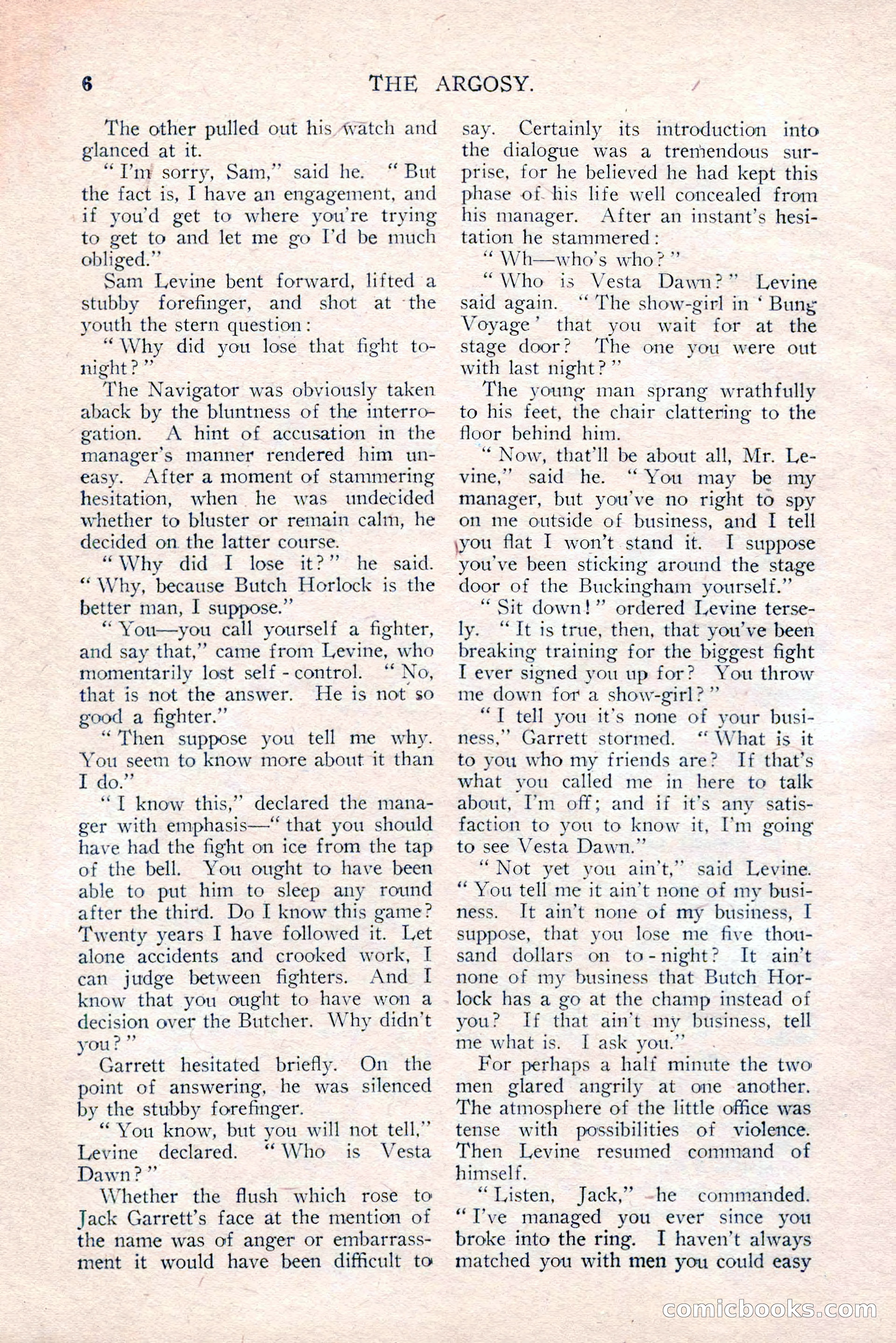
A restored page from Pulp Fiction, 1914. Page through the whole issue in the reader above.
📄 Transcribed text from this page (OCR, searchable)
Machine-transcribed from the original scan — historical spelling and the odd misread are preserved.
6 THE ARGOSY. The other pulled out his 4vatch and glanced at it. “T’m sorry, Sam,’ said he. “ But the fact is, | have an engagement, and if you'd get to where you're trying to get to and let me go I’d be much obliged.” Sam Levine bent forward, lifted a stubby forefinger, and shot at ‘the youth the stern question: “Why did you lose that fight to- night?” 3 The Navigator was obviously taken aback by the bluntness of the interro- gation. A hint of accusation in the manager's manner rendered him un- easy. After a moment of stammering hesitation, when he was _ undecided whether to bluster or remain calm, he decided on the latter course. “Why did I lose it?” he said. “Why, because Butch Horlock is the better man, I suppose.” “You—you call yourself a fighter, and say that,’ came from Levine, who momentarily lost self-control. “ No, that is not the answer. He 1s not so good a fighter.”’ “Then suppose you tell me why. You seem to know more about it than I do.” “T know this,” declared the mana- ger with emphasis—* that you should have had the fight on ice from the tap of the bell. You ought to have been able to put him to sleep any round after the third. Do I know this game? Twenty years I have followed it. Let alone accidents and crooked work, I can judge between fighters. And I know that you ought to have won a decision over the Butcher. Why didn’t your” Garrett hesitated briefly. On _ the point of answering, he was silenced by the stubby forefinger. “You know, but you will not tell,” Levine declared. “Who is Vesta Dawn?” Whether the flush which rose to Jack Garrett’s face at the mention of the name was of anger or embarrass- ment it would have been difficult to say. Certainly its introduction into the dialogue was a tremendous sur- prise, for he believed he had kept this phase of his life well concealed from his manager. After an instant’s hesi- tation he stammered : “ Wh—who's who?” “Who is Vesta Dawn?” Levine said again. “ The show-girl in ‘ Bung Voyage’ that you wait for at the stage door? The one you were out with last night?” The young man sprang wrathfully to his feet, the chair clattering to the floor behind him. “ Now, that'll be about all, Mr. Le- vine,” said he. ‘You may be my manager, but you've no right to spy on me outside of business, and I tell you flat I won’t stand it. I suppose you've been sticking around the stage door of the Buckingham yourself.” “ Sit down!” ordered Levine terse- ly. “It is true, then, that you’ve been breaking training for the biggest fight [ ever signed you up for? You throw me down for a show-girl?”’ “T tell you it’s none of your busi- ness,’ Garrett stormed. ‘ What is it to you who my friends are? If that’s what you called me in here to talk about, ['m off; and if it’s any satis- faction to you to know it, I’m going to see Vesta Dawn.” “Not yet you ain't,” said Levine. “ You tell me it ain’t none of my busi- ness. It ain’t none of my business, I suppose, that you lose me five thou- sand dollars on to-night? It ain't none of my business that Butch Hor- lock has a go at the champ instead of you? If that ain't my business, tell me what is. I ask you.” For perhaps a half minute the two men glared angrily at one another. The atmosphere of the little office was tense with possibilities of violence. Then Levine resumed command of himself. “Tisten, Jack,” -he commanded. “T’ve managed you ever since you broke into the ring. I haven’t always matched you with men you could easy CORMICLOOOKS (C@