
Pulp Fiction, 1914 · page 135 of 258
The Argosy, August 1914 — page 135: what you’re looking at
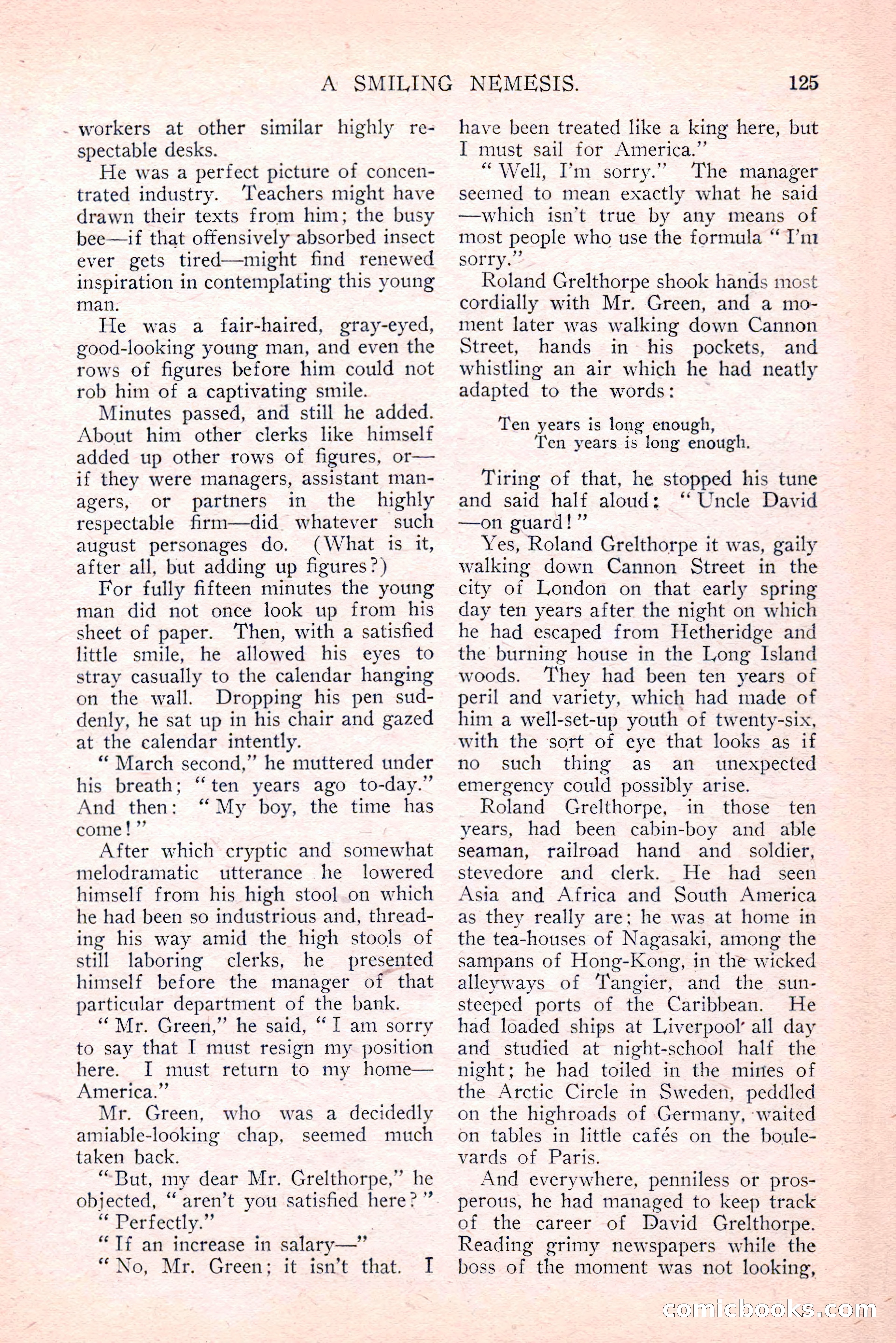
A restored page from Pulp Fiction, 1914. Page through the whole issue in the reader above.
📄 Transcribed text from this page (OCR, searchable)
Machine-transcribed from the original scan — historical spelling and the odd misread are preserved.
A SMILING NEMESIS. - workers at other similar highly re- spectable desks. He was a perfect picture of concen- trated industry. Teachers might have drawn their texts from him; the busy bee—if that offensively absorbed insect ever gets tired—might find renewed inspiration in contemplating this young man. He was a fair-haired, gray-eyed, good-looking young man, and even the rows of figures before him could not rob him of a captivating smile. Minutes passed, and still he added. About him other clerks like himself added up other rows of figures, or— if they were managers, assistant man- agers, or partners in the highly respectable firm—did whatever such august personages do. (What is it, after all, but adding up figures?) For fully fifteen minutes the young man did not once look up from his sheet of paper. Then, with a satisfied little smile, he allowed his eyes to stray casually to the calendar hanging on the wall. Dropping his pen sud- denly, he sat up in his chair and gazed at the calendar intently. ** March second,” he muttered under his breath; ‘‘ten years ago to-day.” And then: “My boy, the time has come! ”’ After which cryptic and somewhat melodramatic utterance he lowered himself from his high stool on which he had been so industrious and, thread- ing his way amid the high stools of still laboring clerks, he presented himself before the manager of that particular department of the bank. “Mr. Green,” he said, “I am sorry to say that I must resign my position here. I must return to my home— America.” Mr. Green, who was a decidedly amiable-looking chap, seemed much taken back. “But, my dear Mr. Grelthorpe,” he objected, “ aren’t you satisfied here?” *“Perfectly.”’ , “Tf an increase in salary—” “No, Mr. Green; it isn’t that. I 125 have been treated like a king here, but I must sail for America.”’ “Well, I’m sorry.” The manager seemed to mean exactly what he said —which isn’t true by any means of most people who use the formula “I’m sorry.” Roland Grelthorpe shook hands most cordially with Mr. Green, and a mo- ment later was walking down Cannon Street, hands in his pockets, and whistling an air which he had neatly adapted to the words: Ten years is long enough, Ten years is long enough. Tiring of that, he stopped his tune and said half aloud: ‘‘ Uncle David —on guard!” Yes, Roland Grelthorpe it was, gaily walking down Cannon Street in the city of London on that early spring day ten years after the night on which he had escaped from Hetheridge and the burning house in the Long Island woods. ‘They had been ten years of peril and variety, which had made of him a well-set-up youth of twenty-six, with the sort of eye that looks as if no stuch thing as an wnexpected emergency could possibly arise. Roland Grelthorpe, in those ten years, had been cabin-boy and able seaman, railroad hand and _ soldier, stevedore and clerk. He had seen Asia and Africa and South America as they really are; he was at home in the tea-houses of Nagasaki, among the sampans of Hong-Kong, in the wicked alleyways of Tangier, and the sun- steeped ports of the Caribbean. He had loaded ships at Liverpool’ all day and studied at night-school half the night; he had toiled in the mines of the Arctic Circle in Sweden, peddled on the highroads of Germany, ‘waited on tables in little cafés on the boule- vards of Paris. And everywhere, penniless or pros- perous, he had managed to keep track of the career of David Grelthorpe. Reading grimy newspapers while the boss of the moment was not looking, GomiGcbdooks COl