
Pulp Fiction, 1914 · page 134 of 258
The Argosy, August 1914 — page 134: what you’re looking at
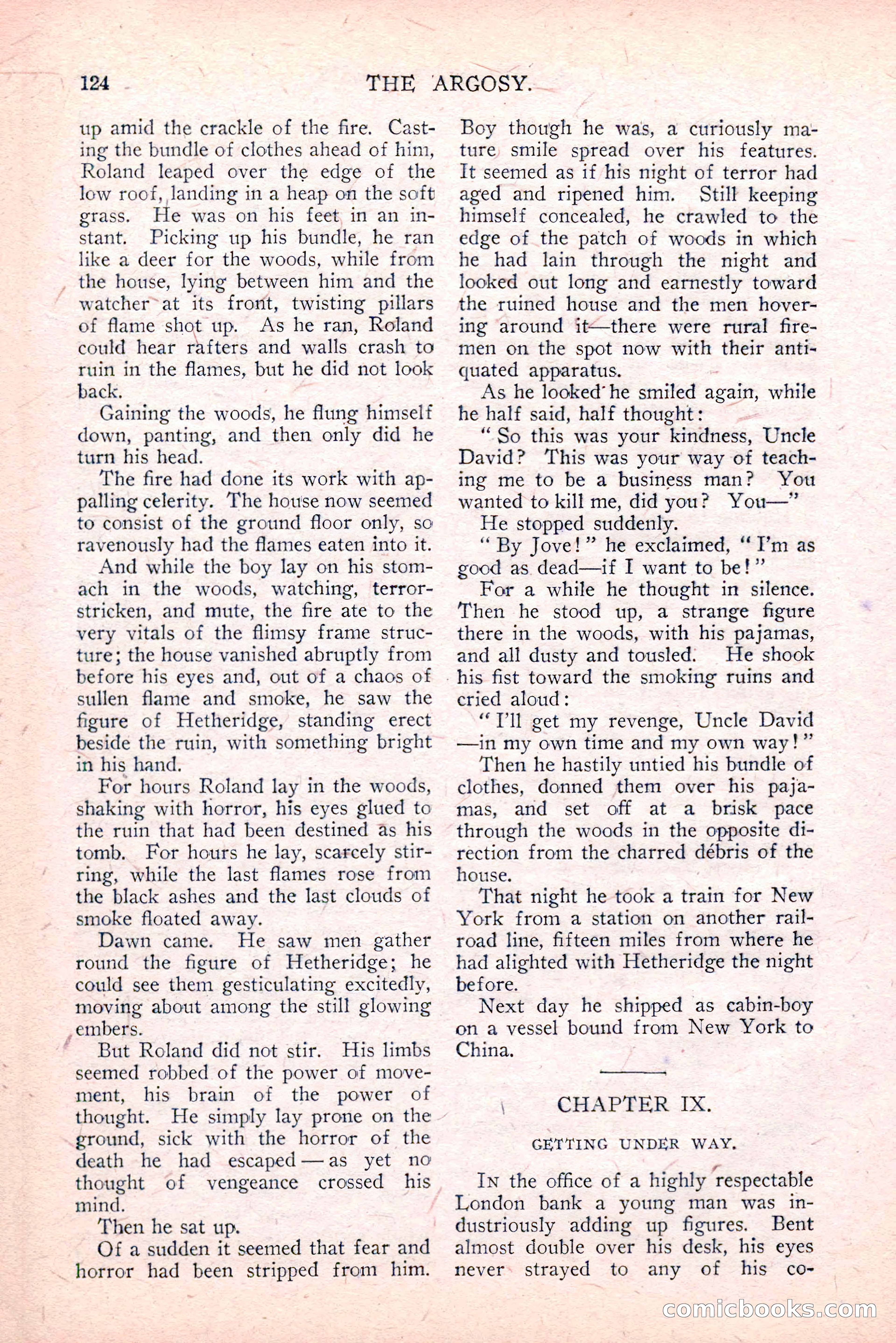
A restored page from Pulp Fiction, 1914. Page through the whole issue in the reader above.
📄 Transcribed text from this page (OCR, searchable)
Machine-transcribed from the original scan — historical spelling and the odd misread are preserved.
124 up amid the crackle of the fire. Cast- ing the bundle of clothes ahead of him, Roland leaped over the edge of the low roof, landing in a heap on the soft grass. He was on his feet in an in- stant. Picking up his bundle, he ran like a deer for the woods, while from _ the house, lying between him and the watcher>at its frort, twisting pillars of flame shot up. As he ran, Roland could hear rafters and walls crash to ruin in the flames, but he did not look back, Gaining the woes he flung himself down, panting, and then only did he turn his head. The fire had done its work with ap- palling celerity. The house now seemed to consist of the ground floor only, so ravenously had the flames eaten into it. And while the boy lay on his stom- ach in the woods, watching, terror- stricken, and mute, the fire ate to the very vitals of the flimsy frame struc- ture; the house vanished abruptly from before his eyes and, out of a chaos of sullen flame and smoke, he saw the figure of Hetheridge, standing erect beside the ruin, with something bright in his hand. For hours Roland lay in the woods, shaking with horror, his eyes glued to the ruin that had been destined as his tomb. For hours he lay, scarcely stir- ring, while the last flames rose from the black ashes and the last clouds of smoke floated away. Dawn came. He saw men gather round the figure of Hetheridge; he could see them gesticulating excitedly, moving about among the still glowing _embers. ~ But Roland did not stir. Huis limbs seemed robbed of the power of move- ment, his brain of the power of thought. He simply lay prone on the ground, sick with the horror of the death he had escaped—as yet no thought of vengeance crossed his mind. Then he sat up. Of a sudden it seemed that fear and _ horror had been stripped from him. THE 'ARGOSY. Boy though he was, a curiously ma- ture smile spread over his features. It seemed as if his night of terror had aged and ripened him. Still keeping himself concealed, he crawled to the edge of the patch of woods in which he had lain through the night and looked out long and earnestly toward the ruined house and the men hover- ing around it—there were rural fire- men on the spot now with their antt- quated apparatus. As he looked’ he smiled again, while he half said, half thought: ‘So this was your ‘kindness, Uncle David? This was your way of teach- ing me to be a business man? You wanted to kill me, did you? You—” He stopped suddenly. “By Jove!” he exclaimed, “‘ I’m as good as. dead—if I want to be!” For a while he thought in silence. Then he stood up, a strange figure there in the woods, with his pajamas, and all dusty and tousled: He shook his fist toward the smoking ruins and cried aloud: “Till get my revenge, Uncle David —in my own time and my own way!” Then he hastily untied his bundle of clothes, donned them over his paja- mas, and set off at a brisk pace through the woods in the opposite di- rection from the charred débris of the house. That night he took a train for New York from a station on another rail- road line, fifteen miles from where he had alighted with Hetheridge the night before. Next day he shipped as cabin-boy on a vessel bound from New York to China. CHAPTER IX. GETTING UNDER WAY. In the office of a highly respectable London bank a young man was in- dustriously adding up figures. Bent almost double over his desk, his eyes never. strayed to any of his co- CORMMICLOOOKS (C@