
Pulp Fiction, 1914 · page 130 of 258
The Argosy, August 1914 — page 130: what you’re looking at
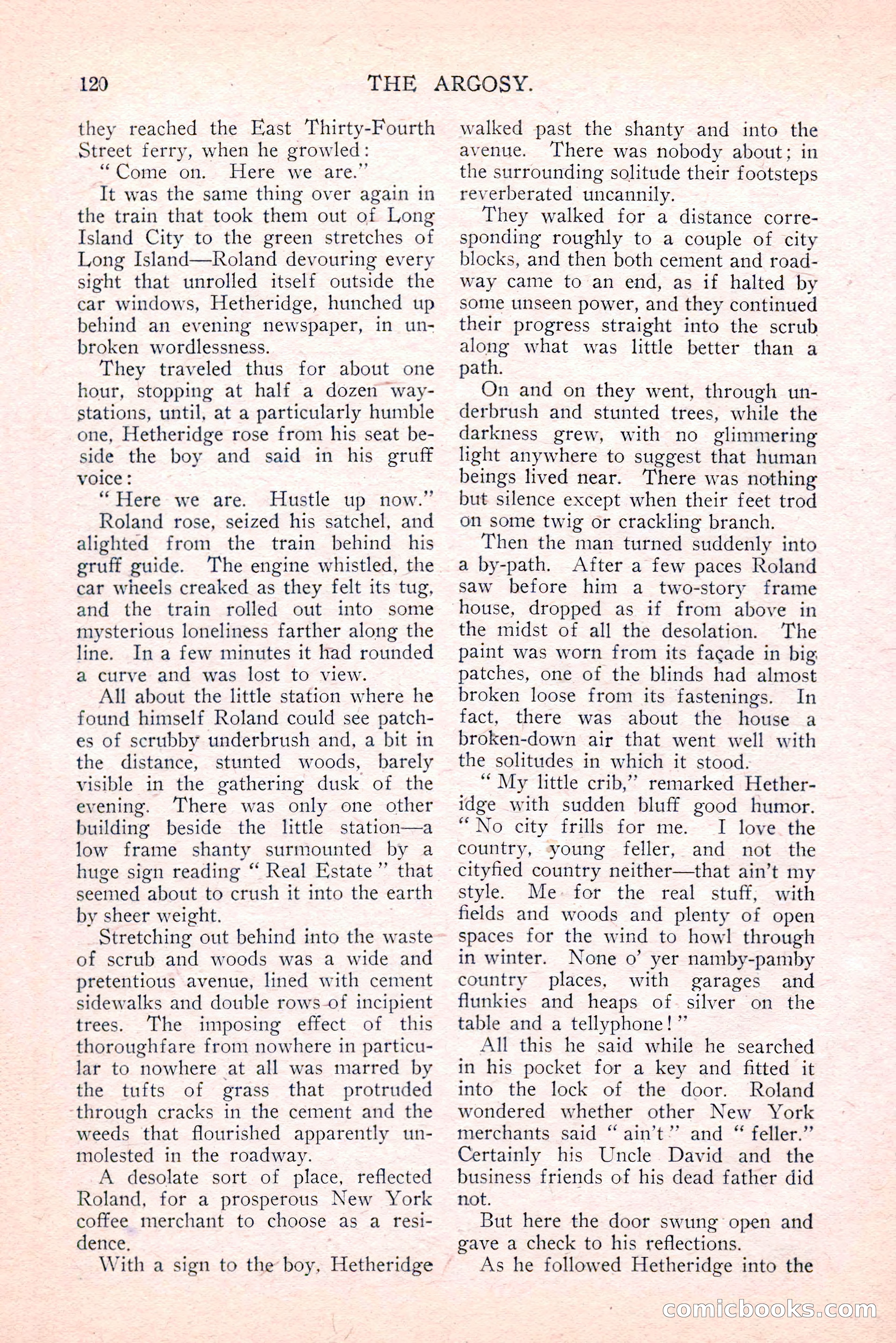
A restored page from Pulp Fiction, 1914. Page through the whole issue in the reader above.
📄 Transcribed text from this page (OCR, searchable)
Machine-transcribed from the original scan — historical spelling and the odd misread are preserved.
120 they reached the East Thirty-Fourth Street ferry, when he growled: “Come on. Here we are.” It was the same thing over again in the train that took them out of Long Island City to the green stretches of Long Island—Roland devouring every sight that unrolled itself outside the car windows, Hetheridge, hunched up behind an evening newspaper, in un- broken wordlessness. They traveled thus for about one hour, stopping at half a dozen way- stations, until, at a particularly humble one, Hetheridge rose from his seat be- side the boy and said in his gruff voice: “Here we are. Hustle up now.” Roland rose, seized his satchel, and alighted from the train behind his gruff guide. The engine whistled, the car wheels creaked as they felt its tug, and the train rolled out into some mysterious loneliness farther along the line. In a few minutes it had rounded a curve and was lost to view. All about the little station where he found himself Roland could see patch- es of scrubby underbrush and, a bit in the distance, stunted woods, barely visible in the gathering dusk of the evening. There was only one other building beside the little station—a low frame shanty surmounted by a huge sign reading “ Real Estate” that seemed about to crush it into the earth by sheer weight. Stretching out behind into the waste of scrub and woods was a wide and pretentious avenue, lined with cement sidewalks and double rows-of incipient trees. The imposing effect of this thoroughfare from nowhere in particu- lar to nowhere at all was marred by the tufts of grass that protruded ‘through cracks in the cement and the weeds that flourished apparently un- molested in the roadway. A desolate sort of place, reflected Roland, for a prosperous New York coffee merchant to choose as a resi- dence. With a sign to the boy, Hetheridge THE ARGOSY. walked past the shanty and into the avenue. There was nobody about; in the surrounding solitude their footsteps reverberated uncannily. They walked for a distance corre- sponding roughly to a couple of city blocks, and then both cement and road- way camne to an end, as if halted by some unseen power, and they continued their progress straight into the scrub along what was little better than a path. On and on they went, through un- derbrush and stunted trees, while the darkness grew, with no glimmering light anywhere to suggest that human beings lived near. ‘There was nothing but silence except when their feet trod on some twig or crackling branch. Then the man turned suddenly into a by-path. After a few paces Roland saw before him a two-story frame house, dropped as if from above in the midst of all the desolation. The paint was worn from its facade in big; patches, one of the blinds had almost broken loose from its fastenings. In fact, there was about the house a broken-down air that went well with the solitudes in which it stood. “My little crib,” remarked Hether- idge with sudden bluff good humor. “No city frills for me. I love the country, young feller, and not the cityfied country neither—that ain’t my style. Me-for the real stuff; with fields and woods and plenty of open spaces for the wind to howl through in winter. None o’ yer namby-pamby country places, with garages and flunkies and heaps of. silver on the table and a tellyphone! ” All this he said while he searched in his pocket for a key and fitted it into the lock of the door. Roland wondered whether other New York merchants said “ain’t’’ and “ feller.” Certainly his Uncle David and the business friends of his dead father did not. But here the door swung open and gave a check to his reflections. As he followed Hetheridge into the COMMICLOOOKS (C@