
Pulp Fiction, 1914 · page 129 of 258
The Argosy, August 1914 — page 129: what you’re looking at
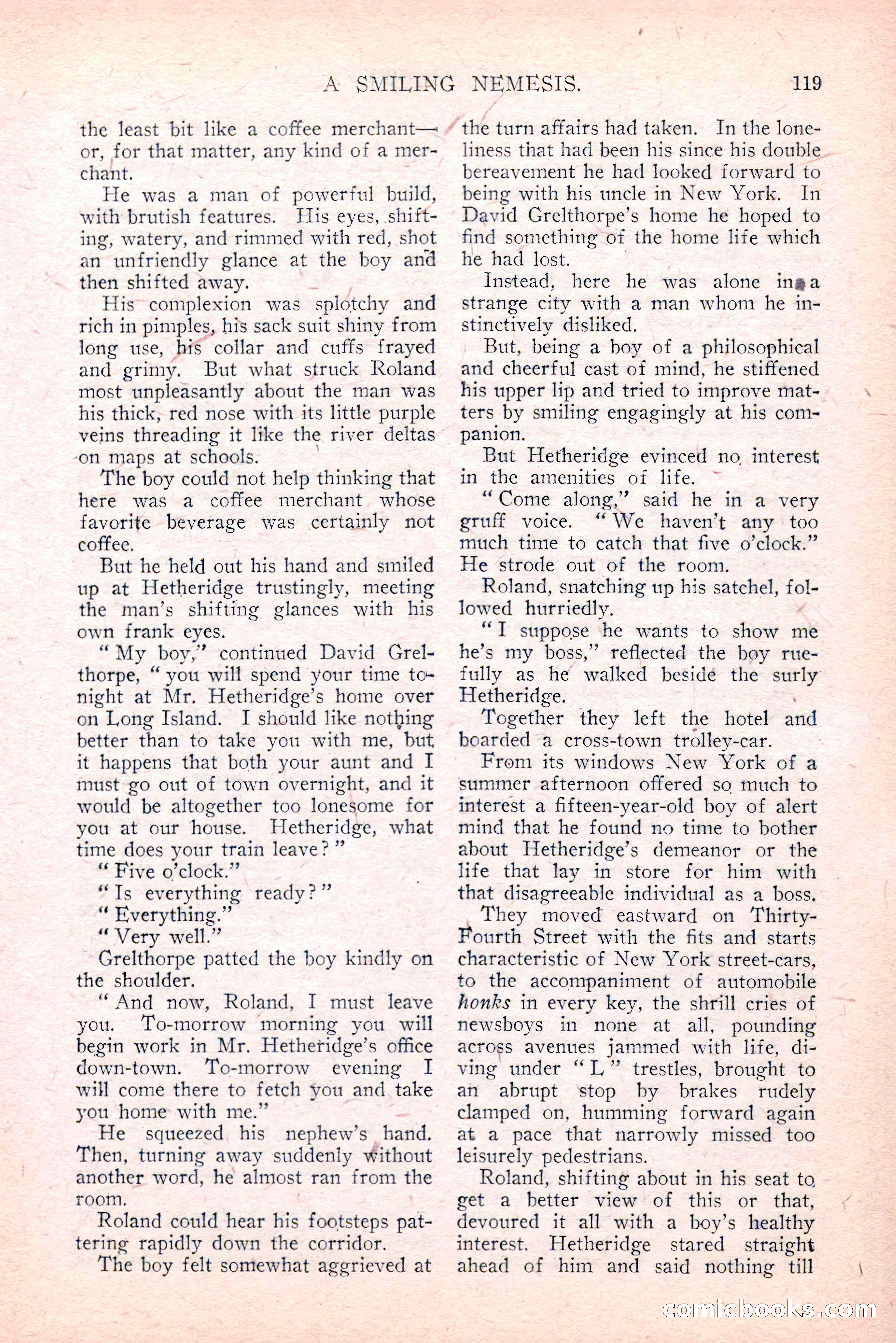
A restored page from Pulp Fiction, 1914. Page through the whole issue in the reader above.
📄 Transcribed text from this page (OCR, searchable)
Machine-transcribed from the original scan — historical spelling and the odd misread are preserved.
A! SMILING NEMESIS. the least bit like a coffee merchant— or, for that matter, any kind of a mer- chant. : He was a man of powerful build, with brutish features. His eyes, shift- ing, watery, and rimmed with red, shot an unfriendly glance at the boy and then shifted away. His complexion was splotchy and rich in pimples, his sack suit shiny from long use, his collar and cuffs frayed and grimy. But what struck Roland most unpleasantly about the man was his thick, red nose with its little purple veins threading it like the river deltas on maps at schools. The boy could not help thinking that here was a coffee merchant whose favorite beverage was certainly not coffee. But he held out his hand and smiled up at Hetheridge trustingly, meeting the man’s shifting glances with his own frank eyes. “My boy,’ continued David Grel- thorpe, “ you will spend your time to- night at Mr. Hetheridge’s home over on Long Island. I should like nothing better than to take you with me, but it happens that both your aunt and I must go out of town overnight, and it would be altogether too lonesome for you at our house. Hetheridge, what time does your train leave?” “ Five o’clock.” “Ts everything ready?” “ Fverything.” “Very well.” Grelthorpe patted the boy kindly on the shoulder. “And now, Roland, I must leave you. To-morrow morning you will begin work in Mr. Hetheridge’s office down-town. To-morrow evening I will come there to fetch you and take you home with me.” He squeezed his nephew’s_ hand. Then, turning away suddenly without another word, he almost ran from the room. Roland could hear his footsteps pat- tering rapidly down the corridor. The boy felt somewhat aggrieved at 118 ‘ the turn affairs had taken. In the lone- liness that had been his since his double bereavement he had looked forward to being with his uncle in New York. In David Grelthorpe’s home he hoped to find something of the home life which he had lost. | | Instead, here he was alone inga strange city with a man whom he in- stinctively disliked. But, being a boy of a philosophical and cheerful cast of mind, he stiffened his upper lip and tried to improve mat- ters by smiling engagingly at his com- panion. But Hetheridge evinced no interest in the amenities of life. “Come along,” said he in a very eruff voice. “We haven’t any too mtch time to catch that five o’clock.” He strode out of the room. Roland, snatching up his satchel, fol- lowed hurriedly. “T suppose he wants to show me he’s my boss,” reflected the boy rue- fully as he walked beside the surly Hetheridge. Together they left the hotel and boarded a cross-town trolley-car. From its windows New York of a summer afternoon offered so much to interest a fifteen-year-old boy of alert mind that he found no time to bother about Hetheridge’s demeanor or the life that lay in store for him with that disagreeable individual as a boss. They moved eastward on Thirty- Fourth Street with the fits and starts characteristic of New York street-cars, to the accompaniment of atutomobile honks in every key, the shrill cries of newsboys in none at all, pounding across avenues jammed with life, di- ving under “LL” trestles, brought to an abrupt ‘stop by brakes rudely clamped on, humming forward again at a pace that narrowly missed too leisurely pedestrians. Roland, shifting about in his seat to get a better view of this or that, devoured it all with a boy’s healthy interest. Hetheridge stared straight ahead of him and said nothing till CORMICLOOOKS (C@)