
Pulp Fiction, 1914 · page 95 of 268
The Argosy, Vol. 75, No. 4 — page 95: what you’re looking at
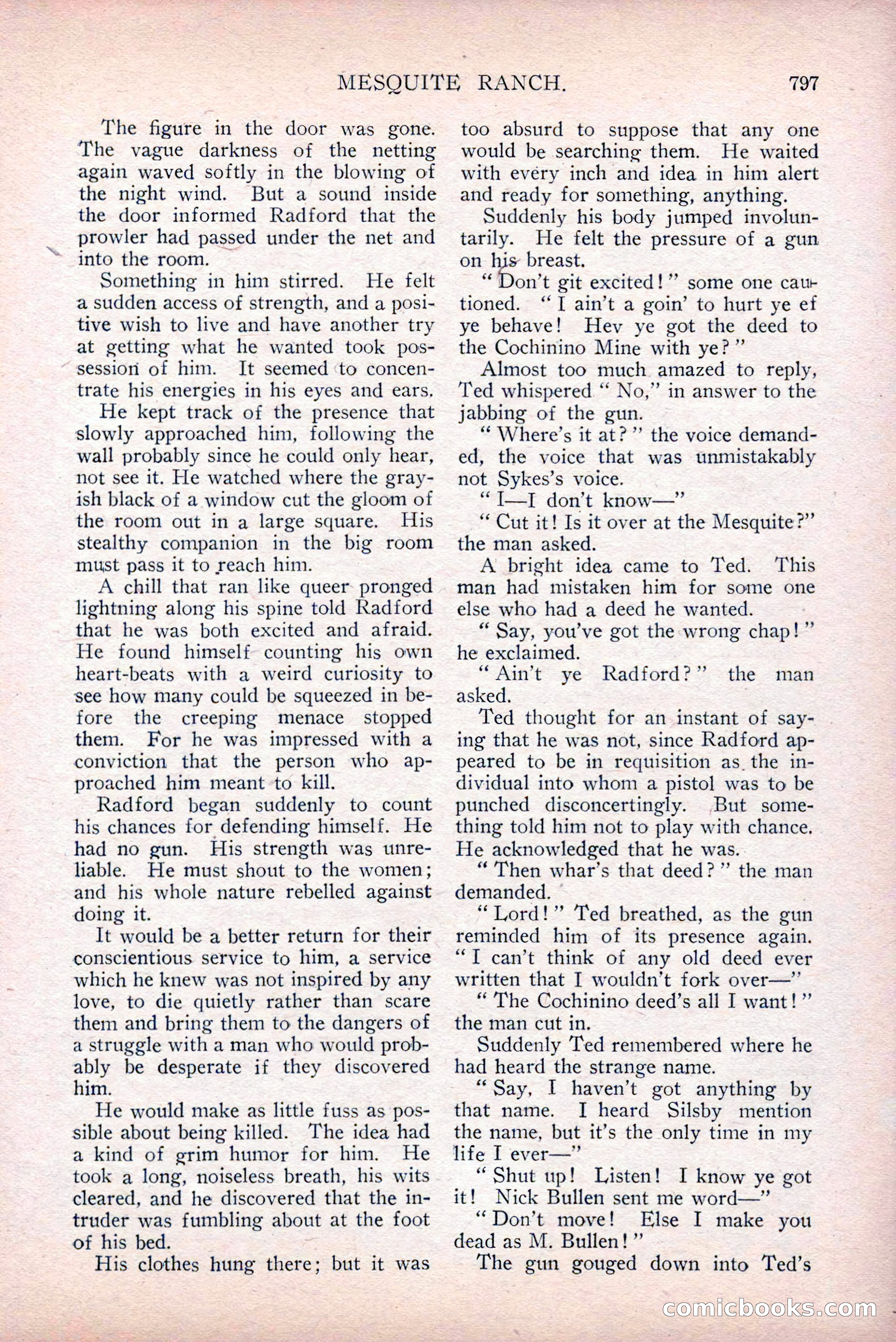
A restored page from Pulp Fiction, 1914. Page through the whole issue in the reader above.
📄 Transcribed text from this page (OCR, searchable)
Machine-transcribed from the original scan — historical spelling and the odd misread are preserved.
MESQUITE RANCH. The figure in the door was gone. The vague darkness of the netting again waved softly in the blowing of the night wind. But a sound inside the door informed Radford that the prowler had passed under the net and into the room. Something in him stirred. He felt a sudden access of strength, and a posi- tive wish to live and have another try at getting what he wanted took pos- session of him. It seemed ‘to concen- trate his energies in his eyes and ears. He kept track of the presence that slowly approached him, following the wall probably since he could only hear, not see it. He watched where the gray- ish black of a window cut the gloom of the room out in a large square. His stealthy companion in the big room must pass it to reach him. A chill that ran like queer pronged lightning along his spine told Radford that he was both excited and afraid. He found himself counting his own heart-beats with a weird curiosity to see how many could be squeezed in be- fore the creeping menace stopped them. For he was impressed with a conviction that the person who ap- proached him meant to kill. Radford began suddenly to count his chances for defending himself. He had no gun. His strength was unre- liable. He must shout to the women; and his whole nature rebelled against doing it. It would be a better return for their conscientious service to him, a service which he knew was not inspired by any love, to die quietly rather than scare them and bring them to the dangers of a struggle with a man who would prob- ably be desperate if they discovered him. He would make as little fuss as pos- sible about being killed. The idea had a kind of grim humor for him. He took a long, noiseless breath, his wits cleared, and he discovered that the in- truder was fumbling about at the foot of his bed. His clothes hung there; but it was 797 too absurd to suppose that any one would be searching them. He waited with every inch and idea in him alert and ready for something, anything. Suddenly his body jumped involun- tarily. He felt the pressure of a gun on his: breast. “Don’t git excited!’ some one caur tioned. ‘I ain’t a goin’ to hurt ye ef ye behave! MHev ye got the deed to the Cochinino Mine with ye?” Almost too much amazed to reply, Ted whispered ‘“‘ No,” in answer to the jabbing of the gun. “ Where’s it at?’ the voice demand- ed, the voice that was unmistakably not Sykes’s voice. “I—I don’t know—” “Cut it! Is it over at the Mesquite?’ the man asked. A bright idea came to Ted. This man had mistaken him for some one else who had a deed he wanted. “ Say, you’ve got the wrong chap!” he exclaimed. “Ain't ye Radford?” asked. Ted thought for an instant of say- ing that he was not, since Radford ap- peared to be in requisition as. the in- dividual into whom a pistol was to be punched disconcertingly. But some- thing told him not to play with chance. He acknowledged that he was. “Then whar’s that deed?” the man demanded. “Lord!” Ted breathed, as the gun reminded him of its presence again. “T can’t think of any old deed ever written that I wouldn’t fork over—”’ “The Cochinino deed’s all I want!” the man cut in. Suddenly Ted remembered where he had heard the strange name. “Say, I haven’t got anything by that name. I heard Silsby mention the name, but it’s the only time in my life [ ever—” “Shut up! Listen! I know ye got Nick Bullen sent me word—” “Don’t move! Else I make you dead as M. Bullen!” The gun gouged down into Ted’s the man it! COPMICLOOOKS (C@)