
Pulp Fiction, 1914 · page 94 of 268
The Argosy, Vol. 75, No. 4 — page 94: what you’re looking at
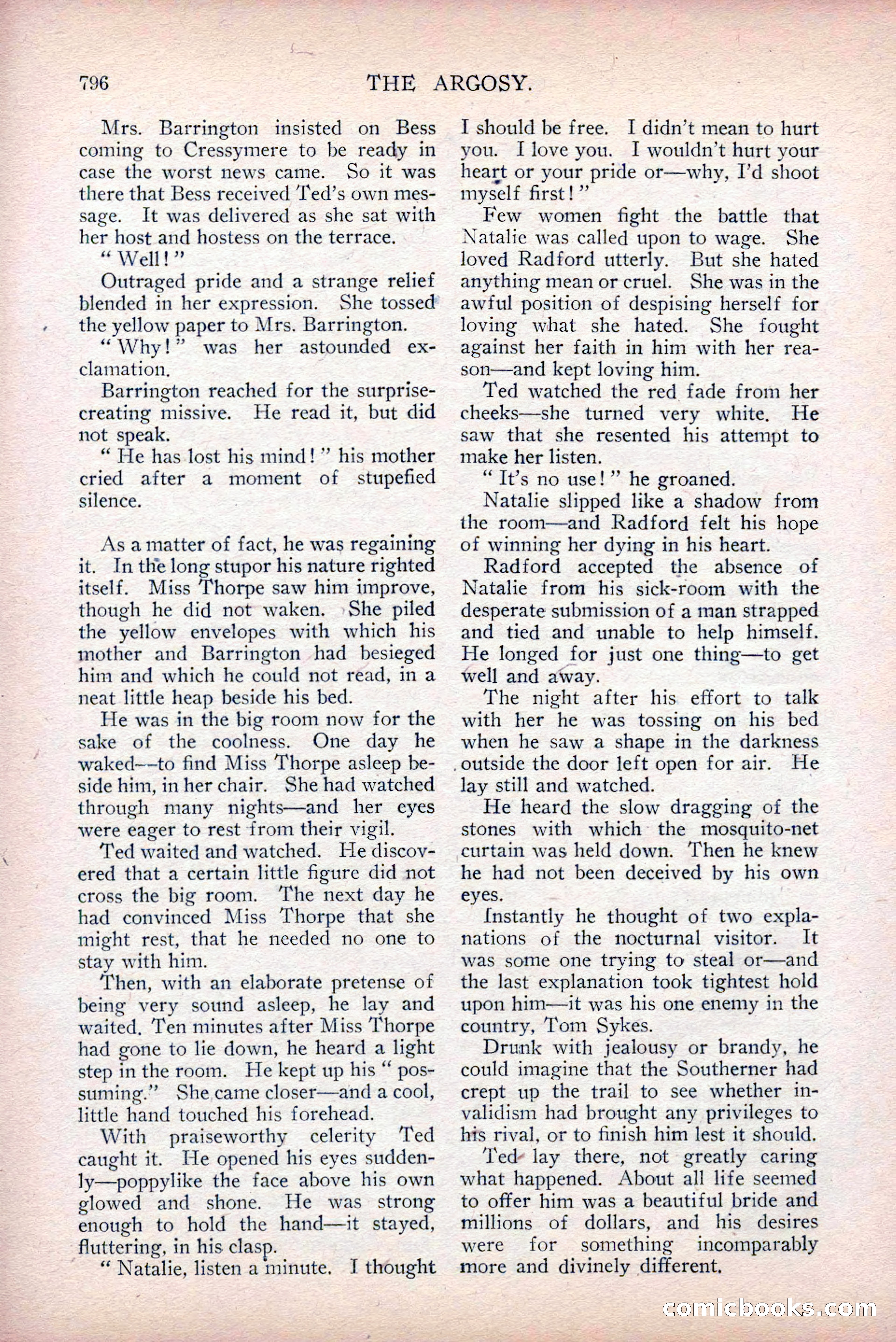
A restored page from Pulp Fiction, 1914. Page through the whole issue in the reader above.
📄 Transcribed text from this page (OCR, searchable)
Machine-transcribed from the original scan — historical spelling and the odd misread are preserved.
796 Mrs. Barrington insisted on Bess coming to Cressymere to be ready in case the worst news came. So it was there that Bess received Ted’s own mes- sage. It was delivered as she sat with her host and hostess on the terrace. * Well!” Outraged pride and a strange relief blended in her expression. She tossed the yellow paper to Mrs. Barrington. “Why!” was her astounded ex- clamation, Barrington reached for the surprise- creating missive. He read it, but did not speak. “ He has lost his mind!” his mother cried after a moment of stupefied silence. As amatter of fact, he was regaining it. In the long stupor his nature righted itself. Miss Thorpe saw him improve, though he did not waken. »She piled the yellow envelopes with which his mother and Barrington had besieged him and which he could not read, in a neat little heap beside his bed. He was in the big room now for the sake of the coolness. One day he waked—-to find Miss Thorpe asleep be- side him, in her chair. She had watched through many nights—and her eyes were eager to rest from their vigil. Ted waited and watched. He discov- ered that a certain little figure did not cross the big room. ‘The next day he had convinced Miss Thorpe that she might rest, that he needed no one to stay with him. Then, with an elaborate pretense of being very sound asleep, he lay and waited, Ten minutes after Miss Thorpe had gone to lie down, he heard a light step in the room. He kept up his “ pos- suming.” She came closer—and a cool, little hand touched his forehead. With praiseworthy celerity Ted caught it. He opened his eyes sudden- ly—poppylike the face above his own glowed and shone. He was strong enough to hold the hand—it stayed, fluttering, in his clasp. “Natalie, listen a minute. I thought THE ARGOSY. I should be free. I didn’t mean to hurt you. [love you. I wouldn’t hurt your heart or your pride or—why, I’d shoot myself first!” Few women fight the battle that Natalie was called upon to wage. She loved Radford utterly. But she hated anything mean or cruel. She was in the awful position of despising herself for loving what she hated. She fought against her faith in him with her rea- son—and kept loving him. Ted watched the red fade from her cheeks—she turned very white. He saw that she resented his attempt to make her listen. “It’s no use!” he groaned. Natalie slipped like a shadow from the room—and Radford felt his hope of winning her dying in his heart. Radford accepted the absence of Natalie from his sick-room with the desperate submission of a man strapped and tied and unable to help himself. He longed for just one thing—to get well and away. The night after his effort to talk with her he was tossing on his bed when he saw a shape in the darkness .outside the door left open for air. He lay still and watched. He heard the slow dragging of the stones with which the mosquito-net curtain was held down. Then he knew he had not been deceived by his own eyes. {Instantly he thought of two expla- nations of the nocturnal visitor. It was some one trying to steal or—and the last explanation took tightest hold upon him—it was his one enemy in the country, Tom Sykes. Drunk with jealousy or brandy, he could imagine that the Southerner had crept up the trail to see whether in- validism had brought any privileges to his rival, or to finish him lest it should. Ted- lay there, not greatly caring what happened. About all life seemed to offer him was a beautiful bride and millions of dollars, and his desires were for something incomparably more and divinely different, EOPMIE LOOKS (E@)