
Pulp Fiction, 1914 · page 92 of 268
The Argosy, Vol. 75, No. 4 — page 92: what you’re looking at
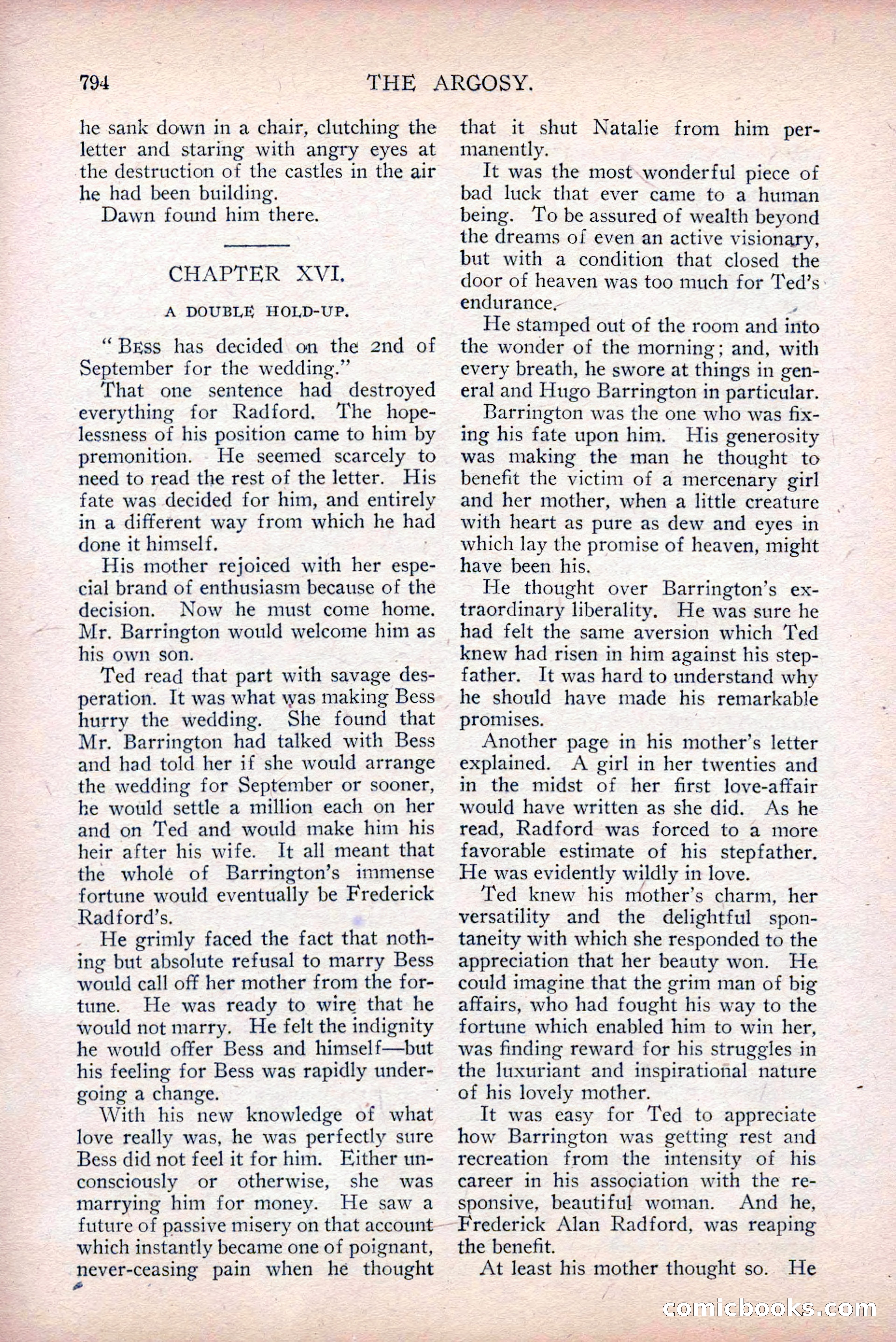
A restored page from Pulp Fiction, 1914. Page through the whole issue in the reader above.
📄 Transcribed text from this page (OCR, searchable)
Machine-transcribed from the original scan — historical spelling and the odd misread are preserved.
794 he sank down in a chair, clutching the letter and staring with angry eyes at the destruction of the castles in the air he had been building. Dawn found him there. CHAPTER XVI. A DOUBLE HOLD-UP. “Bess has decided on the 2nd of September for the wedding.” That one sentence had destroyed everything for Radford. The hope- lessness of his position came to him by premonition. He seemed scarcely to need to read the rest of the letter. His fate was decided for him, and entirely in a different way from which he had done it himself. His mother rejoiced with her espe- cial brand of enthusiasm because of the decision. Now he must come home. Mr. Barrington would welcome him as his own son. Ted read that part with savage des- peration. It was what was making Bess hurry the wedding. She found that Mr. Barrington had talked with Bess and had told her if she would arrange the wedding for September or sooner, he would settle a million each on her and on Ted and would make him his heir after his wife. It all meant that the whole of Barrington’s immense fortune would eventually be Frederick Radford’s. He grimly faced the fact that noth- ing but absolute refusal to marry Bess would call off her mother from the for- tune. He was ready to wire that he would not marry. He felt the indignity he would offer Bess and himself—but his feeling for Bess was rapidly under- going a change. With his new knowledge of what love really was, he was perfectly sure Bess did not feel it for him. Either un- consciously or otherwise, she was marrying him for money. He saw a future of passive misery on that account which instantly became one of poignant, never-ceasing pain when he thought 3 , THE ARGOSY. that it shut Natalie from him per- manently. It was the most.wonderful piece of bad luck that ever came to a human being. To be assured of wealth beyond the dreams of even an active visionary, but with a condition that closed the door of heaven was too much for Ted’s: endurance, He stamped out of the room and into the wonder of the morning; and, with every breath, he swore at things in gen- eral and Hugo Barrington in particular. Barrington was the one who was fix- ing his fate upon him. His generosity was making the man he thought to benefit the victim of a mercenary girl and her mother, when a little creature with heart as pure as dew and eyes in which lay the promise of heaven, might have been his. He thought over Barrington’s ex- traordinary liberality. He was sure he had felt the same aversion which Ted knew had risen in him against his step- father. It was hard to understand why he should have made his remarkable promises. Another page in his mother’s letter explained. <A girl in her twenties and in the midst of her first love-affair would have written as she did. As he read, Radford was forced to a more favorable estimate of his stepfather. He was evidently wildly in love. Ted knew his mother’s charm, her versatility and the delightful spon- taneity with which she responded to the appreciation that her beauty won. He could imagine that the grim man of big affairs, who had fought his way to the fortune which enabled him to win her, was finding reward for his struggles in the luxuriant and inspirational nature of his lovely mother. It was easy for Ted to appreciate how Barrington was getting rest and recreation from the intensity of his career in his association with the re- sponsive, beautiful woman. And he, -Frederick Alan Radford, was reaping the benefit. At least his mother thought so. He EOPMIC MOOKS (E@)