
Pulp Fiction, 1914 · page 91 of 268
The Argosy, Vol. 75, No. 4 — page 91: what you’re looking at
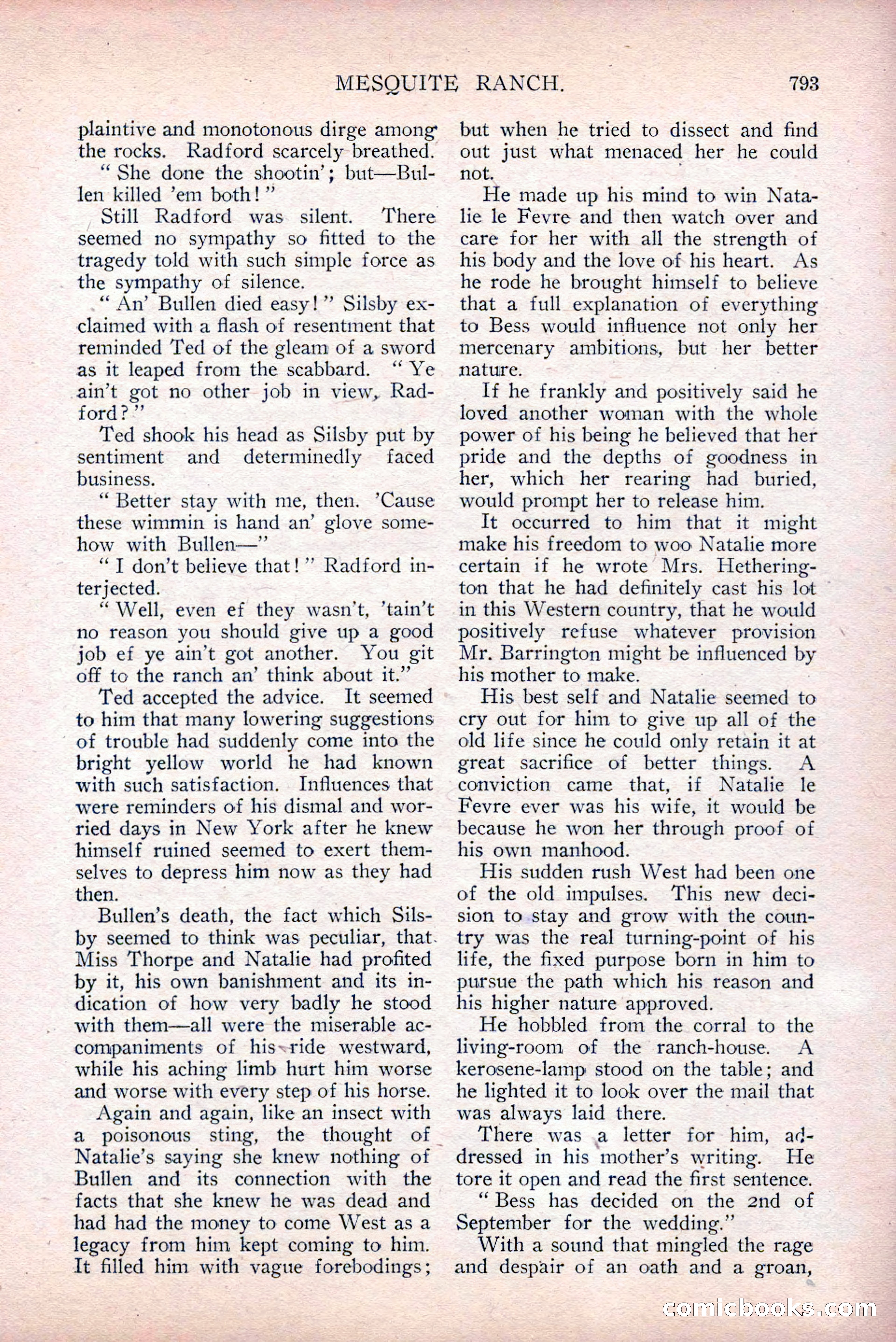
A restored page from Pulp Fiction, 1914. Page through the whole issue in the reader above.
📄 Transcribed text from this page (OCR, searchable)
Machine-transcribed from the original scan — historical spelling and the odd misread are preserved.
MESQUITE RANCH. plaintive and monotonous dirge among the rocks. Radford scarcely breathed. “She done the shootin’; but—Bul- len killed *em both!” Still Radford was silent. There seemed no sympathy so fitted to the tragedy told with such simple force as the sympathy of silence. ““An’ Bullen died easy!” Silsby ex- claimed with a flash of resentment that reminded Ted of the gleam of a sword as it leaped from the scabbard. “ Ye ain’t got no other job in view, Rad- ford?” Ted shook his head as Silsby put by sentiment and determinedly faced business. “ Better stay with me, then. ’Cause these wimmin is hand an’ glove some- how with Bullen—”’ ‘“T don’t believe that!’ Radford in- terjected. “Well, even ef they wasn’t, ‘tain’t no reason you should give up a good job ef ye ain't got another. You git off to the ranch an’ think about it.” Ted accepted the advice. It seemed to him that many lowering suggestions of trouble had suddenly come into the bright yellow world he had known with such satisfaction. Influences that were reminders of his dismal and wor- ried days in New York after he knew himself ruined seemed to exert them- selves to depress him now as they had then. Bullen’s death, the fact which Sils- by seemed to think was peculiar, that. Miss Thorpe and Natalie had profited by it, his own banishment and its in- dication of how very badly he stood with them—all were the miserable ac- companiments of hisxride westward, while his aching limb hurt him worse and worse with every step of his horse. Again and again, like an insect with a poisonous sting, the thought of — Natalie’s saying she knew nothing of Bullen and its connection with the facts that she knew he was dead and had had the money to come West as a legacy from him kept coming to him. It filled him with vague forebodings; 793 but when he tried to dissect and find out just what menaced her he could not. He made up his mind to win Nata- lie le Fevre and then watch over and care for her with all the strength of his body and the love of his heart. As he rode he brought himself to believe that a full explanation of everything to Bess would influence not only her mercenary ambitions, but her better nature. If he frankly and nositivels said he loved another woman with the whole power of his being he believed that her pride and the depths of goodness in her, which her rearing had _ buried, would prompt her to release him. It occurred to him that it might make his freedom to woo Natalie more certain if he wrote Mrs. Hethering- ton that he had definitely cast his lot © in this Western country, that he would positively refuse whatever provision Mr. Barrington might be influenced ey his mother to make. His best self and Natalie seemed to cry out for him to give up all of the old life since he could only retain it at great sacrifice of better things. A conviction came that, if Natalie le Fevre ever was his wife, it would be because he won her through proof of his own manhood. His sudden rush West had been one of the old impulses. This new deci- sion to stay and grow with the coun- try was the real turning-point of his life, the fixed purpose born in him to pursue the path which his reason and his higher nature approved. He hobbled from the corral to the living-room of the ranch-house. A kerosene-lamp stood on the table; and he lighted it to look over the mail that was always laid there. There was a letter for him, ad- dressed in his mother’s writing. He tore it open and read the first sentence. “Bess has decided on the 2nd of September for the wedding.” With a sound that mingled the rage and despair of an oath and a groan, COMMICOOOKS (C@