
Pulp Fiction, 1914 · page 51 of 268
The Argosy, Vol. 75, No. 4 — page 51: what you’re looking at
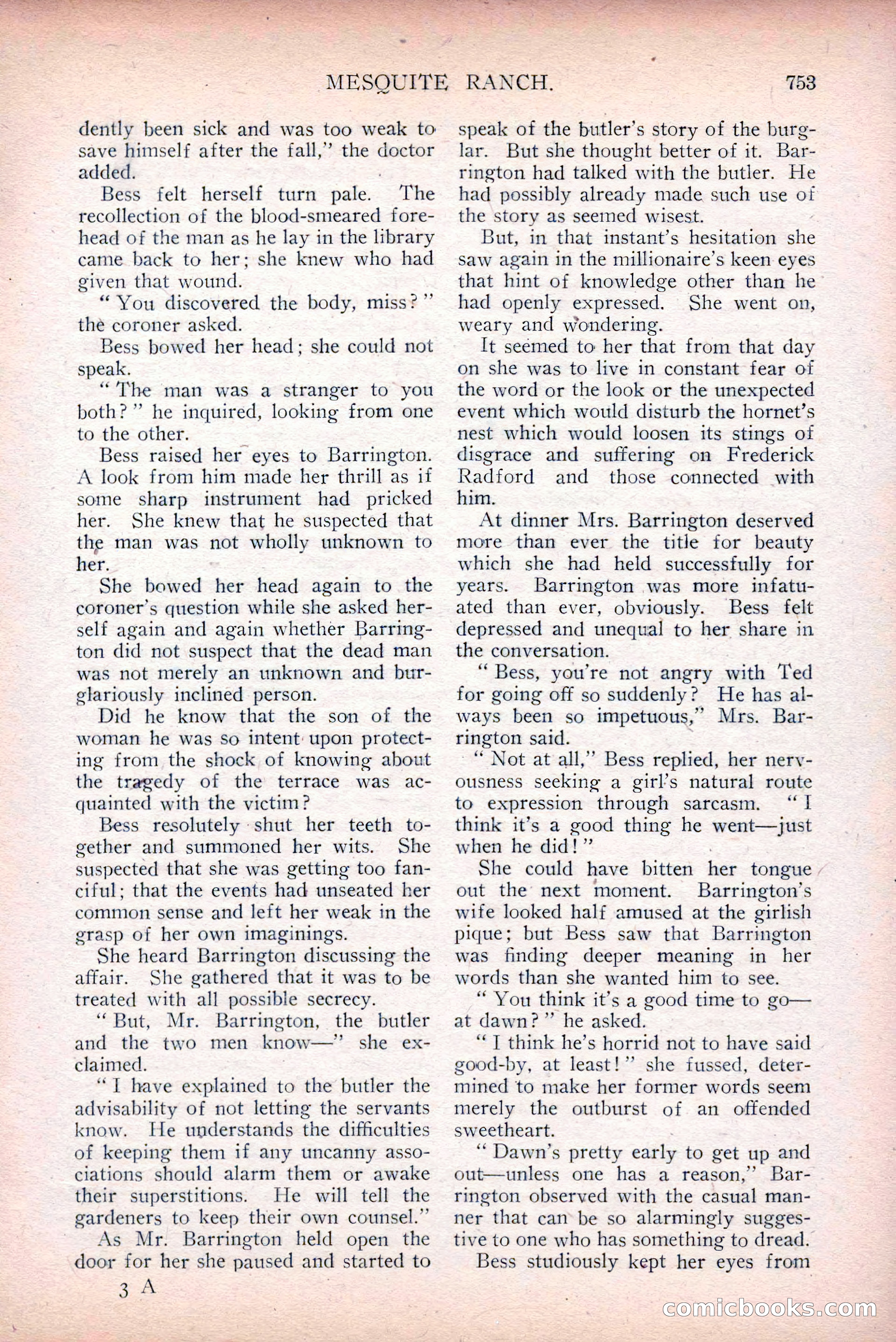
A restored page from Pulp Fiction, 1914. Page through the whole issue in the reader above.
📄 Transcribed text from this page (OCR, searchable)
Machine-transcribed from the original scan — historical spelling and the odd misread are preserved.
MESQUITE RANCH. dently been sick and was too weak to save himself after the fall,’ the doctor added. . Bess felt herself turn pale. The recollection of the blood-smeared fore- head of the man as he lay in the library came back to her; she knew who had eiven that wound. “You discovered the body, miss?” the coroner asked. Bess bowed her head; she could not speak. “The man was a stranger to you both?” he inquired, looking from one to the other. : Bess raised her eyes to Barrington. A look from him made her thrill as if some sharp instrument had _ pricked her. She knew that he suspected that the man was not wholly unknown to her. She bowed her head again to the coroner's question while she asked her- self again and again whether Barring- ton did not suspect that the dead man was not merely an unknown and bur- elariously inclined person. Did he know that the son of the woman he was so intent: upon protect- ing from the shock of knowing about the tragedy of the terrace was ac- quainted with the victim? Bess resolutely shut her teeth to- gether and summoned her wits. She suspected that she was getting too fan- ciful; that the events had unseated her common sense and left her weak in the grasp of her own imaginings. She heard Barrington discussing the affair. She gathered that it was to be treated with all possible secrecy. ‘But, Mr. Barrington, the butler and the two men know—” she ex- claimed. “| have explained to the butler the advisability of not letting the servants know. He understands the difficulties of keeping them if any uncanny asso- ciations should alarm them or awake their superstitions. He will tell the gardeners to keep their own counsel.”’ As Mr. Barrington held open the door for her she paused and started to Ces 753 speak of the butler’s story of the burg- lar. But she thought better of it. Bar- rington had talked with the butler. He had possibly already made such use of the story as seemed wisest. But, in that instant’s hesitation she Saw again in the millionaire’s keen eyes that hint of knowledge other than he had openly expressed. She went on, weary and wondering. It seemed to her that from that day on she was to live 1n constant fear of the word or the look or the unexpected event which would disturb the hornet’s nest which would loosen its stings of disgrace and suffering on Frederick Radford and those connected with him. At dinner Mrs. Barrington deserved more than ever the title for beauty which she had held successfully for years. Barrington was more infatu- ated than ever, obviously. Bess felt depressed and unequal to her share in the conversation. ‘Bess, you're not angry with Ted for going off so suddenly? He has al- ways been so impetuous,” Mrs. Bar- rington said. 3 ~“ Not at all,” Bess replied, her nerv- ousness seeking a girl’s natural route to expression through sarcasm. “I think it’s a good thing he went—yjust when he did!” 3 She could have bitten her tongue out the next moment. Barrington’s wife looked half amused at the girlish pique; but Bess saw that Barrington was finding deeper meaning in her words than she wanted him to see. “ You think it’s a good time to go— at dawn?” he asked. “| think he’s horrid not to have said good-by, at least!’’ she fussed, deter- mined to make her former words seem merely the outburst of an offended sweetheart. ‘Dawn's pretty early to get up and out—unless one has a reason,” Bar- rington observed with the casual man- ner that can be so alarmingly sugges- tive to one who has something to dread. Bess studiously kept her eyes from EOPMICLOOKS (E@