
Pulp Fiction, 1914 · page 50 of 268
The Argosy, Vol. 75, No. 4 — page 50: what you’re looking at
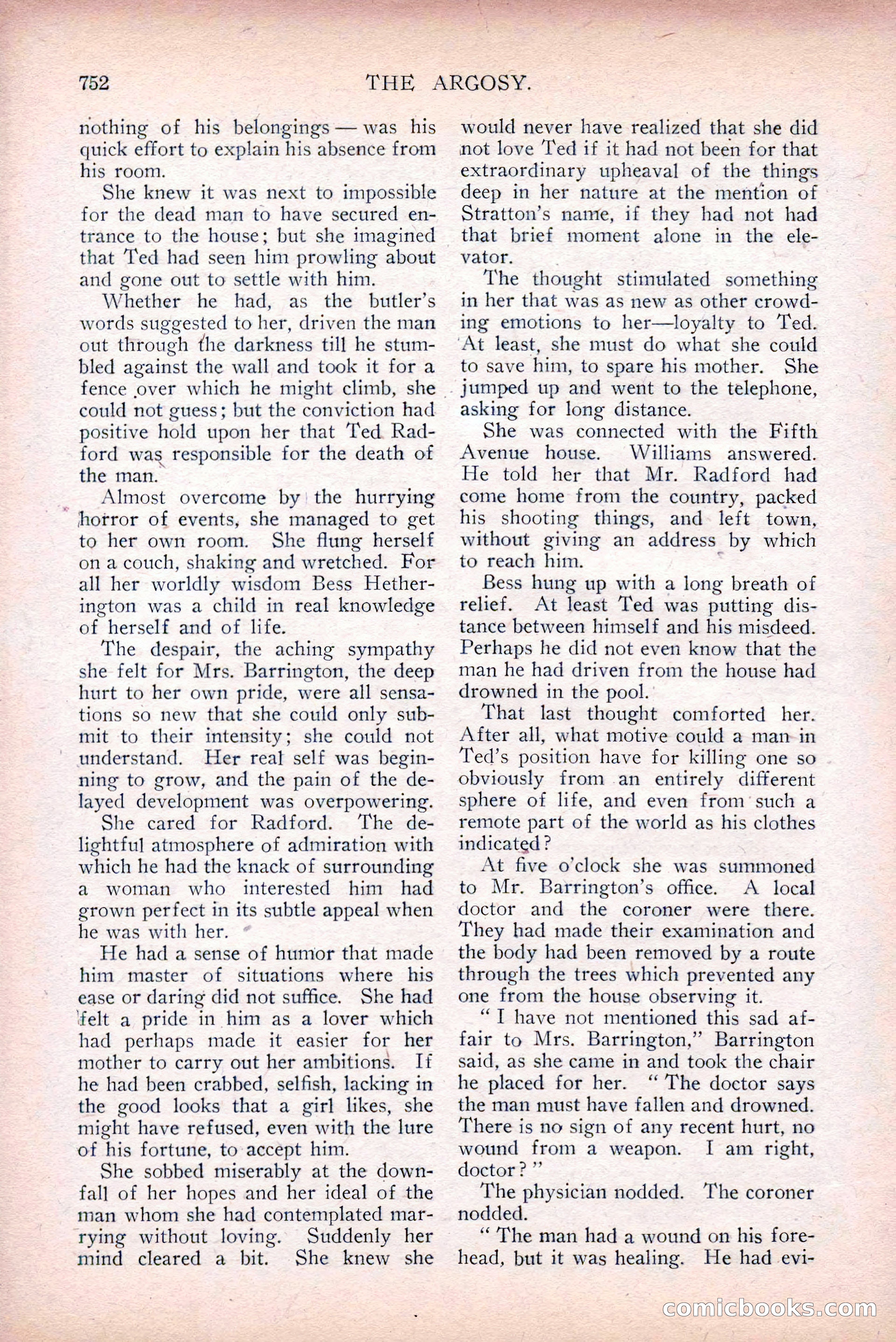
A restored page from Pulp Fiction, 1914. Page through the whole issue in the reader above.
📄 Transcribed text from this page (OCR, searchable)
Machine-transcribed from the original scan — historical spelling and the odd misread are preserved.
es ee 752 nothing of his belongings — was his quick effort to explain his absence from his room. She knew it was next to impossible for the dead man to have secured en- trance to the house; but she imagined that Ted had seen him prowling about and gone out to settle with him. Whether he had, as the butler’s words suggested to her, driven the man out through the darkness till he stum- bled against the wall and took it for a fence over which he might climb, she could not guess; but the conviction had positive hold upon her that Ted Rad- ford was responsible for the death ot the man. Almost overcome by the hurrying “horror of events, she managed to get to her own room. She flung herself on a couch, shaking and wretched. For all her worldly wisdom Bess Hether- ington was a child in real knowledge of herself and of life. The despair, the aching sympathy she felt for Mrs. Barrington, the deep hurt to her own pride, were all sensa- tions so new that she could only sub- mit to their intensity; she could not understand. Her real self was begin- ning to grow, and the pain of the de- layed development was overpowering. She cared for Radford. The de- lightful atmosphere of admiration with which he had the knack of surrounding a woman who interested him had grown perfect in its subtle appeal when he was with her. He had a sense of humor that made him master of situations where his ease or daring did not suffice. She had ‘felt a pride in him as a lover which had perhaps made it easier for her mother to carry out her ambitions. If he had been crabbed, selfish, lacking in the good looks that a girl likes, she might have refused, even with the lure of his fortune, to accept him. She sobbed miserably at the down- fall of her hopes and her ideal of the man whom she had contemplated mar- rying without loving. Suddenly her mind cleared a bit. She knew she THE ARGOSY. would never have realized that she did not love ‘Ted if it had not been for that extraordinary upheaval of the things deep in her nature at the mention of Stratton’s name, if they had not had that brief moment alone in the ele- vator. 7 The thought stimulated something in her that was as new as other crowd- ing emotions to her—loyalty to Ted. ‘At least, she must do what she could to save him, to spare his mother. She jumped up and went to the telephone, asking for long distance. She was connected with the Fifth Avenue house. Williams answered. He told her that Mr. Radford had come home from the country, packed his shooting things, and left town, without giving an address by which to reach him. Bess hung up with a long breath of relief. At least Ted was putting dis- tance between himself and his misdeed. Perhaps he did not even know that the man he had driven from the house had drowned in the pool. That last thought comforted her. After all, what motive could a man in Ted’s position have for killing one so obviously from an entirely different sphere of life, and even from’ such a remote part of the world as his clothes indicated ? At five o’clock she was summoned to Mr. Barrington’s office. <A _ local doctor and the coroner were there. They had made their examination and the body had been removed by a route through the trees which prevented any one from the house observing it. “T have not mentioned this sad af- fair to Mrs. Barrington,” Barrington said, as she came in and took the chair he placed for her. ‘“ The doctor says the man must have fallen and drowned. There is no sign of any recent hurt, no wound from a weapon. I am right, doctor? ”’ The physician nodded. ‘The coroner nodded. “The man had a wound on his fore- head, but it was healing. He had evi- COPMICGLOOOKS (C@)