
Pulp Fiction, 1914 · page 40 of 268
The Argosy, Vol. 75, No. 4 — page 40: what you’re looking at
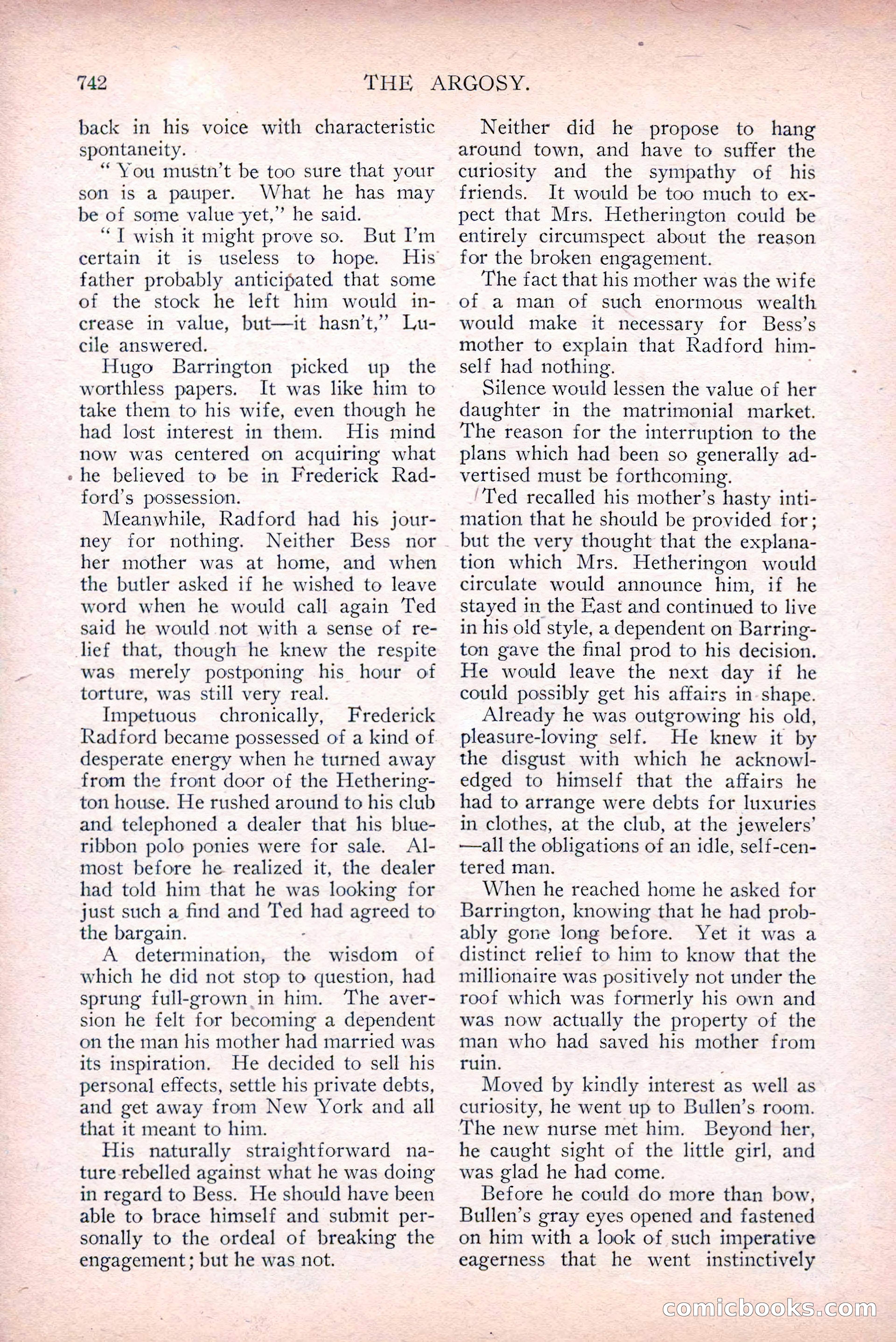
A restored page from Pulp Fiction, 1914. Page through the whole issue in the reader above.
📄 Transcribed text from this page (OCR, searchable)
Machine-transcribed from the original scan — historical spelling and the odd misread are preserved.
a 742 back in his voice with characteristic spontaneity. “You mustn’t be too sure that your son is a pauper. What he has may be of some value yet,” he said. ‘1 wish it might prove so. certain it is useless to hope. father probably anticipated that some of the stock he left him would in- crease in value, but—it hasn't,’ Lu- cile answered. Hugo Barrington picked up _ the worthless papers. It was like him to take them to his wife, even though he had lost interest in them. His mind now was centered on acquiring what he believed to be in Frederick Rad- ford’s possession. Meanwhile, Radford had his jour- ney for nothing. Neither Bess nor her mother was at home, and when the butler asked if he wished to leave word when he would call again Ted said he would not with a sense of re- But I’m lief that, though he knew the respite was merely postponing his hour of torture, was still very real. Impetuous chronically, Frederick Radford became possessed of a kind of desperate energy when he turned away from the front door of the Hethering- ton house. He rushed around to his club and telephoned a dealer that his blue- ribbon polo ponies were for sale. A\l- most before he realized it, the dealer had told him that he was looking for just such a find and Ted had agreed to the bargain. A determination, the wisdom of which he did not stop to question, had sprung full-grown in him. ‘The aver- sion he felt for becoming a dependent on the man his mother had married was its inspiration. He decided to sell his personal effects, settle his private debts, and get away from New York and all that it meant to him. His naturally straightforward na- ture rebelled against what he was doing in regard to Bess. He should have been able to brace himself and submit per- sonally to the ordeal of breaking the engagement; but he was not. His THE ARGOSY. Neither did he propose to hang around town, and have to suffer the curiosity and the sympathy of his friends. It would be too much to ex- pect that Mrs. Hetherington could be entirely circumspect about the reason for the broken engagement. The fact that his mother was the wife of a man of such enormous wealth would make it necessary for Bess’s mother to explain that Radford him- self had nothing. | Silence would lessen the value of her daughter in the matrimonial market. The reason for the interruption to the plans which had been so generally ad- vertised must be forthcoming. ‘Ted recalled his mother’s hasty inti- mation that he should be provided for; but the very thought that the explana- tion which Mrs. Hetheringon would circulate would announce him, if he stayed in the East and continued to live in his old style, a dependent on Barring- ton gave the final prod to his decision. He would leave the next day if he could possibly get his affairs in shape. Already he was outgrowing his old, pleasure-loving self. He knew it by the disgust with which he acknowl- edged to himself that the affairs he had to arrange were debts for luxuries in clothes, at the club, at the jewelers’ —all the obligations of an idle, self-cen- tered man. When he reached home he asked for Barrington, knowing that he had prob- ably gone long before. Yet it was a distinct relief to him to know that the millionaire was positively not under the roof which was formerly his own and was now actually the property of the man who had saved his mother from ruin. Moved by kindly interest as well as curiosity, he went up to Bullen’s room. The new nurse met him. Beyond her, he caught sight of the little girl, and was glad he had come. Before he could do more than bow, Bullen’s gray eyes opened and fastened on him with a look of such imperative eagerness that he went instinctively Gomichoo (C <S (C@)