
Pulp Fiction, 1914 · page 39 of 268
The Argosy, Vol. 75, No. 4 — page 39: what you’re looking at
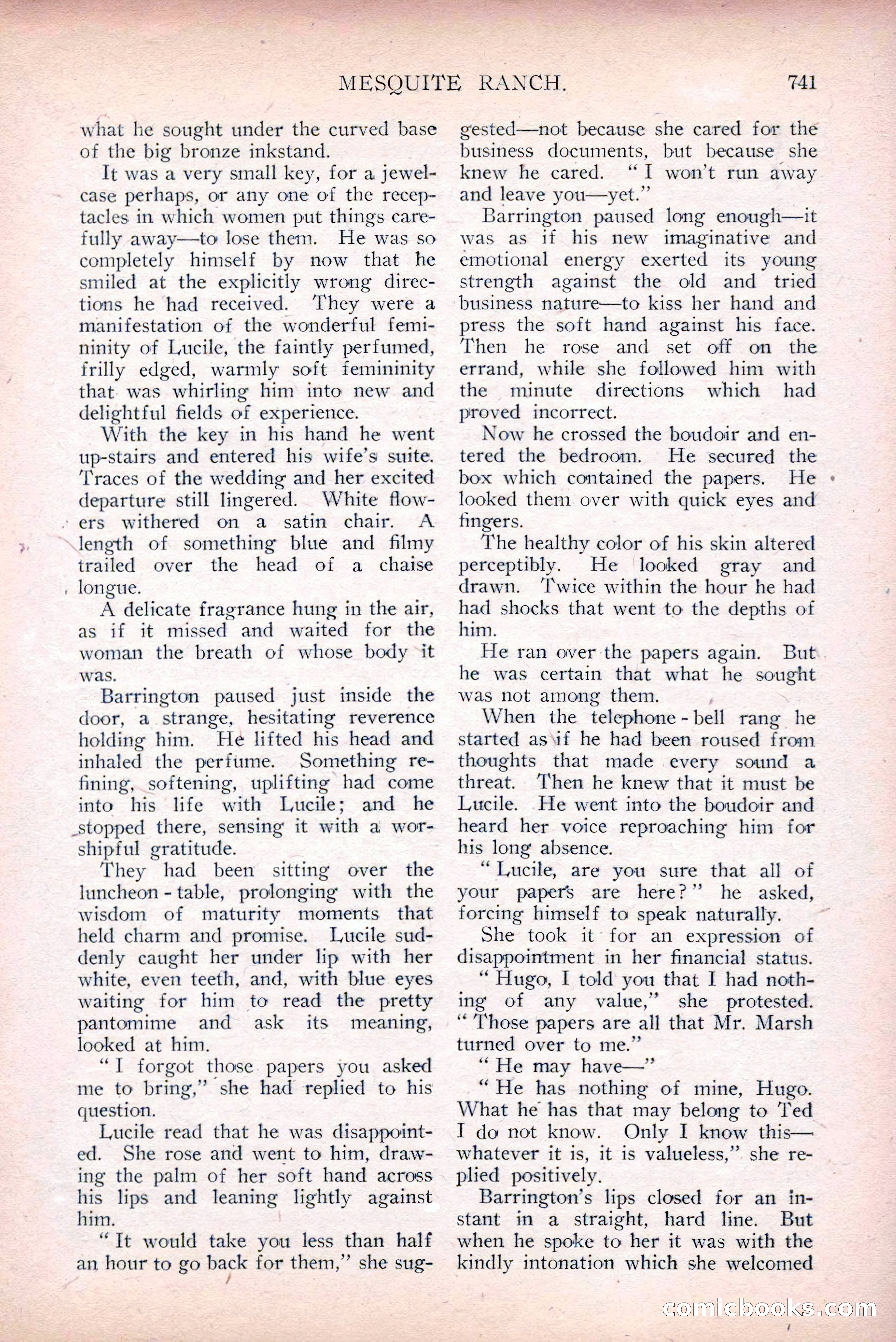
A restored page from Pulp Fiction, 1914. Page through the whole issue in the reader above.
📄 Transcribed text from this page (OCR, searchable)
Machine-transcribed from the original scan — historical spelling and the odd misread are preserved.
MESQUITE RANCH. what he sought under the curved base of the big bronze inkstand. It was a very small key, for a jewel- case perhaps, or any one of the recep- tacles in which women put things care- fully away—to lose them. He was so completely himself by now that he smiled at the explicitly wrong direc- tions he had received. They were a manifestation of the wonderful fem1- ninity of Lucile, the faintly perfumed, frilly edged, warmly soft femininity that. was whirling him into new and delightful fields of experience. With the key in his hand he went up-stairs and entered his wife’s suite. ‘Traces of the wedding and her excited departure still lingered. White flow- - ers withered on a satin chair. A leneth of something blue and filmy trailed over the head of a chaise . longue. A delicate fragrance hung in the air, as if it missed and waited for the woman the breath of whose body it was. Barrington paused just inside the door, a strange, hesitating reverence holding him. He lifted his head and inhaled the perfume. Something re- fining, softening, uplifting had come into his life with Lucile; and he stopped there, sensing’ it with a wor- shipful gratitude. They had been sitting over the luncheon - table, prolonging with the wisdom of maturity moments that held charm and promise. Lucile sud- denly caught her under lip with her white, even teeth, and, with blue eyes waiting for him to read the pretty pantomime and ask its meaning, looked at him. “I forgot those. papers you asked me to bring,” ‘she had replied to his question. Lucile read that he was disappoint- ed. She rose and went to him, draw- ing the palm of her soft hand across his lips and leaning lightly against him, “Tt would take you less than half an hour to go back for them,” she sug- Ca oo» * TAL eested—not because she cared for the business documents, but because she knew he cared. “ I won't run away and leave you—yet.”’ Barrington paused long enough—it was as if his new imaginative and emotional energy exerted its young strength against the old and _ tried business nature—to kiss her hand and press the soft hand against his face. Then he rose and set off on the errand, while she followed him with the minute directions which had proved incorrect. Now he crossed the boudoir and en- tered the bedroom. He secured the box which contained the papers. He looked them over with quick eyes and fingers. The healthy color of his skin altered perceptibly. He looked gray and drawn. ‘Twice within the hour he had had shocks that went to the depths of him. He ran over the papers again. But he was certain that what he sought was not among them. When the telephone - bell rang he started as\if he had been roused from thoughts that made every sound a threat. Then he knew that it must be Lucile. He went into the boudoir and heard her voice reproaching him for his long absence. “Lucile, are you sure that all of your papers are here?” he asked, forcing himself to speak naturally. She took it for an expression of disappointment in her financial status. “ Hugo, I told you that I had noth- ing of any value,” she protested. “Those papers are all that Mr. Marsh turned over to me.” “He may have—” “He has nothing of mine, Hugo. What he has that may belong to Ted I do not know. Only I know this— whatever it is, it is valueless,” she re- plied positively. Barrington’s lips closed for an in- stant in a straight, hard line. But when he spoke to her it was with the kindly intonation which she welcomed CORMICLOOKS i (C@)