
Pulp Fiction, 1914 · page 179 of 268
The Argosy, Vol. 75, No. 4 — page 179: what you’re looking at
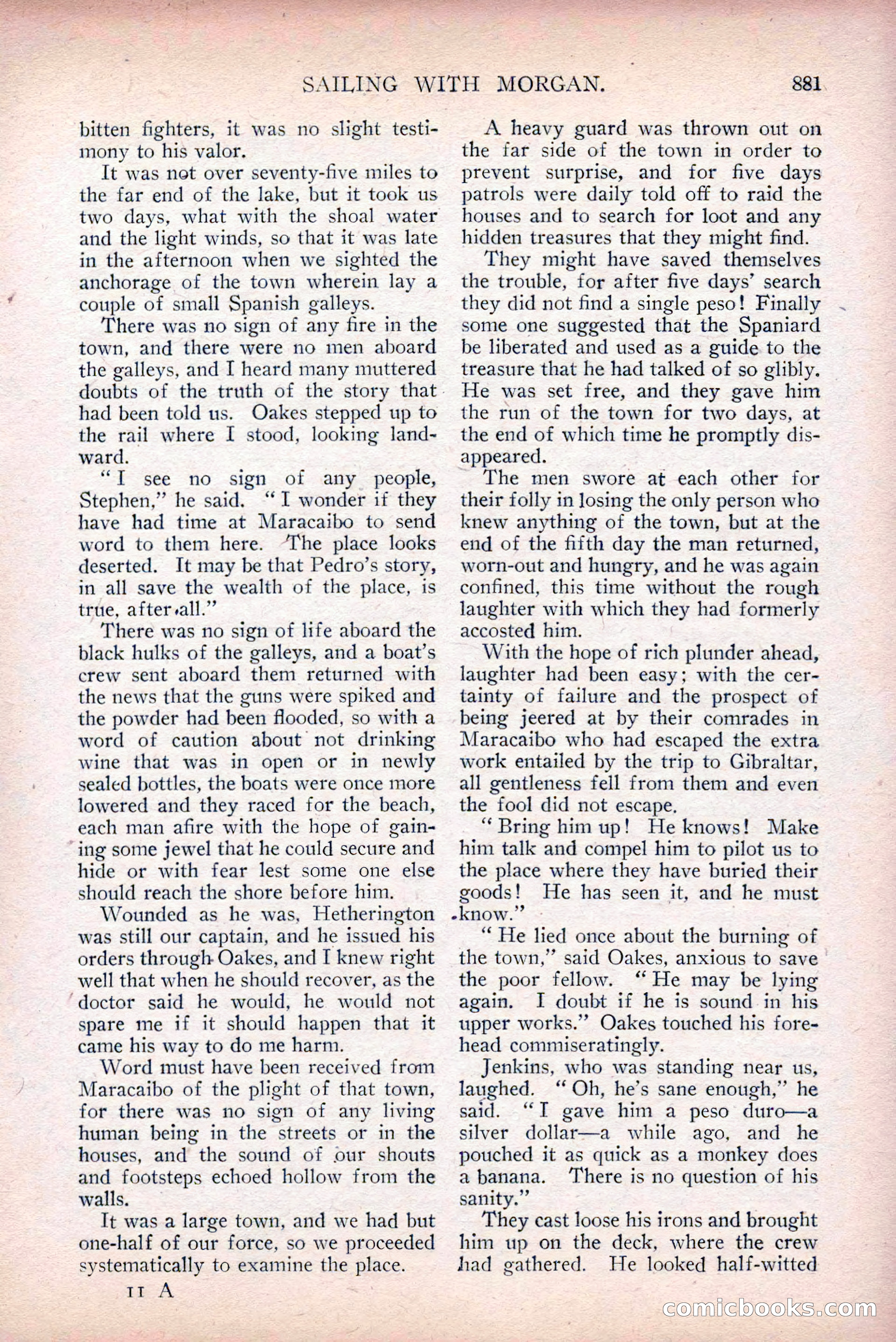
A restored page from Pulp Fiction, 1914. Page through the whole issue in the reader above.
📄 Transcribed text from this page (OCR, searchable)
Machine-transcribed from the original scan — historical spelling and the odd misread are preserved.
SAILING WITH MORGAN. bitten fighters, it was no slight testi- mony to his valor, It was not over seventy-five miles to the far end of the lake, but it took us two days, what with the shoal water and the light winds, so that it was late in the afternoon when we sighted the anchorage of the town wherein lay a couple of small Spanish galleys. There was no sign of any fire in the town, and there were no men aboard the galleys, and I heard many muttered doubts of the truth of the story that. had been told us. Oakes stepped up to the rail where I stood, looking land~ ward. “T see no sign of any people, Stephen,” he said. “I wonder if they have had time at Maracaibo to send word to them here. “The place looks deserted. It may be that Pedro’s story, in all save the wealth of the place, is true, afterall.” There was no sign of life aboard the black hulks of the galleys, and a boat’s crew sent aboard them returned with the news that the guns were spiked and the powder had been flooded, so with a word of caution about not drinking wine that was in open or in newly sealed bottles, the boats were once more lowered and they raced for the beach, each man afire with the hope of gain- ‘ing some jewel that he could secure and hide or with fear lest some one else should reach the shore before him. Wounded as he was, Hetherington was still our captain, and he issued his orders through Oakes, and [ knew right well that when he should recover, as the ‘doctor said he would, he would not spare me if it should happen that it came his way to do me harm. Word must have been received from Maracaibo of the plight of that town, for there was no sign of any living human being in the streets or in the houses, and the sound of our shouts and footsteps echoed hollow from the walls. It was a large town, and we had but one-half of our force, so we proceeded systematically to examine the place. IA A heavy guard was thrown out on the far side of the town in order to prevent surprise, and for five days patrols were daily told off to raid the houses and to search for loot and any hidden treasures that they might find. They might have saved themselves the trouble, for after five days’ search they did not find a single peso! Finally some one suggested that the Spaniard be liberated and used as a guide to the treasure that he had talked of so glibly. He was set free, and they gave him the run of the town for two days, at the end of which time he promptly dis- appeared. The men swore at each other for their folly in losing the only person who knew anything of the town, but at the end of the fifth day the man returned, worn-out and hungry, and he was again confined, this time without the rough laughter with which they had formerly accosted him. With the hope of rich plunder ahead, laughter had been easy; with the cer- tainty of failure and the prospect of being jeered at by their comrades in Maracaibo who had escaped the extra work entailed by the trip to Gibraltar, all gentleness fell from them and even the fool did not escape, “ Bring him up! He knows! Make him talk and compel him to pilot us to the place where they have buried their goods! He has seen it, and he must -know.”’ “ He lied once about the burning of the town,” said Oakes, anxious to save the poor fellow. “ He may be lying again. I doubt if he is sound in his upper works.’ Oakes touched his fore- head commiseratingly. Jenkins, who was standing near us, laughed. ‘“ Oh, he’s sane enough,” he said. “I gave him a peso duro—a silver dollar—a while ago, and he pouched it as quick as a monkey does a banana. ‘There is no question of his sanity.” They cast loose his irons and brought him up on the deck, where the crew had gathered. He looked half-witted COMMUC S 881. 0)(@\) (E@)