
Pulp Fiction, 1914 · page 178 of 268
The Argosy, Vol. 75, No. 4 — page 178: what you’re looking at
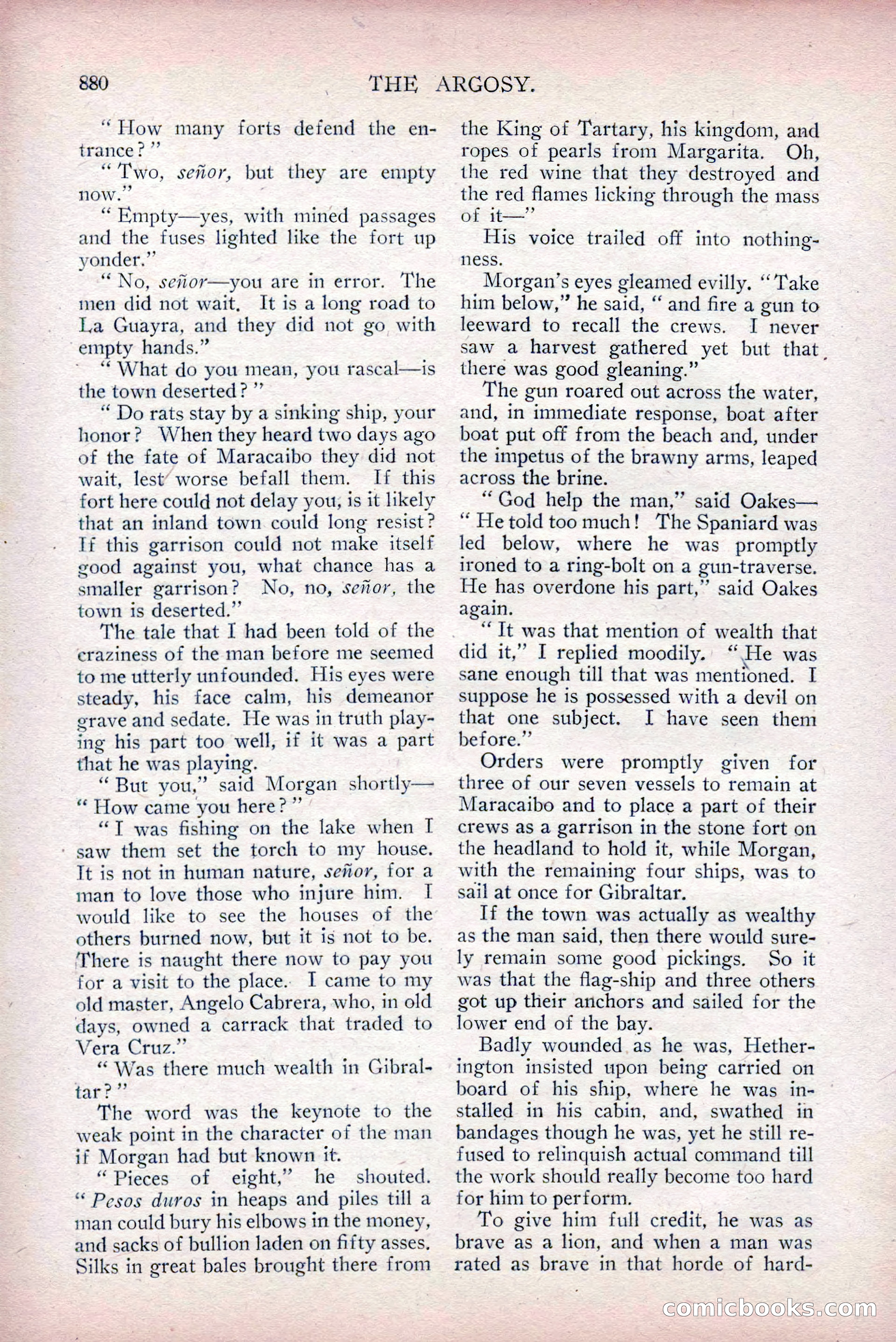
A restored page from Pulp Fiction, 1914. Page through the whole issue in the reader above.
📄 Transcribed text from this page (OCR, searchable)
Machine-transcribed from the original scan — historical spelling and the odd misread are preserved.
880 “How many forts defend the en- trance? ” “Two, senor, but they are empty now.” . ‘“ Empty—yes, with mined passages and the fuses lighted like the fort up yonder.”’ “No, sefior—you are in error. The men did not wait, It is a long road to La Guayra, and they did not go with empty hands.” ‘What do you mean, you rascal—is the town deserted? ”’ Do rats stay by a sinking ship, your honor? When they heard two days ago of the fate of Maracaibo they did not wait, lest’ worse befall them. If this fort here could not delay you, is it likely that an inland town could long resist? If this garrison could not make itself good against you, what chance has a smaller garrison? No, no, sevor, the town is deserted.”’ The tale that I had been told of the craziness of the man before me seemed to me utterly unfounded. His eyes were steady, his face calm, his demeanor erave and sedate. He was in truth play- ing his part too well, if it was a part that he was playing. “But you,’ said Morgan shortly— “ Tow came you here? ”’ “T was fishing on the lake when I - saw them set the torch to my house. Tt is not in human nature, senvor, for a man to love those who injure him. [| would like to see the houses of the others burned now, but it 1s not to be. There is naught there now to pay you for a visit to the place. I came to my old master, Angelo Cabrera, who, in old days, owned a carrack that traded to Vera Cruz.” “ Was there much wealth in Gibral- tar?” The word was the keynote to the weak point in the character of the man if Morgan had but known it. “Pieces of eight,” he shouted. “ Pesos duros in heaps and piles till a man could bury his elbows in the money, and sacks of bullion laden on fifty asses. Silks in great bales brought there from THE ARGOSY. the King of Tartary, his kingdom, and ropes of pearls from Margarita. Oh, the red wine that they destroyed and the red flames licking through the mass of it—” His voice trailed off into nothing- ness. Morgan's eyes gleamed evilly. “Take him below,” he said, “ and fire a gun to leeward to recall the crews. I never saw a harvest gathered yet but that. there was good gleaning.” The gun roared out across the water, and, in immediate response, boat after boat put off from the beach and, under the impetus of the brawny arms, leaped across the brine. “God help the man,” said Oakes— ‘“ He told too much! The Spaniard was led below, where he was _ promptly ironed to a ring-bolt on a gun-traverse. He has overdone his part,” said Oakes again. “It was that mention of wealth that did it,” I replied moodily. “He was sane enough till that was mentioned. I suppose he is possessed with a devil on that one subject. JI have seen them before.” Orders were promptly given for three of our seven vessels to remain at Maracaibo and to place a part of their crews as a garrison in the stone fort on the headland to hold it, while Morgan, with the remaining four ships, was to sail at once for Gibraltar. If the town was actually as wealthy as the man said, then there would sure- ly remain some good pickings. So it was that the flag-ship and three others got up their anchors and sailed for the lower end of the bay. Badly wounded as he was, Hether- ington insisted upon being carried on board of his ship, where he was in- stalled in his cabin, and, swathed in bandages though he was, yet he still re- fused to relinquish actual command till the work should really become too hard for him to perform. To give him full credit, he was as brave as a lion, and when a man was rated as brave in that horde of hard- EOPMICLOOOKS (C@)