
Pulp Fiction, 1914 · page 168 of 268
The Argosy, Vol. 75, No. 4 — page 168: what you’re looking at
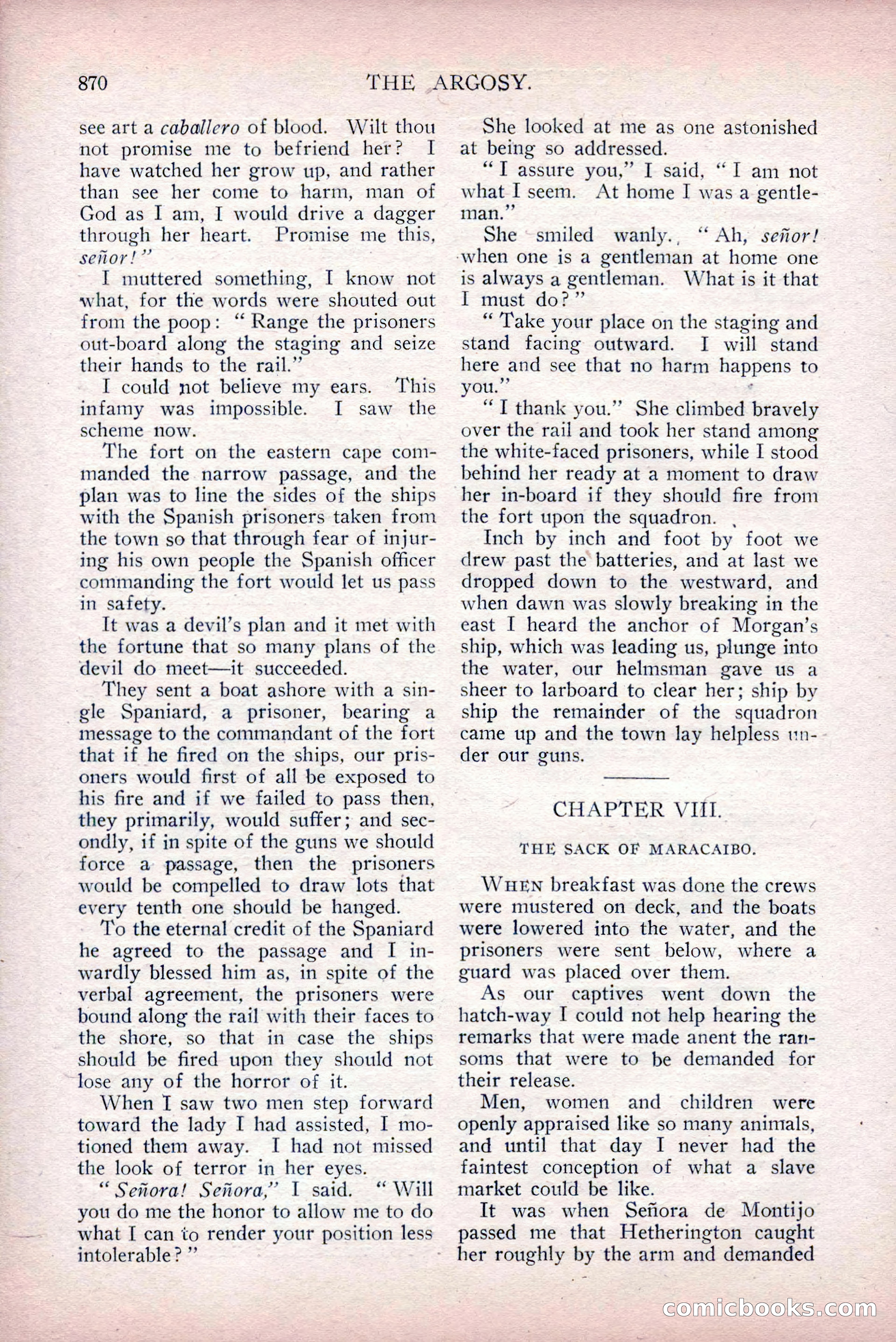
A restored page from Pulp Fiction, 1914. Page through the whole issue in the reader above.
📄 Transcribed text from this page (OCR, searchable)
Machine-transcribed from the original scan — historical spelling and the odd misread are preserved.
870 see art a caballero of blood. Wilt thou not promise me to befriend her? I have watched her grow up, and rather than see her come to harm, man of God as I am, I would drive a dagger through her heart. Promise me this, senior!” | I muttered something, I know not what, for the words were shouted out from the poop: “ Range the prisoners out-board along the staging and seize their hands to the rail.”’ I could not believe my ears. infamy was impossible. I saw scheme now. The fort on the eastern cape com- manded the narrow passage, and the plan was to line the sides of the ships with the Spanish prisoners taken from the town so that through fear of injur- ing his own people the Spanish officer commanding the fort would let us pass in safety. It was a devil’s plan and it met with the fortune that so many plans of the devil do meet—it succeeded. They sent a boat ashore with a sin- gle Spaniard, a prisoner, bearing a message to the commandant of the fort that if he fired on the ships, our pris- oners would first of all be exposed to his fire and if we failed to pass then, they primarily, would suffer; and sec- ondly, if in spite of the guns we should force a passage, then the prisoners would be compelled to draw lots that every tenth one should be hanged. To the eternal credit of the Spaniard he agreed to the passage and I in- wardly blessed him as, in spite of the verbal agreement, the prisoners were bound along the rail with their faces to the shore, so that in case the ships should be fired upon they should not lose any of the horror of it. When TI saw two men step forward toward the lady [ had assisted, I mo- tioned them away. I had not missed the look of terror in her eyes. “ Senora! Senora,’ I said. “ Will you do me the honor to allow me to do This the what [ can to render your position less intolerable? ”’ THE ARGOSY. She looked at me as one astonished at being so addressed. ““T assure you,” I said, “I am not what I seem. At home I was a gentle- man.”’ She smiled wanly., “ Ah, sefor! ‘when one is a gentleman at home one is always a gentleman. What is it that I must do?” “Take your place on the staging and stand facing outward. JI will stand here and see that no harm happens to you.” : “I thank you.” She climbed bravely over the rail and took her stand among the white-faced prisoners, while I stood behind her ready at a moment to draw her in-board if they should fire from the fort upon the squadron. , Inch by inch and foot by foot we drew past the batteries, and at last we dropped down to the westward, and when dawn was slowly breaking in the east [ heard the anchor of Morgan’s ship, which was leading us, plunge into the water, our helmsman gave us a sheer to larboard to clear her; ship by ship the remainder of the squadron came up and the town lay helpless un- der our guns. CHAPTER VIII. THE SACK OF MARACAIBO. WHEN breakfast was done the crews were mustered on deck, and the boats were lowered into the water, and the prisoners were sent below, where a guard was placed over them. As our captives went down the hatch-way I could not help hearing the remarks that were made anent the ran- soms that were to be demanded for their release. Men, women and children were openly appraised like so many animals, and until that day I never had the faintest conception of what a slave market could be like. It was when Sefiora de Montijo passed me that Hetherington caught her roughly by the arm and demanded COPMICGLOOOKS (©)