
Pulp Fiction, 1914 · page 167 of 268
The Argosy, Vol. 75, No. 4 — page 167: what you’re looking at
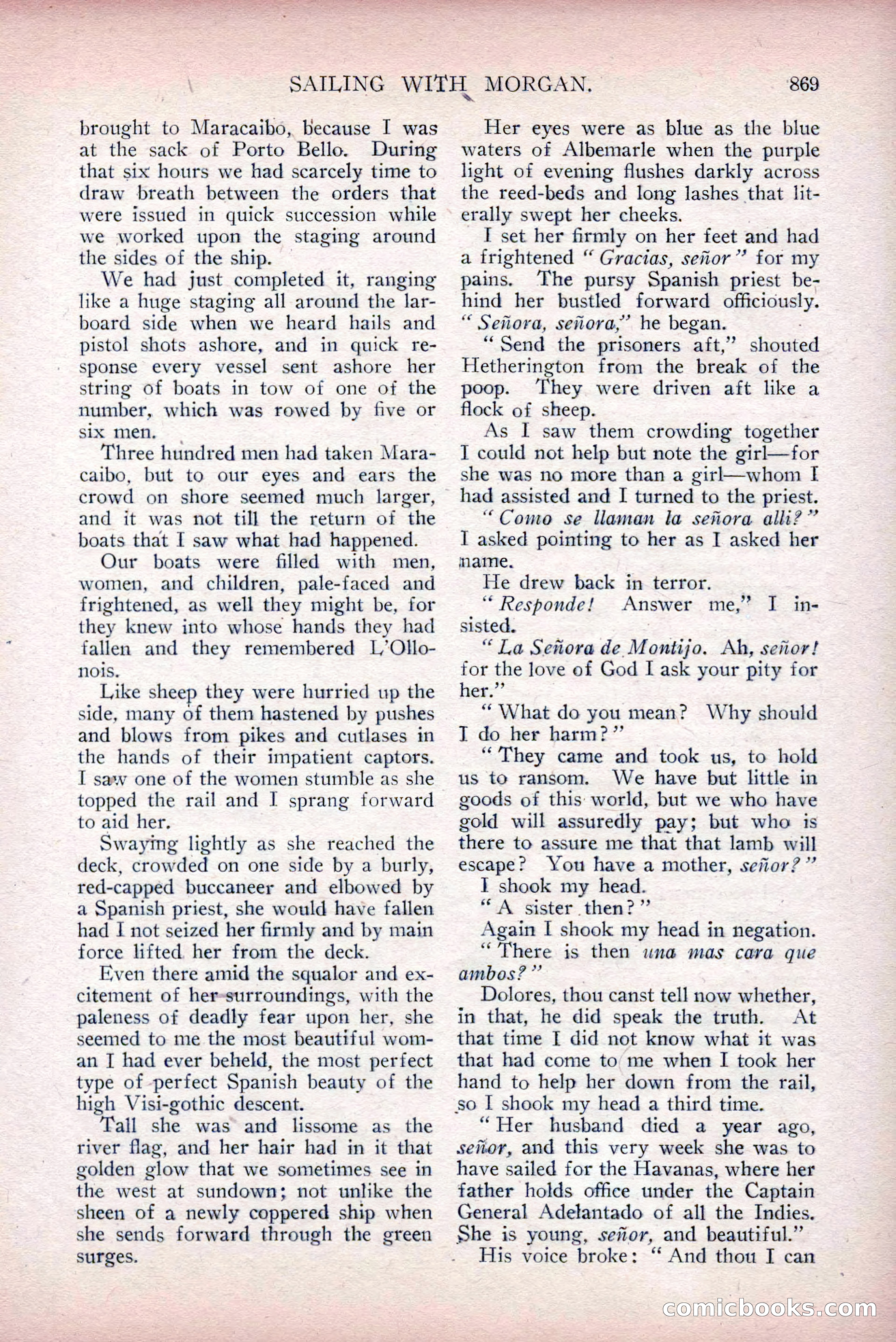
A restored page from Pulp Fiction, 1914. Page through the whole issue in the reader above.
📄 Transcribed text from this page (OCR, searchable)
Machine-transcribed from the original scan — historical spelling and the odd misread are preserved.
SAILING WITH MORGAN, brought to Maracaibo, because I was at the sack of Porto Bello. During that six hours we had scarcely time to draw breath between the orders that were issued in quick succession while we worked upon the staging around the sides of the ship. | We had just completed it, ranging like a huge staging all around the lar- board side when we heard hails and pistol shots ashore, and in quick re- sponse every vessel sent ashore her string of boats in tow of one of the number, which was rowed by five or six men. Three hundred men had taken Mara- caibo, but to our eyes and ears the crowd on shore seemed much larger, and it was not till the return of the boats that [ saw what had happened. Our boats were filled with men, women, and children, pale-faced and frightened, as well they might be, for they knew into whose hands they had fallen and they remembered L’Ollo- nois. Like sheep they were hurried up the side, many of them hastened by pushes and blows from pikes and cutlases in the hands of their impatient captors. I saw one of the women stumble as she topped the rail and I sprang forward to aid her. Swaying lightly as she reached the deck, crowded on one side by a burly, red-capped buccaneer and elbowed by a Spanish priest, she would have fallen had I not seized her firmly and by main force lifted her from the deck. Even there amid the squalor and ex- citement of her-surroundings, with the paleness of deadly fear upon her, she seemed to me the most beautiful wom- an [ had ever beheld, the most perfect type of perfect Spanish beauty of the high Visi-gothic descent. Tall she was and lissome as the river flag, and her hair had in it that golden glow that we sometimes see in the west at sundown; not unlike the sheen of a newly coppered ship when she sends forward through the green surges. 869 Her eyes were as blue as the blue waters of Albemarle when the purple light of evening flushes darkly across the reed-beds and long lashes that lit- erally swept her cheeks. I set her firmly on her feet and had a frightened “ Gracias, senor” for my pains. ‘The pursy Spanish priest be- hind her bustled forward officiously. Setora, seiora,’ he began. “Send the prisoners aft,’ shouted Hetherington from the break of the poop. They were driven aft like a flock of sheep. As I saw them crowding together I could not help but note the girl—for she was no more than a girl—whom I had assisted and I turned to the priest. “Como se llaman la seiora alli?” I asked pointing to her as I asked her name. He drew back in terror. Responde! Answer sisted. “ La Senora de Montijo. Ah, seor! for the love of God | ask your pity for her,” “ What do you mean? Why should J do her harm?” “They came and took us, to hold us to ransom. We have but little in goods of this world, but we who have gold will assuredly pay; but who is there to assure me that that lamb will escape? You have a mother, sefor?” I shook my head. “A sister then? ” Again I shook my head in negation. “There is then una mas cara que ambos?” Dolores, thou canst tell now whether, in that, he did speak the truth. At that time I did not know what it was that had come to me when I took her hand to help her down from the rail, so I shook my head a third time. “Her husband died a year ago, seior, and this very week she was to have sailed for the Havanas, where her father holds office under the Captain General Adelantado of all the Indies. She is young, sefor, and beautiful.” His voice broke: “‘ And thou I can 33 me,’ J in- ECOPMICLOOOKS (©)