
Pulp Fiction, 1914 · page 142 of 268
The Argosy, Vol. 75, No. 4 — page 142: what you’re looking at
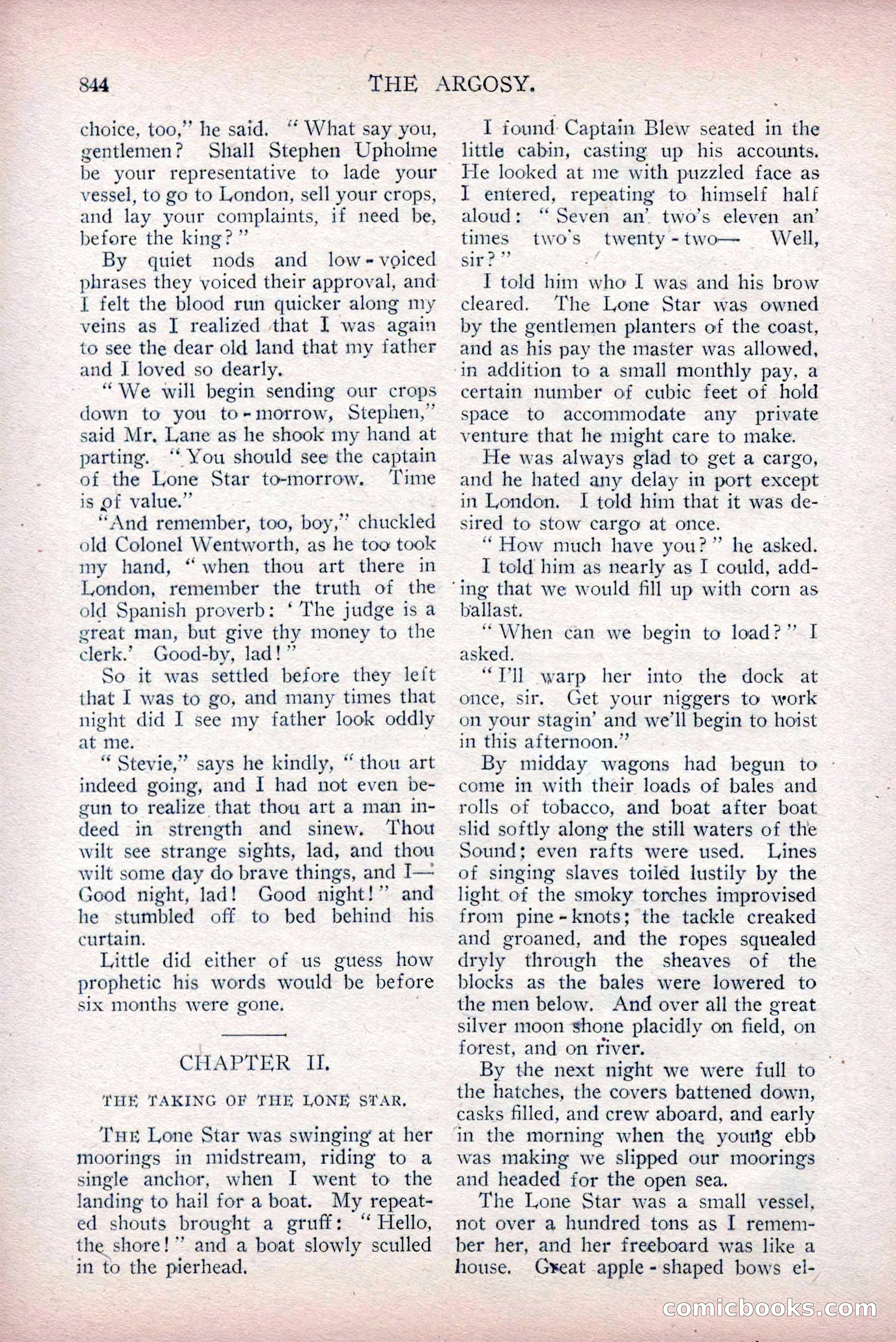
A restored page from Pulp Fiction, 1914. Page through the whole issue in the reader above.
📄 Transcribed text from this page (OCR, searchable)
Machine-transcribed from the original scan — historical spelling and the odd misread are preserved.
S44 choice, too,” he said. “‘ What say you, gentlemen? Shall Stephen Upholme be your representative to lade your vessel, to go to London, sell your crops, and lay your complaints, if need be, before the king?” By quiet nods and low voiced phrases they yoiced their approval, and I felt the blood run quicker along my veins as I realized that I was again to see the dear old land that my father and I loved so dearly. “We will begin sending our crops down to you to-morrow, Stephen,” said Mr. Lane as he shook my hand at parting. “* You should see the captain of the Lone Star to-morrow. ‘Time is of value.” “And remember, too, boy,’ chuckled old Colonel Wentworth, as he too took my hand, “ when thou art there in London, remember the truth of the old Spanish proverb: ‘ The judge is a ereat man, but give thy money to the clerk.’ Good-by, lad!”’ So it was settled before they leit that I was to go, and many times that night did I see my father look oddly at me. ‘ Stevie,” says he kindly, “ thou art indeed going, and I had not even be- gun to realize that thou art a man in- deed in strength and sinew. Thou wilt see strange sights, lad, and thou wilt some day do brave things, and I— Good night, lad! Good night!” and he stumbled off to bed behind his curtain. Little did either of us guess how prophetic his words would be before six months were gone. 3 CHAPTER II. THE TAKING OF THE LONE STAR, Tue Lone Star was swinging’ at her moorings in midstream, riding to a single anchor, when I went to the landing to hail for a boat. My repeat- ed shouts brought a gruff: ‘ Hello, the shore!” and a boat slowly sculled in to the pierhead. THE ARGOSY. I found Captain Blew seated in the little cabin, casting up his accounts. He looked at me with puzzled face as I entered, repeating to himself half aloud: ‘“ Seven an’ two's eleven an’ times twos twenty-two— Well, S1r! Y told him who I was and his brow cleared. The Lone Star was owned by the gentlemen planters of the coast, and as his pay the master was allowed, ‘in addition to a small monthly pay, a certain number of cubic feet of hold space to accommodate any private venture that he might care to make. He was always glad to get a cargo, and he hated any delay in port except in London. I told him that it was de- sired to stow cargo at once. ‘“ How much have you?” he asked. I told him as nearly as I could, add- ‘ing that we would fill up with corn as ballast. “When can we begin to load?” I asked. “Tl warp her into the dock at once, sir, Get your niggers to work on your stagin’ and we'll begin to hoist in this afternoon.” By midday wagons had begun to ~ come in with their loads of bales and rolls of tobacco, and boat after boat slid softly along the still waters of the Sound: even rafts were used. Lines of singing slaves toiled lustily by the light. of the smoky torches improvised from pine-knots; the tackle creaked and groaned, and the ropes squealed dryly through the sheaves of the blocks as the bales were lowered to the men below, And over all the great silver moon shone placidly on field, on forest, and on river. By the next night we were full to — the hatches, the covers battened down, casks filled, and crew aboard, and early in the morning when the yourig ebb was making we slipped our moorings and headed for the open sea. The Lone Star was a small vessel, not over a hundred tons as I remem- ber her, and her freeboard was like a house. Great apple - shaped bows el- KS) GEomichoo (E@)