
Pulp Fiction, 1914 · page 141 of 268
The Argosy, Vol. 75, No. 4 — page 141: what you’re looking at
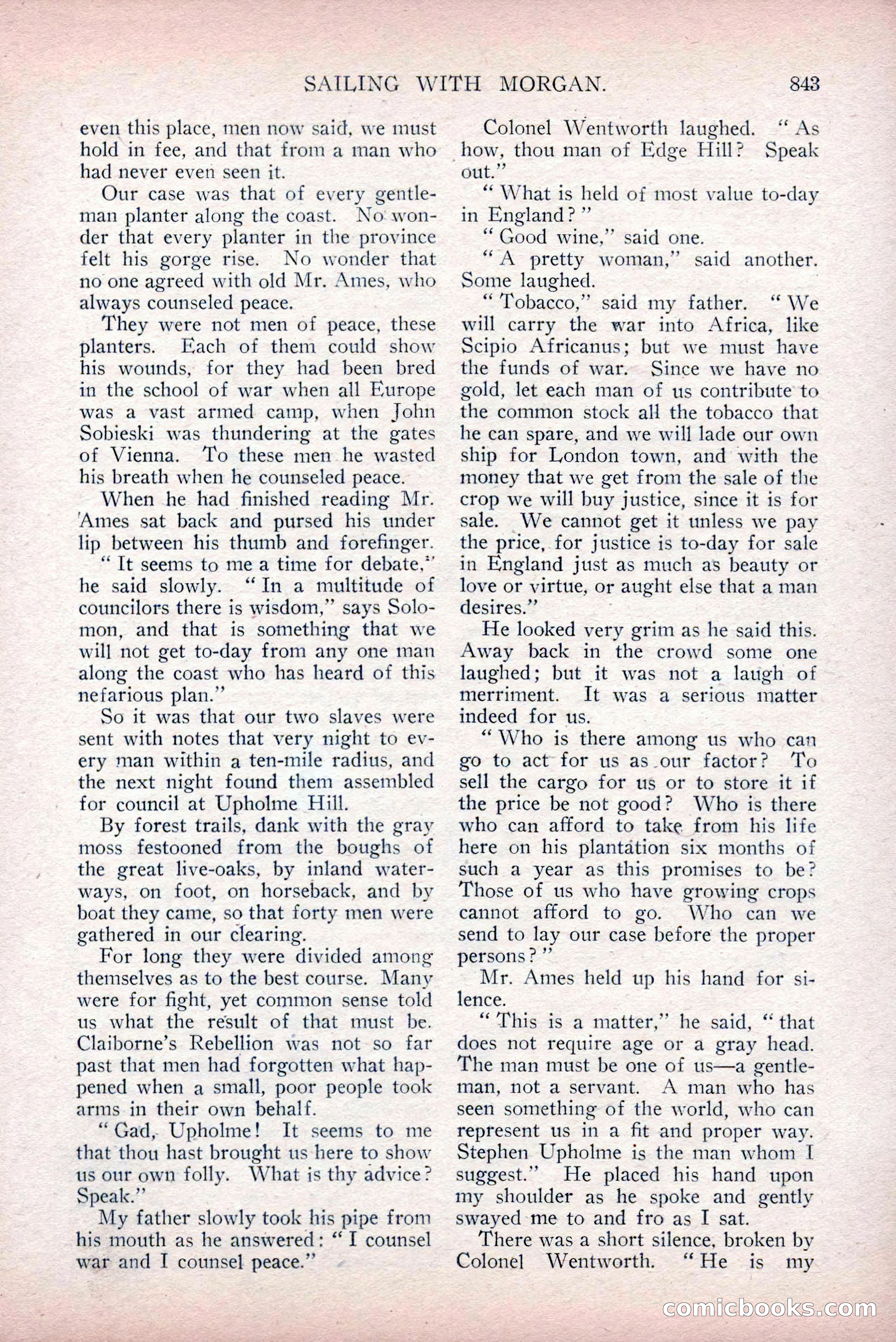
A restored page from Pulp Fiction, 1914. Page through the whole issue in the reader above.
📄 Transcribed text from this page (OCR, searchable)
Machine-transcribed from the original scan — historical spelling and the odd misread are preserved.
SAILING WITH even this place, men now said, we must hold in fee, and that from a man who had never even seen it. Our case was that of every gentle- man planter along the coast. No won- der that every planter in the province felt his gorge rise. No wonder that no one agreed with old Mr. Ames, who always counseled peace. They were not men of peace, these planters. Each of them could show his wounds, for they had been bred in the school of war when all Europe was a vast armed camp, when John Sobieski was thundering at the gates of Vienna. ‘To these men he wasted his breath when he counseled peace. When he had finished reading Mr. Ames sat back and pursed his under lip between his thumb and forefinger. “It seems to me a time for debate,”’ he said slowly. “In a multitude of councilors there is wisdom,” says Solo- mon, and that is something that we wil] not get to-day from any one man along the coast who has heard of this nefarious plan.” So it was that our two slaves were sent with notes that very night to ev- ery man within a ten-mile radius, and the next night found them assembled for council at Upholme Hill. By forest trails, dank with the gray moss festooned from the boughs of the great live-oaks, by inland water- ways, on foot, on horseback, and by boat they came, so that forty men were gathered in our clearing. For long they were divided among themselves as to the best course. Many were for fight, yet common sense told us what the result of that must be. Claiborne’s Rebellion was not so far past that men had forgotten what hap- pened when a small, poor people took arms in their own behalf. “Gad, Upholme! It seems to me that thou hast brought us here to show us our own folly. What is thy advice? Speak.” My father slowly took his pipe from his mouth as he answered: “ I counsel war and I counsel peace.”’ how, thou man of Edge Hill? MORGAN. 848 Colonel Wentworth laughed. “ As Speak out.” “What is held of most value to-day in England? ” “Good wine,” said one. “A pretty woman,” said another. Some laughed. “Tobacco,” said my father. ‘“ We will carry the war into Africa, like Scipio Africanus; but we must have the funds of war. Since we have no gold, let each man of us contribute to the common stock all the tobacco that he can spare, and we will lade our own ship for London town, and with the money that we get from the sale of the crop we will buy justice, since it is for sale. We cannot get it unless we pay the price, for justice is to-day for sale in England just as much as beauty or love or virtue, or aught else that a man desires.” He looked very grim as he said this. Away back in the crowd some one laughed; but it was not a laugh of merriment. It was a serious matter indeed for us. “Who is there among us who can go to act for us as_our factor? ‘To sell the cargo for us or to store it if the price be not good? Who is there who can afford to take from his life here on his plantation six months of such a year as this promises to be? Those of us who have growing crops cannot afford to go. Who can we send to lay our case before the proper persons? ”’ Mr. Ames held up his hand for si- lence. “This is a matter,” he said, ‘‘ that does not require age or a gray head. The man must be one of us—a gentle- man, not a servant. A man who has seen something of the world, who can represent us in a fit and proper way. Stephen Upholme is the man whom | suggest.’ He placed his hand upon my shoulder as he spoke and gently swayed me to and fro as I sat. There was a short silence, broken by Colonel Wentworth. “He is my ECOPMICGLOOOKS (E@)