
Pulp Fiction, 1914 · page 125 of 268
The Argosy, Vol. 75, No. 4 — page 125: what you’re looking at
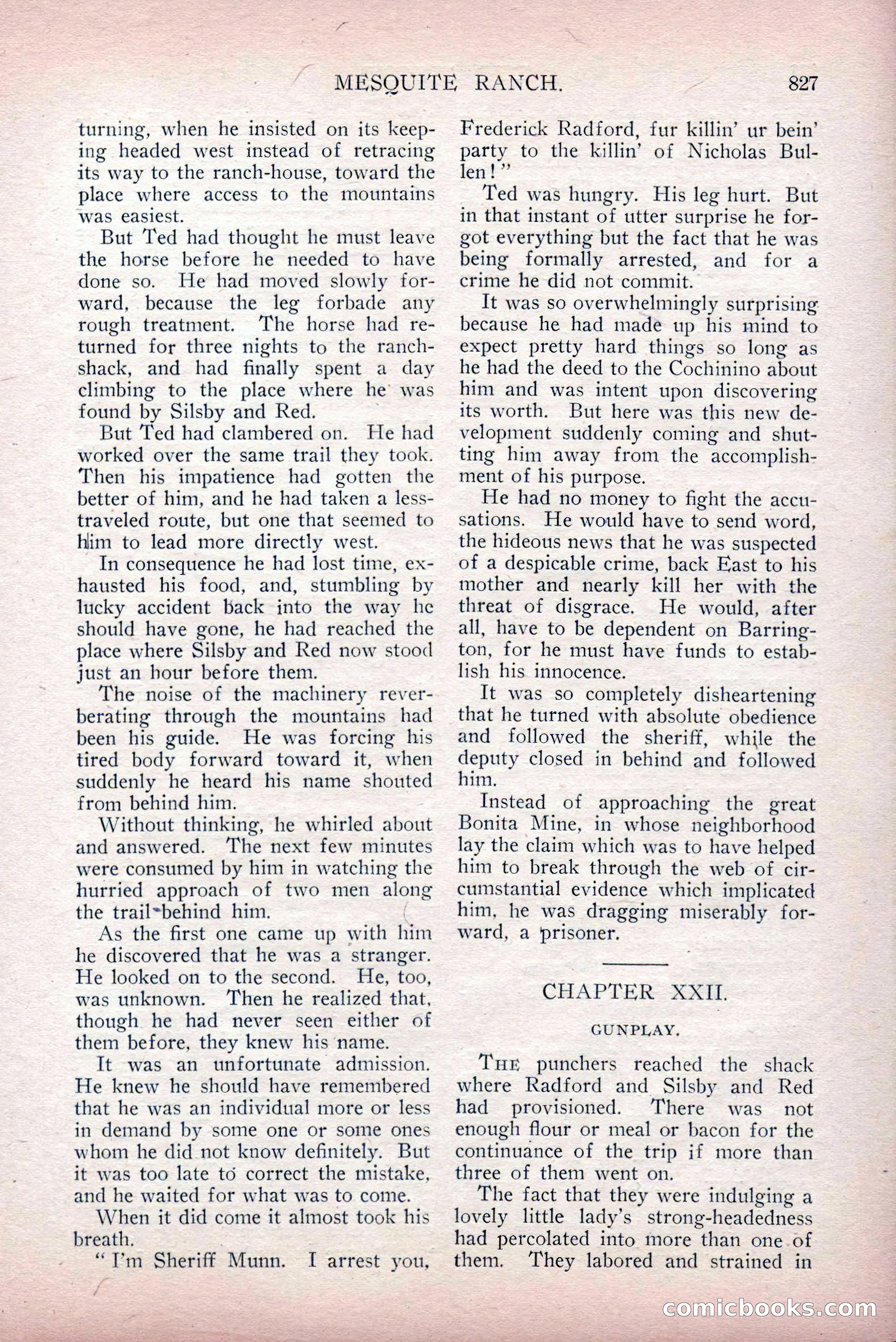
A restored page from Pulp Fiction, 1914. Page through the whole issue in the reader above.
📄 Transcribed text from this page (OCR, searchable)
Machine-transcribed from the original scan — historical spelling and the odd misread are preserved.
MESQUITE RANCH. turning, when he insisted on its keep- ing headed west instead of retracing its way to the ranch-house, toward the place where access to the mountains was easiest. But Ted had thought he must leave the horse before he needed to have done so. He had moved slowly for- ward, because the leg forbade any rough treatment. The horse had re- turned for three nights to the ranch- shack, and had finally spent a day climbing to the place where he was found by Silsby and Red. But Ted had clambered on. He had worked over the same trail they took. Then his impatience had gotten the better of him, and he had taken a less- traveled route, but one that seemed to him to lead more directly west. In consequence he had lost time, ex- hausted his food, and, stumbling by lucky accident back into the way he should have gone, he had reached the place where Silsby and Red now stood just an hour before them. The noise of the machinery rever- berating through the mountains had been his guide. He was forcing his tired body forward toward it, when suddenly he heard his name shouted from behind him. Without thinking, he whirled about and answered. The next few minutes were consumed by him in watching the hurried approach of two men along the trailsbehind him. As the first one came up with him he discovered that he was a stranger. He looked on to the second. He, too, was unknown. Then he realized that, though he had never seen either of them before, they knew his name. It was an unfortunate admission. He knew he should have remembered that he was an individual more or less in demand by some one or some ones whom he did not know definitely. But it was too late to correct the mistake, and he waited for what was to come. When it did come it almost took his breath. “T’m Sheriff Munn. I arrest you, 827 Frederick Radford, fur killin’ ur bein’ party to the killin’ of Nicholas Bul- len!” Ted was hungry. His leg hurt. But in that instant of utter surprise he for- got everything but the fact that he was being formally arrested, and for a crime he did not commit. It was so overwhelmingly surprising because he had made up his mind to expect pretty hard things so long as he had the deed to the Cochinino about him and was intent upon discovering its worth. But here was this new de- velopment suddenly coming and shut- ting him away from the accomplish- ment of his purpose. He had no money to fight the accu- sations. He would have to send word, the hideous news that he was suspected of a despicable crime, back East to his mother and nearly kill her with the threat of disgrace. He would, after all, have to be dependent on Barring- ton, for he must have funds to estab- lish his innocence. It was so completely disheartening that he turned with absolute obedience and followed the sheriff, while the deputy closed in behind and followed him. Instead of approaching the great Bonita Mine, in whose neighborhood lay the claim which was to have helped him to break through the web of cir- cumstantial evidence which implicated him, he was dragging miserably for- ward, a ‘prisoner. CHAPTER XXII. GUNPLAY. Tur punchers reached the shack where Radford and Silsby and Red had provisioned. There was _ not enough flour or meal or bacon for the continuance of the trip if more than three of them went on. The fact that they were indulging a lovely little lady’s strong-headedness had percolated into more than one of them. They labored and strained in GEomichbooks (E(@) AL