
Pulp Fiction, 1912 · page 53 of 238
The Argosy, April 1912 — page 53: what you’re looking at
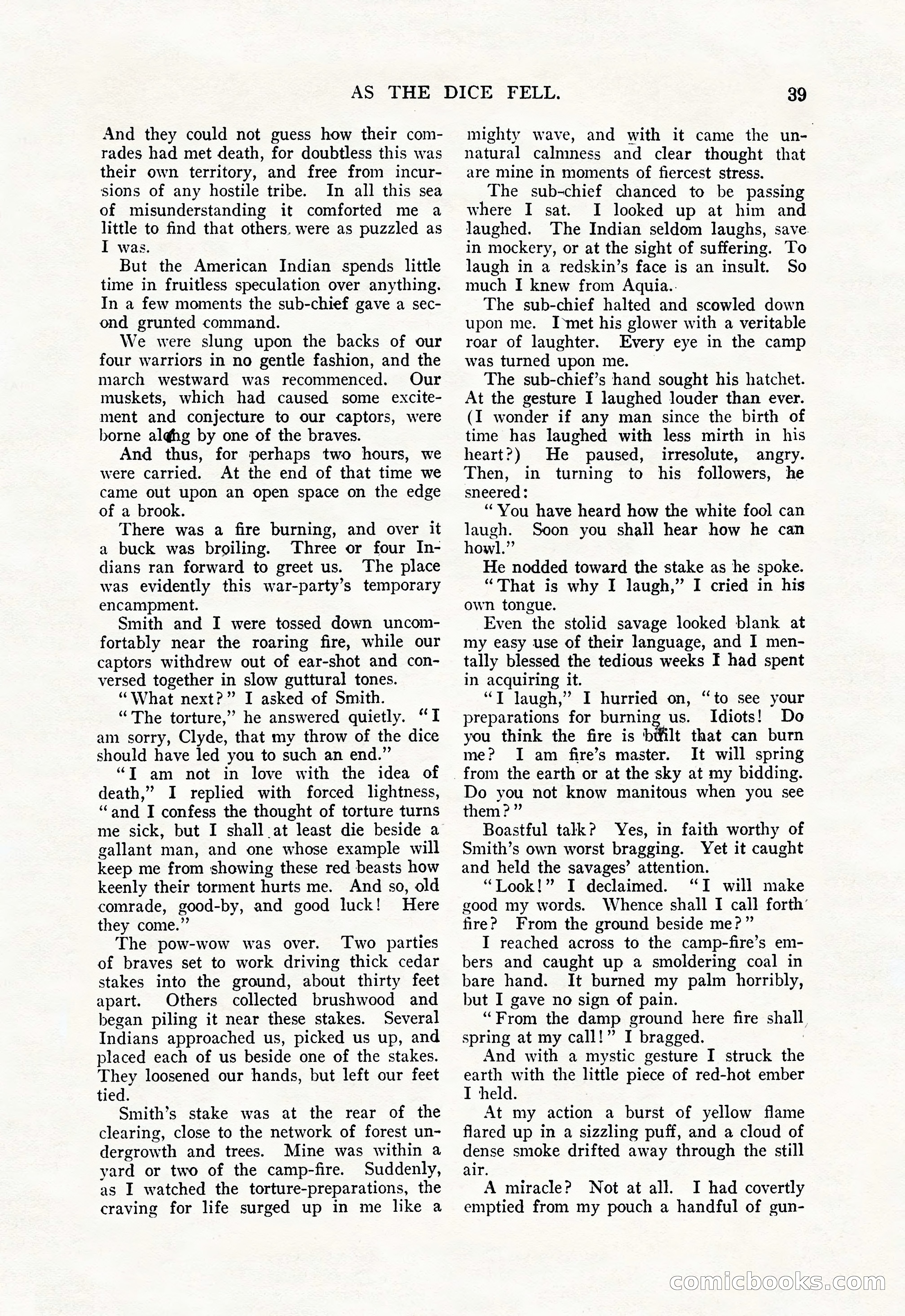
A restored page from Pulp Fiction, 1912. Page through the whole issue in the reader above.
📄 Transcribed text from this page (OCR, searchable)
Machine-transcribed from the original scan — historical spelling and the odd misread are preserved.
AS THE DICE FELL. And they could not guess how their com- rades had met death, for doubtless this was their own territory, and free from incur- sions of any hostile tribe. In all this sea of misunderstanding it comforted me a little to find that others. were as puzzled as I was. But the American Indian spends little time in fruitless speculation over anything. In a few moments the sub-chief gave a sec- ond grunted command. We were slung upon the backs of our four warriors in no gentle fashion, and the march westward was recommenced. Our muskets, which had caused some excite- ment and conjecture to our captors, were borne al@hg by one of the braves. And thus, for perhaps two hours, we were carried. At the end of that time we came out upon an open space on the edge of a brook. There was a fire burning, and over it a buck was broiling. Three or four In- dians ran forward to greet us. The place was evidently this war-party’s temporary encampment. Smith and I were tossed down uncom- fortably near the roaring fire, while our captors withdrew out of ear-shot and con- versed together in slow guttural tones. 4 What next?” I asked of Smith. “The torture,” he answered quietly. “I am. sorry, Clyde, that my throw of the dice should have led you to such an end.” “T am not in love with the idea of death,” I replied with forced lightness, “and I confess the thought of torture turns me sick, but I shall at least die beside a gallant man, and one whose example will keep me from showing these red beasts how keenly their torment hurts me. And so, old comrade, good-by, and good luck! Here they come.”’ The pow-wow was over. Two parties of braves set to work driving thick cedar stakes into the ground, about thirty feet apart. Others collected brushwood and began piling it near these stakes. Several Indians approached us, picked us up, and placed each of us beside one of the stakes. They loosened our hands, but left our feet tied. Smith’s stake was at the rear of the clearing, close to the network of forest un- dergrowth and trees. Mine was within a yard or two of the camp-fire. Suddenly, as I watched the torture-preparations, the craving for life surged up in me like a 39 mighty wave, and with it came the un- natural calmness and clear thought that are mine in moments of fiercest stress. The sub-chief chanced to be passing where I sat. I looked up at him and laughed. ‘The Indian seldom laughs, save. in mockery, or at the sight of suffering. To laugh in a redskin’s face is an insult. So much I knew from Aquia.. The sub-chief halted and scowled down upon me. Imet his glower with a veritable roar of laughter. Every eye in the camp was turned upon me. The sub-chief’s hand sought his hatchet. At the gesture I laughed louder than ever. (I wonder if any man since the birth of time has laughed with less mirth in his heart?) He paused, irresolute, angry. Then, in turning to his followers, he sneered: ‘You have heard how the white fool can laugh. Soon you shall hear how he can howl.” He nodded toward the stake as he spoke. “That is why I laugh,” I cried in his own tongue. Even the stolid savage looked blank at my easy use of their language, and I men- tally blessed the tedious weeks I had spent in acquiring it. “T laugh,” I hurried on, “to see your preparations for burning us. Idiots! Do you think the fire is bifilt that can burn me? I am fire’s master. It will spring from the earth or at the sky at my bidding. Do you not know manitous when you see them?” Boastful talk? Yes, in faith worthy of Smith’s own worst bragging. Yet it caught and held the savages’ attention. “Look!” I declaimed. “I will make good my words. fire? From the ground beside me?” I reached across to the camp-fire’s em- bers and caught up a smoldering coal in bare hand. It burned my palm horribly, but I gave no sign of pain. “From the damp ground here fire shall spring at my call!” i bragged. And with a mystic gesture I struck the earth with the TE piece of red-hot ember I held. At my action a burst of yellow flame flared up in a sizzling puff, and a cloud of dense smoke drifted away through the still air. A miracle? Not at all. I had covertly emptied from my pouch a handful of gun- CoOmicoool. Whence shall I call forth’