
Pulp Fiction, 1912 · page 52 of 238
The Argosy, April 1912 — page 52: what you’re looking at
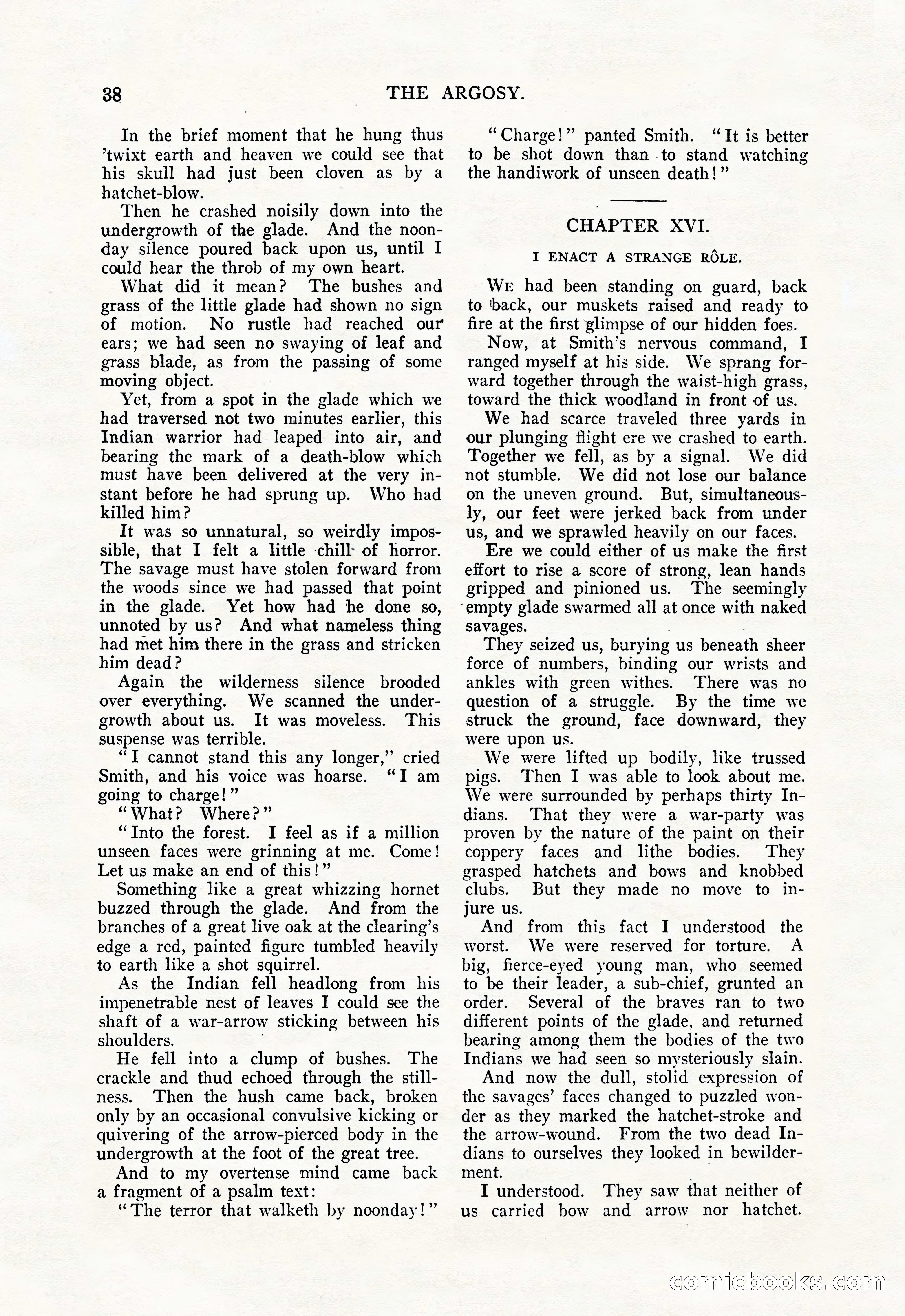
A restored page from Pulp Fiction, 1912. Page through the whole issue in the reader above.
📄 Transcribed text from this page (OCR, searchable)
Machine-transcribed from the original scan — historical spelling and the odd misread are preserved.
38 In the brief moment that he hung thus ’twixt earth and heaven we could see that his skull had just been cloven as by a hatchet-blow. Then he crashed noisily down into the undergrowth of the glade. And the noon- day silence poured back upon us, until I could hear the throb of my own heart. What did it mean? The bushes and grass of the little glade had shown no sign of motion. No rustle had reached our ears; we had seen no swaying of leaf and grass blade, as from the passing of some moving object. Yet, from a spot in the glade which we had traversed not two minutes earlier, this Indian warrior had leaped into air, and bearing the mark of a death-blow which must have been delivered at the very in- stant before he had sprung up. Who had killed him? It was so unnatural, so weirdly impos- sible, that I felt a little -chill- of horror. The savage must have stolen forward from the woods since we had passed that point in the glade. Yet how had he done s0, unnoted by us? And what nameless thing had met him there in the grass and stricken him dead? Again the wilderness silence brooded over everything. We scanned the under- growth about us. It was moveless. This suspense was terrible. “T cannot stand this any longer,” cried Smith, and his voice was hoarse. “I am going to charge!” “What? Where?” “Into the forest. I feel as if a million unseen faces were grinning at me. Come! Let us make an end of this!” Something like a great whizzing hornet buzzed through the glade. And from the branches of a great live oak at the clearing’s edge a red, painted figure tumbled heavily to earth like a shot squirrel. As the Indian fell headlong from his impenetrable nest of leaves I could see the shaft of a war-arrow sticking between his shoulders. He fell into a clump of bushes. The crackle and thud echoed through the still- ness. ‘Then the hush came back, broken only by an occasional convulsive kicking or quivering of the arrow-pierced body in the undergrowth at the foot of the great tree. And to my overtense mind came back a fragment of a psalm text: “The terror that walketh by noonday!”’ ? THE ARGOSY. “Charge!” panted Smith. “It is better to be shot down than -to stand watching the handiwork of unseen death!” CHAPTER XVI. I ENACT A STRANGE ROLE. WE had been standing on guard, back to back, our muskets raised and ready to fire at the first glimpse of our hidden foes. Now, at Smith’s nervous command, I ranged myself at his side. We sprang for- ward together through the waist-high grass, toward the thick woodland in front of us. We had scarce traveled three yards in our plunging flight ere we crashed to earth. Together we fell, as by a signal. We did not stumble. We did not lose our balance on the uneven ground. But, simultaneous- ly, our feet were jerked back from under us, and we sprawled heavily on our faces. Ere we could either of us make the first effort to rise a score of strong, lean hands gripped and pinioned us. The seemingly ‘empty glade swarmed all at once with naked savages. 3 | They seized us, burying us beneath sheer force of numbers, binding our wrists and ankles with green withes. There was no question of a struggle. By the time we struck the ground, face downward, they were upon us. We were lifted up bodily, like trussed pigs. Then I was able to look about me. We were surrounded by perhaps thirty In- dians. That they were a war-party was proven by the nature of the paint on their coppery faces and lithe bodies. They grasped hatchets and bows and knobbed clubs. But they made no move to in- jure us. And from this fact I understood the worst. We were reserved for torture. A big, flerce-eyed young man, who seemed to be their leader, a sub-chief, grunted an order. Several of the braves ran to two different points of the glade, and returned bearing among them the bodies of the two Indians we had seen so mysteriously slain. And now the dull, stolid expression of the savages’ faces changed to puzzled won- der as they marked the hatchet-stroke and the arrow-wound. From the two dead In- dians to ourselves they looked in bewilder- ment. I understood. They saw that neither of us carried bow and arrow nor hatchet. nn (©) cClooolk< (CO