
Pulp Fiction, 1912 · page 47 of 238
The Argosy, April 1912 — page 47: what you’re looking at
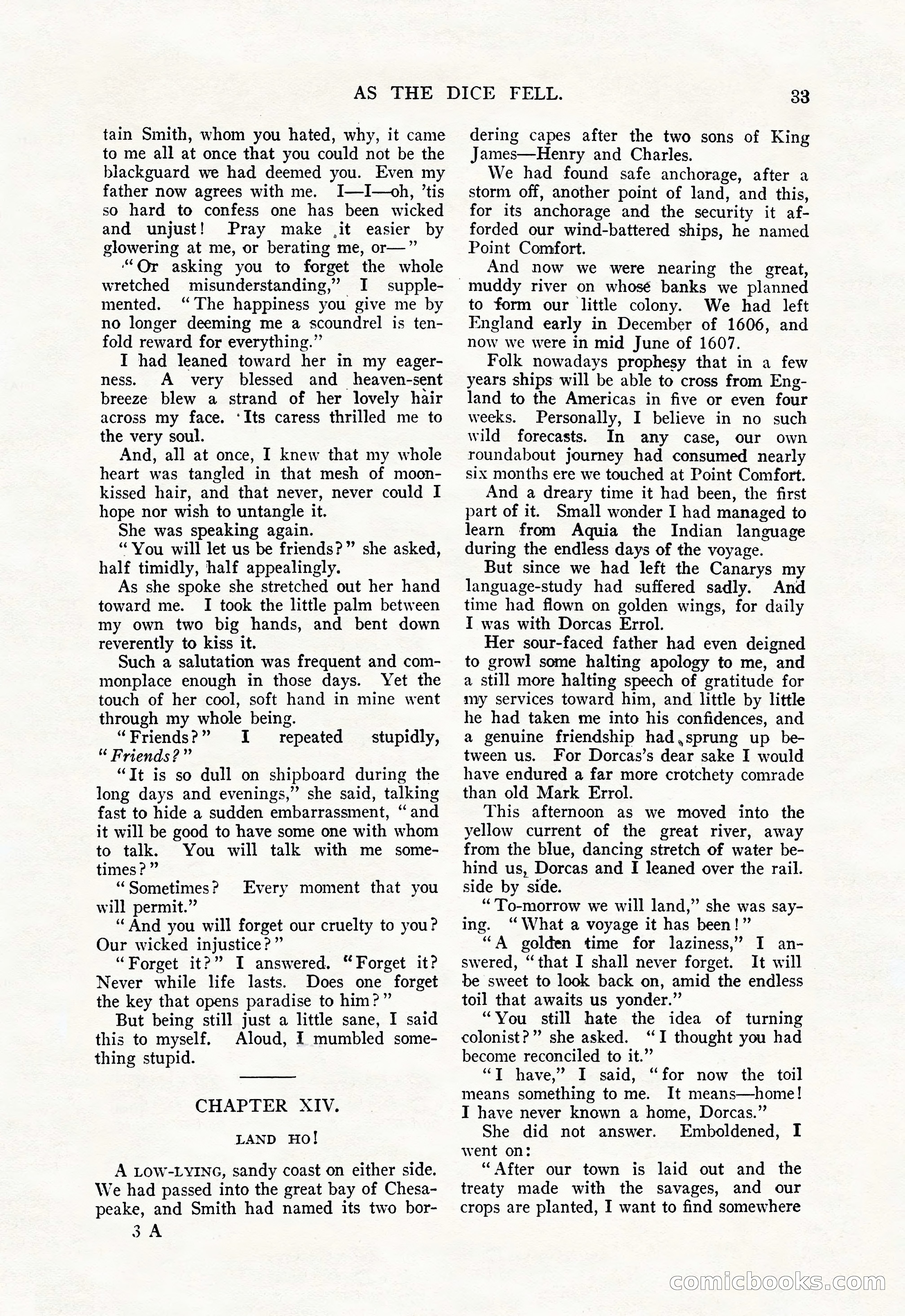
A restored page from Pulp Fiction, 1912. Page through the whole issue in the reader above.
📄 Transcribed text from this page (OCR, searchable)
Machine-transcribed from the original scan — historical spelling and the odd misread are preserved.
AS THE DICE FELL. tain Smith, whom you hated, why, it came to me all at once that you could not be the blackguard we had deemed you. Even my father now agrees with me. I—I—oh, ’tis so hard to confess one has been wicked and unjust! Pray make ,it easier by glowering at me, or berating me, or—” ““Or asking you to forget the whole wretched misunderstanding,” I supple- mented. “The happiness you give me by no longer deeming me a scoundrel is ten- fold reward for everything.” I had leaned toward her in my eager- ness. A very blessed and _heaven-sent breeze blew a strand of her lovely hair across my face. ‘Its caress thrilled me to the very soul. And, all at once, I knew that my whole heart was tangled in that mesh of moon- kissed hair, and that never, never could I hope nor wish to untangle it. She was speaking again. “You will let us be friends?” she asked, half timidly, half appealingly. As she spoke she stretched out her hand toward me. I took the little palm between my own two big hands, and bent down reverently to kiss it. Such a salutation was frequent and com- monplace enough in those days. Yet the touch of her cool, soft hand in mine went through my whole being. “Friends?” I repeated “ Friends?” “Jt is so dull on shipboard during the long days and evenings,” she said, talking fast to hide a sudden embarrassment, “and it will be good to have some one with whom to talk. You will talk with me some- times?” “Sometimes ? will permit.” ‘And you will forget our cruelty to you? Our wicked injustice?” “Forget it?” I answered. “Forget it? Never while life lasts. Does one forget the key that opens paradise to him?” But being still just a little sane, I said this to myself. Aloud, 1 mumbled some- thing stupid. stupidly, Every moment that you CHAPTER XIV. LAND Ho! A LOW-LYING, sandy coast on either side. We had passed into the great bay of Chesa- peake, and Smith had named its two bor- 3A 33 dering capes after the two sons of King James—Henry and Charles. We had found safe anchorage, after a storm off, another point of land, and this, for its anchorage and the security it af- forded our wind-battered ships, he named Point Comfort. And now we were nearing the great, -muddy river on whosé banks we planned to form our little colony. We had left England early in December of 1606, and now we were in mid June of 1607. Folk nowadays prophesy that in a few years ships will be able to cross from Eng- land to the Americas in five or even four weeks. Personally, I believe in no such wild forecasts. In any case, our own roundabout journey had consumed nearly six months ere we touched at Point Comfort. And a dreary time it had been, the first part of it. Small wonder I had managed to learn from Aquia the Indian language during the endless days of the voyage. But since we had left the Canarys my language-study had suffered sadly. And time had flown on golden wings, for daily I was with Dorcas Errol. Her sour-faced father had even deigned to growl some halting apology to me, and a still more halting speech of gratitude for my services toward him, and little by little he had taken me into his confidences, and a genuine friendship had,sprung up be- tween us. For Dorcas’s dear sake I would have endured a far more crotchety comrade than old Mark Errol. This afternoon as we moved into the yellow current of the great river, away from the blue, dancing stretch of water be- hind us, Dorcas and I leaned over the rail. side by side. “To-morrow we will land,” she was say- ing. “What a voyage it has been!” “A golden time for laziness,’ I an- swered, “that I shall never forget. It will be sweet to look back on, amid the endless toil that awaits us yonder.” “You still hate the idea of turning colonist?’’ she asked. “I thought you had become reconciled to it.” “T have,” I said, “for now the toil means something to me. It means—home! I have never known a home, Dorcas.” She did not answer. Emboldened, I went on: “After our town is laid out and the treaty made with the savages, and our crops are planted, I want to find somewhere CONMUC NOOK CO