
Pulp Fiction, 1912 · page 46 of 238
The Argosy, April 1912 — page 46: what you’re looking at
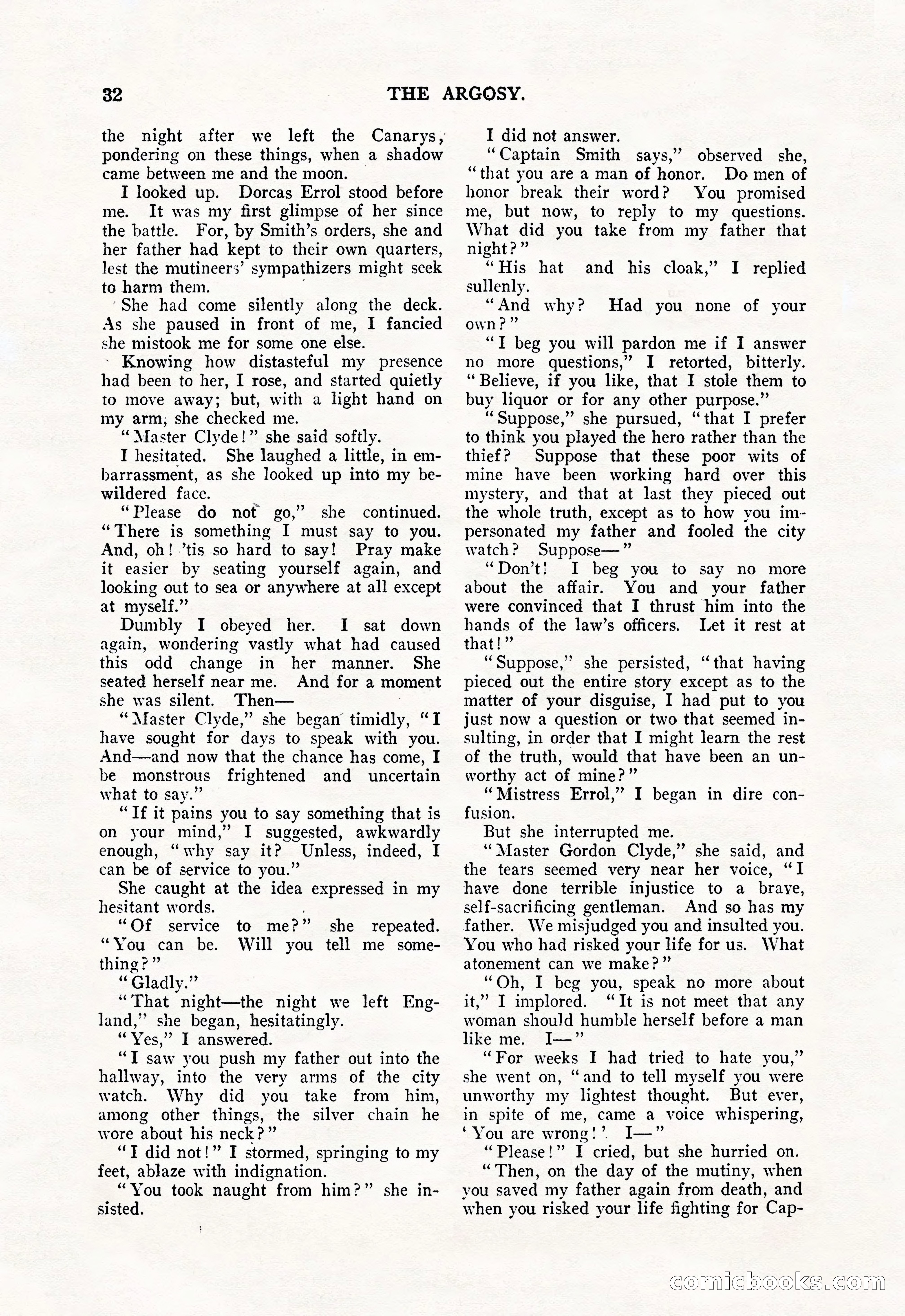
A restored page from Pulp Fiction, 1912. Page through the whole issue in the reader above.
📄 Transcribed text from this page (OCR, searchable)
Machine-transcribed from the original scan — historical spelling and the odd misread are preserved.
32 the night after we left the pondering on these things, when a shadow came between me and the moon. I looked up. Dorcas Errol stood before me. It was my first glimpse of her since the battle. For, by Smith’s orders, she and her father had kept to their own quarters, lest the mutineers’ sympathizers might seek to harm them. ‘She had come silently along the deck. As she paused in front of me, I fancied she mistook me for some one else. - Knowing how distasteful my presence had been to her, I rose, and started quietly to move away; but, with a light hand on my arm; she checked me. “Master Clyde!” she said softly. I hesitated. She laughed a little, in em- barrassment, as she looked up into my be- wildered face. “Please do not go,” she continued. “There is something I must say to you. And, oh! ’tis so hard to say! Pray make it easier by seating yourself again, and looking out to sea or anywhere at all except at myself.” Dumbly I obeyed her. I sat down again, wondering vastly what had caused this odd change in her manner. She seated herself near me. And for a moment she was silent. Then— | “Master Clyde,” she began timidly, “I have sought for days to speak with you. And—and now that the chance has come, I be monstrous frightened and _ uncertain what to say.” “Tf it pains you to say something that is on your mind,” I suggested, awkwardly enough, “why say it? Unless, indeed, I can be of service to you.” She caught at the idea expressed in my hesitant words. “Of service to me?” she repeated. “You can be. Will you tell me some- thing?” “Gladly.” “That night—the night we left Eng- land,” she began, hesitatingly. “Yes,” I answered. “I saw you push my father out into the hallway, into the very arms of the city watch. Why did you take from hin, among other things, the silver chain he wore about his neck?” “T did not!” I stormed, springing to my feet, ablaze with indignation. “You took naught from him?” she in- sisted. 4 Canarys, THE ARGOSY. I did not answer. ‘Captain Smith says,” observed she, “that you are a man of honor. Do men of honor break their word? You promised me, but now, to reply to my questions. What did you take from my father that ? night?” “His hat and his cloak,” I replied sullenly. “And why? Had you none of your own?” “T beg you will pardon me if I answer no more questions,’ I retorted, bitterly. ‘Believe, if you like, that I stole them to buy liquor or for any other purpose.” “Suppose,” she pursued, “that I prefer to think you played the hero rather than the thief? Suppose that these poor wits of mine have been working hard over this mystery, and that at last they pieced out the whole truth, except as to how vou im- personated my father and fooled the city watch? Suppose—” “Don’t! I beg you to say no more about the affair. You and your father were convinced that I thrust him into the hands of the law’s officers. Let it rest at that!” “Suppose,” she persisted, “that having pieced out the entire story except as to the matter of your disguise, I had put to you just now a question or two that seemed in- sulting, in order that I might learn the rest of the truth, would that have been an un- worthy act of mine?” “Mistress Errol,’ I began in dire con- fusion. But she interrupted me. ‘Master Gordon Clyde,” she said, and the tears seemed very near her voice, “I have done terrible injustice to a_ braye, self-sacrificing gentleman. And so has my father. We misjudged you and insulted you. You who had risked your life for us. What atonement can we make?” “Oh, I beg you, speak no more about it,’ I implored. “It is not meet that any woman should humble herself before a man like me. J—” “For weeks I had tried to hate you,” she went on, “and to tell myself you were unworthy my lightest thought. But ever, in spite of me, came a voice whispering, ‘You are wrong!’ I—” “Please!” I cried, but she hurried on. “Then, on the day of the mutiny, when you saved my father again from death, and when you risked your life fighting for Cap- comicoool. CO