
Pulp Fiction, 1912 · page 156 of 238
The Argosy, April 1912 — page 156: what you’re looking at
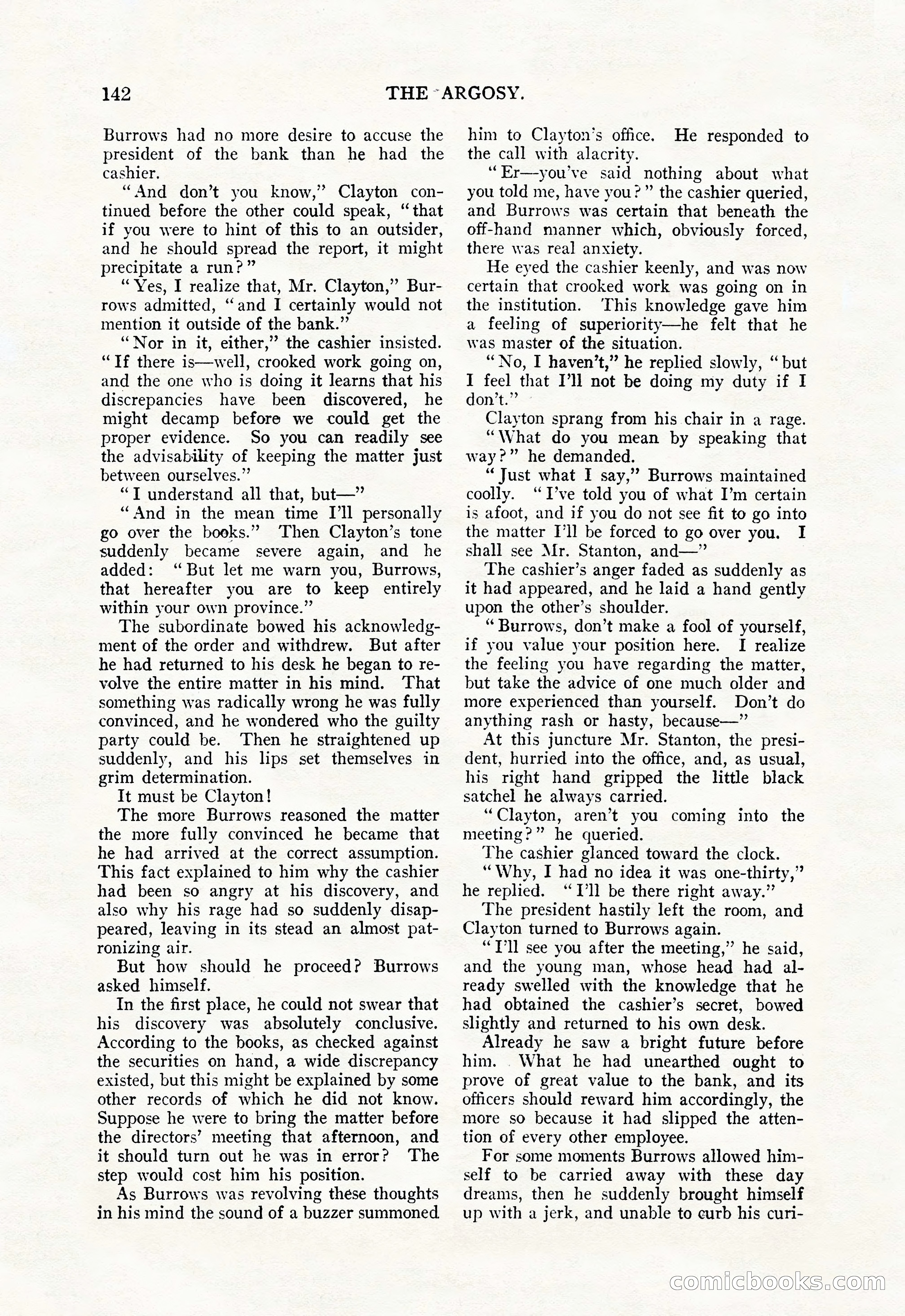
A restored page from Pulp Fiction, 1912. Page through the whole issue in the reader above.
📄 Transcribed text from this page (OCR, searchable)
Machine-transcribed from the original scan — historical spelling and the odd misread are preserved.
142 THE ~ARGOSY. Burrows had no more desire to accuse the president of the bank than he had the cashier, “And don’t you know,” Clayton con- tinued before the other could speak, “that if you were to hint of this to an outsider, and he should spread the report, it might precipitate a run?” “Yes, I realize that, Mr. Clayton,” Bur- rows admitted, “and I certainly would not mention it outside of the bank.” “Nor in it, either,” the cashier insisted. “Tf there is—well, crooked work going on, and the one who is doing it learns that his discrepancies have been discovered, he might decamp before we could get the proper evidence. So you can readily see the advisability of keeping the matter just between ourselves.” “T understand all that, but—” ‘““And in the mean time I'll personally go over the books.” ‘Then Clayton’s tone suddenly became severe again, and he added: ‘But let me warn you, Burrows, that hereafter you are to keep entirely within your own province.” The subordinate bowed his acknowledg- ment of the order and withdrew. But after he had returned to his desk he began to re- volve the entire matter in his mind. That something was radically wrong he was fully convinced, and he wondered who the guilty party could be. ‘Then he straightened up suddenly, and his lips set themselves in grim determination. It must be Clayton! The more Burrows reasoned the matter the more fully convinced he became that he had arrived at the correct assumption. This fact explained to him why the cashier had been so angry at his discovery, and also why his rage had so suddenly disap- peared, leaving in its stead an almost pat- ronizing air. But how should he proceed? Burrows asked himself. In the first place, he could not swear that his discovery was absolutely conclusive. According to the books, as checked against the securities on hand, a wide discrepancy existed, but this might be explained by some other records of which he did not know. Suppose he were to bring the matter before the directors’ meeting that afternoon, and it should turn out he was in error? The step would cost him his position. As Burrows was revolving thése thoughts in his mind the sound of a buzzer summoned. him to Clayton’s office. He responded to the call with alacrity. ‘““Er—you’ve said nothing about what you told me, have you?” the cashier queried, and Burrows was certain that beneath the off-hand manner which, obviously forced, there was real anxiety. He eyed the cashier keenly, and was now certain that crooked work was going on in the institution. This knowledge gave him a feeling of superiority—he felt that he was master of the situation. “No, I haven’t,” he replied slowly, “ but I feel that I’M] not be doing my duty if I don’t.” » Clayton sprang from his chair in a rage. “What do you mean by speaking that way?” he demanded. ‘Just what I say,”? Burrows maintained coolly. “I’ve told you of what I’m certain is afoot, and if you do not see fit to go into the matter I’ll be forced to go over you. I shall see Mr. Stanton, and—” The cashier’s anger faded as suddenly as it had appeared, and he laid a hand gently upon the other’s shoulder. “Burrows, don’t make a fool of yourself, if you value your position here. I realize the feeling you have regarding the matter, but take the advice of one much older and more experienced than yourself. Don’t do anything rash or hasty, because—”’ At this juncture Mr. Stanton, the presi- dent, hurried into the office, and, as usual, his right hand gripped the little black satchel he always carried. “Clayton, aren’t you coming into the meeting?” he queried. The cashier glanced toward the clock. “Why, I had no idea it was one-thirty,” he replied. “Ill be there right away.” The president hastily left the room, and Clayton turned to Burrows again. “T’ll see you after the meeting,” he said, and the young man, whose head had al- ready swelled with the knowledge that he had obtained the cashier’s secret, bowed slightly and returned to his own desk. Already he saw a bright future before him. . What he had unearthed ought to prove of great value to the bank, and its officers should reward him accordingly, the more so because it had slipped the atten- tion of every other employee. For some moments Burrows allowed him- self to be carried away with these day dreams, then he suddenly brought himself up with a jerk, and unable to curb his curi- comicloooKks