
Pulp Fiction, 1912 · page 155 of 238
The Argosy, April 1912 — page 155: what you’re looking at
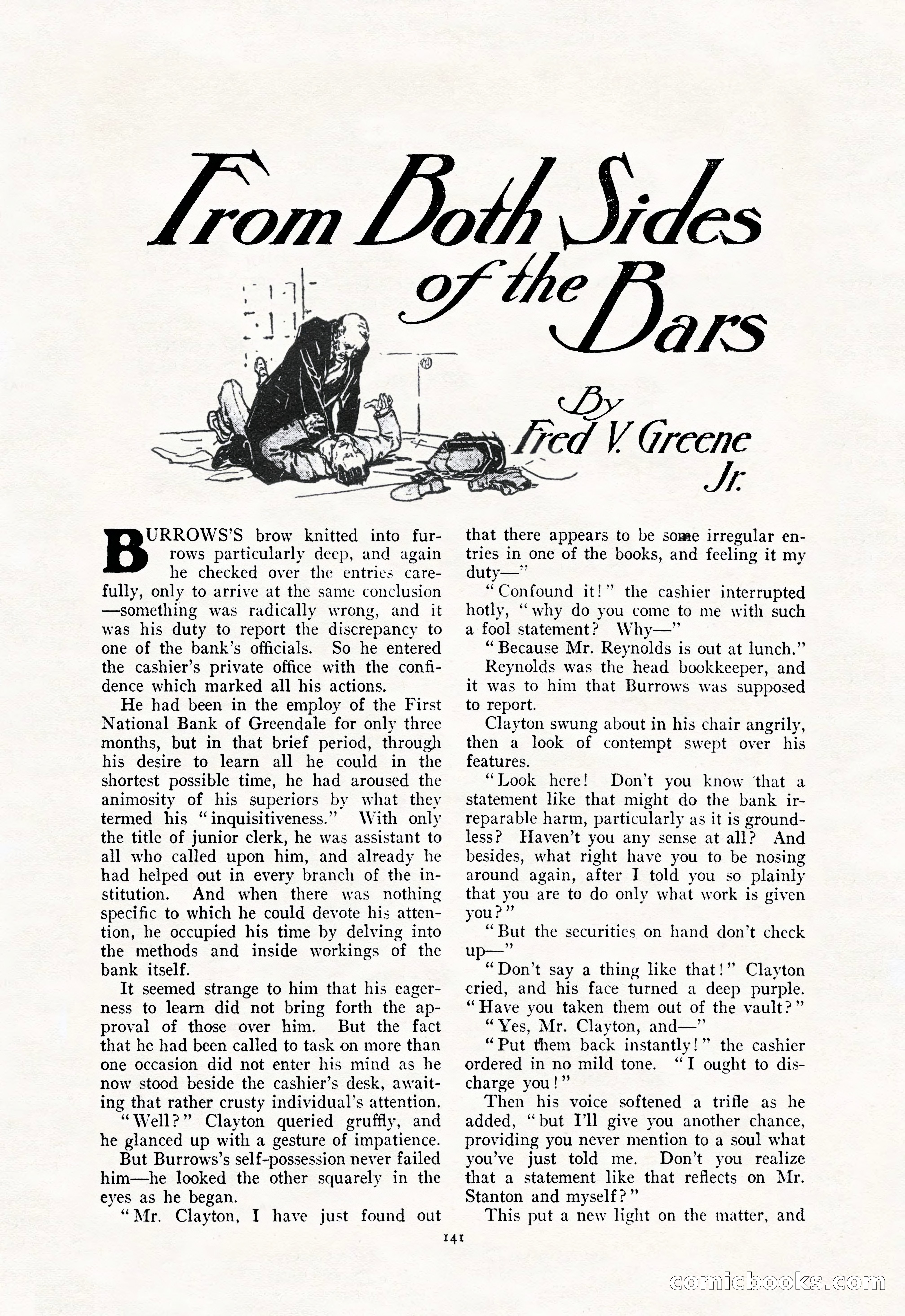
A restored page from Pulp Fiction, 1912. Page through the whole issue in the reader above.
📄 Transcribed text from this page (OCR, searchable)
Machine-transcribed from the original scan — historical spelling and the odd misread are preserved.
Lrom Doth Sides rows particularly deep, and again he checked over the entries care- fully, only to arrive at the same conclusion —something was radically wrong, and it was his duty to report the discrepancy to one of the bank’s officials. So he entered the cashier’s private office with the confi- dence which marked all his actions. He had been in the employ of the First National Bank of Greendale for only three months, but in that brief period, through his desire to learn all he could in the shortest possible time, he had aroused the animosity of his superiors by what they termed his “inquisitiveness.” With only the title of junior clerk, he was assistant to all who called upon him, and already he had helped out in every branch of the in- stitution. And when there was nothing specific to which he could devote his atten- tion, he occupied his time by delving into the methods and inside workings of the bank itself. It seemed strange to him that his eager- ness to learn did not bring forth the ap- proval of those over him. But the fact that he had been called to task on more than one occasion did not enter his mind as he now stood beside the cashier’s desk, await- ing that rather crusty individual’s attention. “Well?” Clayton queried gruffly, and he glanced up with a gesture of impatience. But Burrows’s self-possession never failed him—he looked the other squarely in the eyes as he began. “Mr. Clayton, BD ees per brow knitted into fur- I have just found out 141 aS St; that there appears to be some irregular en- tries in one of the books, and feeling it my duty—”’ ‘“Confound it!” the cashier interrupted hotly, “why do you come to me with such a fool statement? Why—” “Because Mr. Reynolds is out at lunch.” Reynolds was the head bookkeeper, and it was to him that Burrows was supposed to report. Clayton swung about in his chair angrily, then a look of contempt swept over his features. “Look here! Don't you know ‘that a statement like that might do the bank ir- reparable harm, particularly as it is ground- less? Haven’t you any sense at all? And besides, what right have you to be nosing around again, after I told you so plainly that you are to do only what work is given you?” “But the securities on hand don’t check up—” “Don’t say a thing like that!” Clayton cried, and his face turned a deep purple. “Have you taken them out of the vault?” “Yes, Mr. Clayton, and—”’ “Put them back instantly!” the cashier ordered in no mild tone. “I ought to dis- charge you!” Then his voice softened a trifle as he added, “but I’) give you another chance, providing you never mention to a soul what you’ve just told me. Don’t you realize that a statement like that reflects on Mr. Stanton and myself?” This put a new light on the matter, and AMICLOOO (C(O) S GO)