
Pulp Fiction, 1912 · page 133 of 238
The Argosy, April 1912 — page 133: what you’re looking at
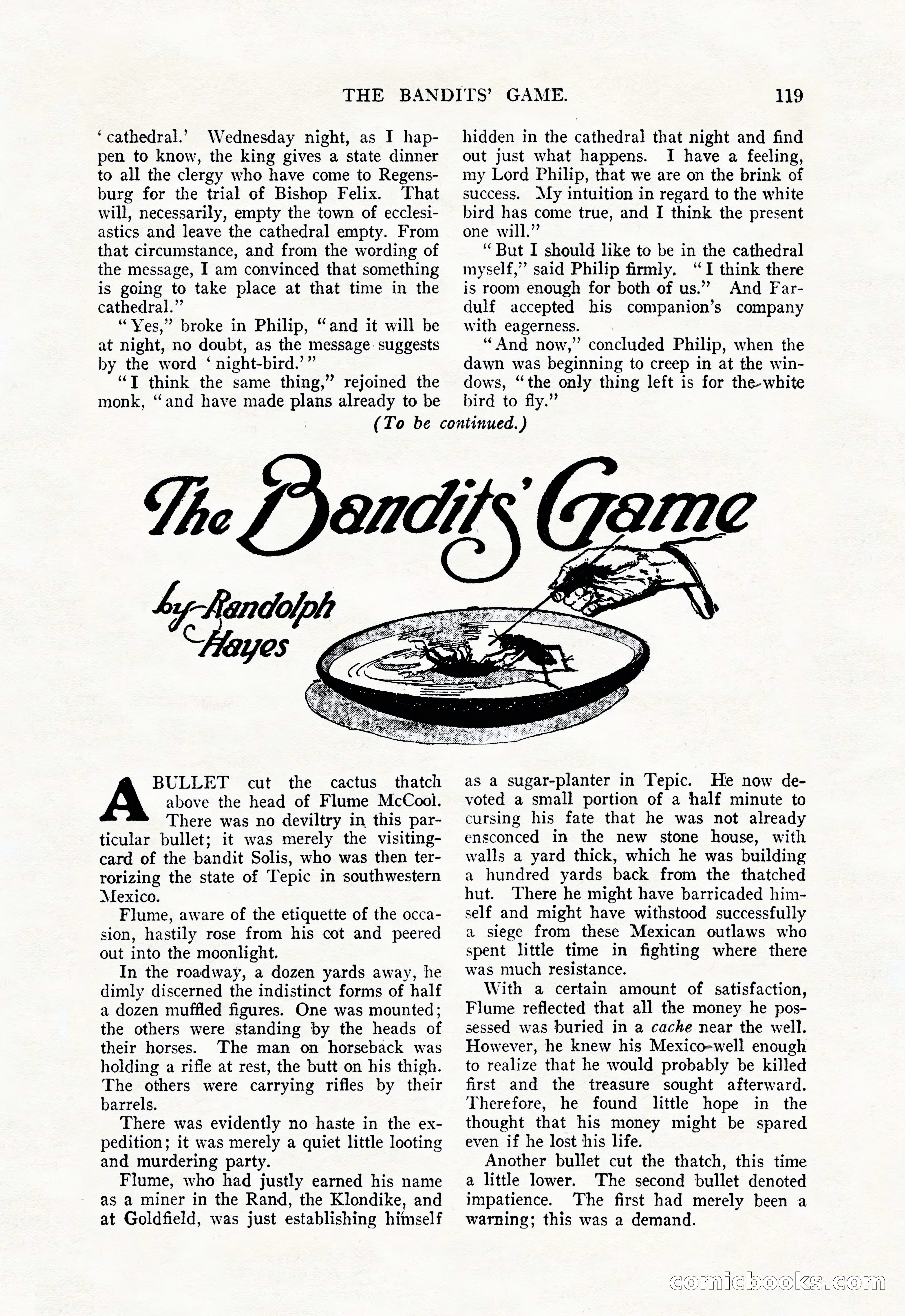
A restored page from Pulp Fiction, 1912. Page through the whole issue in the reader above.
📄 Transcribed text from this page (OCR, searchable)
Machine-transcribed from the original scan — historical spelling and the odd misread are preserved.
THE BANDITS’ GAME. ‘cathedral.’ Wednesday night, as I hap- pen to know, the king gives a state dinner to all the clergy who have come to Regens- burg for the trial of Bishop Felix. That will, necessarily, empty the town of ecclesi- astics and leave the cathedral empty. From that circumstance, and from the wording of the message, I am convinced that something is going to take place at that time in the cathedral.” “Yes,” broke in Philip, “and it will be at night, no doubt, as the message: suggests by the word ‘ night-bird.’”’ “JT think the same thing,” rejoined the monk, “and have made plans already to be 119 hidden in the cathedral that night and find out just what happens. I have a feeling, my Lord Philip, that we are on the brink of success. My intuition in regard to the white bird has come true, and I think the present one will.” ‘But I should like to be in the cathedral myself,” said Philip firmly. “I think there is room enough for both of us.” And Far- dulf accepted his companion’s company with eagerness. “And now,” concluded Philip, when the dawn was beginning to creep in at the win- dows, “the only thing left is for the-white bird to fly.” (To be continued.) The Lanclfs (game biy-fendofplr BULLET cut the cactus thatch A above the head of Flume McCool. There was no deviltry in, this par- ticular bullet; it was merely the visiting- card of the bandit Solis, who was then ter- rorizing the state of Tepic in southwestern Mexico. Flume, aware of the etiquette of the occa- sion, hastily rose from his cot and peered out into the moonlight. In the roadway, a dozen yards away, he dimly discerned the indistinct forms of half a dozen muffled figures. One was mounted; the others were standing by the heads of their horses. The man on horseback was holding a rifle at rest, the butt on his thigh. The others were carrying rifles by their barrels. There was evidently no haste in the ex- pedition; it was merely a quiet little looting and murdering party. Flume, who had justly earned his name as a miner in the Rand, the Klondike, and at Goldfield, was just establishing himself He now de- as a sugar-planter in Tepic. voted a small portion of a half minute to cursing his fate that he was not already ensconced in the new stone house, with walls a yard thick, which he was building a hundred yards back from the thatched hut. There he might have barricaded him- self and might have withstood successfully a siege from these Mexican outlaws who spent little time in fighting where there was much resistance. With a certain amount of satisfaction, Flume reflected that all the money he pos- sessed was buried in a cache near the well. However, he knew his Mexico-well enough to realize that he would probably be killed first and the treasure sought afterward. Therefore, he found little hope in the thought that his money might be spared even if he lost his life. Another bullet cut the thatch, this time a little lower. The second bullet denoted impatience. The first had merely been a warning; this was a demand. COMmicloool< CO